


DS005628: eeg dataset, 102 subjects#
Dataset of Visual and Audiovisual Stimuli in Virtual Reality from the Edzna Archaeological Site
Access recordings and metadata through EEGDash.
Citation: Juan Pablo Rosado-Aíza, Fernando José Domínguez-Morales, Tania Yareni Pech-Canul, Paola Guadalupe Vázquez-Rodríguez, Gustavo Navas-Reascos, Luz María Alonso-Valerdi, David I. Ibarra Zarate (20). Dataset of Visual and Audiovisual Stimuli in Virtual Reality from the Edzna Archaeological Site. 10.18112/openneuro.ds005628.v1.0.0
Modality: eeg Subjects: 102 Recordings: 306 License: CC0 Source: openneuro
Metadata: Complete (100%)
102-participant EEG dataset — Dataset of Visual and Audiovisual Stimuli in Virtual Reality from the Edzna Archaeological Site.
Quickstart#
Install
pip install eegdash
Access the data
from eegdash.dataset import DS005628

dataset = DS005628(cache_dir="./data")
# Get the raw object of the first recording
raw = dataset.datasets[0].raw
print(raw.info)
Filter by subject
dataset = DS005628(cache_dir="./data", subject="01")
Advanced query
dataset = DS005628(
    cache_dir="./data",
    query={"subject": {"$in": ["01", "02"]}},
)
Iterate recordings
for rec in dataset:
    print(rec.subject, rec.raw.info['sfreq'])
If you use this dataset in your research, please cite the original authors.
BibTeX
@dataset{ds005628,
  title = {Dataset of Visual and Audiovisual Stimuli in Virtual Reality from the Edzna Archaeological Site},
  author = {Juan Pablo Rosado-Aíza and Fernando José Domínguez-Morales and Tania Yareni Pech-Canul and Paola Guadalupe Vázquez-Rodríguez and Gustavo Navas-Reascos and Luz María Alonso-Valerdi and David I. Ibarra Zarate},
  doi = {10.18112/openneuro.ds005628.v1.0.0},
  url = {https://doi.org/10.18112/openneuro.ds005628.v1.0.0},
}
About This Dataset#
Juan Pablo Rosado-Aíza, Fernando José Domínguez-Morales, Tania Yareni Pech-Canul, Paola Guadalupe Vázquez-Rodríguez, Gustavo Navas-Reascos, Luz María Alonso-Valerdi, David I. Ibarra Zarate
Contact person
Gustavo Navas-Reascos
https://orcid.org/0000-0003-0250-765X A01681952@tec.mx
README
Authors
Overview
Project name
Dataset of Visual and Audiovisual Stimuli in Virtual Reality from the Edzna Archaeological Site - Year that the project ran
View full README
README
Authors
Overview
Project name
Dataset of Visual and Audiovisual Stimuli in Virtual Reality from the Edzna Archaeological Site - Year that the project ran
2024 - Brief overview
The purpose of this dataset is to analyze user experience in a virtual reality (VR) environment, focusing on a comparative study between visual and audiovisual stimuli based on the archaeological site of Edzna, Mexico. The immersive experience allowed participants to explore the site without needing to physically being there, and the experiment was conducted in a museum setting, offering a unique experience that goes beyond traditional visual-only exhibits. The dataset includes both Electroencephalography (EEG) recordings from eight channels (Fz, C3, Cz, C4, Pz, PO7, Oz, and PO8) and user responses to the User Experience Questionnaire (UEQ), providing necessary data for future studies on how immersive environments affect user perception.
The EEG data was collected using a Unicorn Hybrid Black EEG system with a sampling rate of 250 Hz. Participants were exposed to two conditions: a visual-only stimulus and an audiovisual stimulus, both of which represented scenes from the archaeological site in VR. Prior to exposure, a baseline measurement was taken to capture the initial state of the participants. Data collection was conducted in MOSTLA, a digital innovation lab at Tecnologico de Monterrey campus, and the Museum of Contemporary Art in Monterrey. Each EEG recording is shared in .set format and follows the BIDS structure. The recordings include eight channels of brainwave recordings for the baseline, visual, and audiovisual conditions. The signals are presented in both formats: raw and preprocessed. Additionally, an .xlsx file is provided with basic participant metadata, such as age, gender, unique identifier as well as the UEQ responses.
Each EEG file contains data segmented into the three phases of the experiment: baseline, visual stimulus, and audiovisual stimulus, allowing researchers to directly compare neural responses across conditions. This dataset offers a comprehensive resource for researchers interested in investigating the effects of immersive VR environments on user engagement, and attention, making it highly applicable and useful. - Description of the contents of the dataset
sub-N - Raw data sub-Np - Preprocesed data Example: sub-1 - Raw data of subject 1
sub-1p - Preprocesed data of subject 1
Subjects
A total of 51 participants were obtained.
Apparatus
Unicorn Hybrid Black EEG system VR Headset Headphones
Experimental location
MOSTLA place at Tecnologico de Monterrey. It is located at Av. Eugenio Garza Sada 2501 Sur, Tecnologico, 64849 Monterrey, N.L., Mexico. MARCO a contemporary art museum located in Monterrey at Zuazua y Jardón, Centro, 64000 Monterrey, N.L., Mexico.
Notes
All the metadata information, including the UEQ answers could be obtained from the file metadata.xlsx The videos presented to the participants are shown in:
Audiovisual video: https://youtu.be/FBWbtSFwVuo Visual video: https://youtu.be/aLzzl0ygBnc
Cohort#
Dataset Statistics#
Channel counts: 8 ch (n=306 recordings)
Sampling frequencies: 250.0 Hz (n=306 recordings)
Total recording duration: 20 h 57 min
Signal · Electrodes & live trace#
Live trace viewer — sub-13 · task-Edzna · run-3
Showing one representative recording out of
102 subjects and 306 recordings in this dataset.
Browse the full set on OpenNeuro;
drop any other _eeg.{set,edf,bdf,vhdr} file onto the
viewer (or pass ?eeg=<url>) to inspect it.
No scalp electrode layout is currently indexed for this dataset. Once the eegdash montage registry ingests it, the interactive viewer will appear here automatically.
NEMAR Processing Statistics#
The plots below are generated by NEMAR’s automated EEG pipeline. The histogram shows pipeline success for data cleaning and ICA decomposition, the percentage of data frames and EEG channels retained after artefact removal, line noise per channel (RMS, dB), and the age/gender distribution of participants.

HED event descriptors word cloud

Manifest#
File Explorer#
Browse the BIDS file structure of this dataset. Records are fetched on demand from the EEGDash catalog the first time you open the explorer.
Full dataset metadata table
Dataset ID |
|
Title |
Dataset of Visual and Audiovisual Stimuli in Virtual Reality from the Edzna Archaeological Site |
Author (year) |
|
Canonical |
— |
Importable as |
|
Year |
20 |
Authors |
Juan Pablo Rosado-Aíza, Fernando José Domínguez-Morales, Tania Yareni Pech-Canul, Paola Guadalupe Vázquez-Rodríguez, Gustavo Navas-Reascos, Luz María Alonso-Valerdi, David I. Ibarra Zarate |
License |
CC0 |
Citation / DOI |
|
Source links |
Copy-paste BibTeX
@dataset{ds005628,
  title = {Dataset of Visual and Audiovisual Stimuli in Virtual Reality from the Edzna Archaeological Site},
  author = {Juan Pablo Rosado-Aíza and Fernando José Domínguez-Morales and Tania Yareni Pech-Canul and Paola Guadalupe Vázquez-Rodríguez and Gustavo Navas-Reascos and Luz María Alonso-Valerdi and David I. Ibarra Zarate},
  doi = {10.18112/openneuro.ds005628.v1.0.0},
  url = {https://doi.org/10.18112/openneuro.ds005628.v1.0.0},
}
API Reference#
eegdash.datasetEEGDashDatasetDS005628 · RosadoAiza2024eegdash/dataset/registry.py · [source ↗]- class eegdash.dataset.DS005628(cache_dir: str, query: dict | None = None, s3_bucket: str | None = None, **kwargs)[source]#
Dataset of Visual and Audiovisual Stimuli in Virtual Reality from the Edzna Archaeological Site
- Study:
ds005628(OpenNeuro)- Author (year):
RosadoAiza2024- Canonical:
—
Also importable as:
DS005628,RosadoAiza2024.Modality:
eeg; Experiment type:Attention; Subject type:Healthy. Subjects: 102; recordings: 306; tasks: 1.- Parameters:
cache_dir (str | Path) – Directory where data are cached locally.
query (dict | None) – Additional MongoDB-style filters to AND with the dataset selection. Must not contain the key
dataset.s3_bucket (str | None) – Base S3 bucket used to locate the data.
**kwargs (dict) – Additional keyword arguments forwarded to
EEGDashDataset.
- data_dir#
Local dataset cache directory (
cache_dir / dataset_id).- Type:
Path
Notes
Each item is a recording; recording-level metadata are available via
dataset.description.querysupports MongoDB-style filters on fields inALLOWED_QUERY_FIELDSand is combined with the dataset filter. Dataset-specific caveats are not provided in the summary metadata.References
OpenNeuro dataset: https://openneuro.org/datasets/ds005628 NeMAR dataset: https://nemar.org/dataexplorer/detail?dataset_id=ds005628 DOI: https://doi.org/10.18112/openneuro.ds005628.v1.0.0
Examples
>>> from eegdash.dataset import DS005628
>>> dataset = DS005628(cache_dir="./data")
>>> recording = dataset[0]
>>> raw = recording.load()
- __init__(cache_dir: str, query: dict | None = None, s3_bucket: str | None = None, **kwargs)[source]#
- save(path: str, overwrite: bool = False, offset: int = 0)[source]#
Save datasets to files by creating one subdirectory for each dataset:
path/
    0/
        0-raw.fif | 0-epo.fif
        description.json
        raw_preproc_kwargs.json (if raws were preprocessed)
        window_kwargs.json (if this is a windowed dataset)
        window_preproc_kwargs.json  (if windows were preprocessed)
        target_name.json (if target_name is not None and dataset is raw)
    1/
        1-raw.fif | 1-epo.fif
        description.json
        raw_preproc_kwargs.json (if raws were preprocessed)
        window_kwargs.json (if this is a windowed dataset)
        window_preproc_kwargs.json  (if windows were preprocessed)
        target_name.json (if target_name is not None and dataset is raw)
- Parameters:
path (str) –
- Directory in which subdirectories are created to store
-raw.fif | -epo.fif and .json files to.
overwrite (bool) – Whether to delete old subdirectories that will be saved to in this call.
offset (int) – If provided, the integer is added to the id of the dataset in the concat. This is useful in the setting of very large datasets, where one dataset has to be processed and saved at a time to account for its original position.
BaseDataset from braindecode — windowed via create_windows_from_events.braindecodeDataLoader; supports parallel workers and on-the-fly augmentations.pytorchdatasets.load_dataset("EEGDash/ds005628").huggingface Find datasets with the EEGDash APIQuery the catalogue, filter by task or modality, list candidates.
 Load one EEG recordingResolve a single record to an MNE Raw with channels and events.
 EEG recording to PyTorch DataLoaderWrap braindecode windows in a DataLoader for model training.
 Preprocess EEG and create windowsFilter, resample, epoch — and persist the windowed dataset.
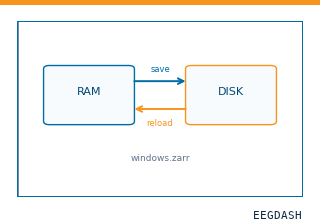 Save and reload prepared dataCache a windowed dataset to disk and reattach it without recompute.
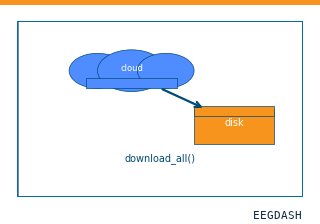 Download a dataset locallyPrefetch BIDS files to a local cache and validate the layout.
Swap any load_dataset(...) call for ds005628 to reproduce the tutorial on this dataset.
Citation
Juan Pablo Rosado-Aíza, Fernando José Domínguez-Morales, Tania Yareni Pech-Canul, Paola Guadalupe Vázquez-Rodríguez, Gustavo Navas-Reascos, … (20). Dataset of Visual and Audiovisual Stimuli in Virtual Reality from the Edzna Archaeological Site. 10.18112/openneuro.ds005628.v1.0.0
Provenance
¹Contributed to openneuro in BIDS format.
²Curated & ingested by the EEGDash catalog; see CITATION.cff for canonical reference.
³Persistent identifier: 10.18112/openneuro.ds005628.v1.0.0.
See Also#
eegdash.dataset.EEGDashDataseteegdash.dataset