


DS007222: eeg dataset, 15 subjects#
Visual Occlusions with Treadmill Walking Speeds EEG
Access recordings and metadata through EEGDash.
Citation: Jonel Morris, Kenneth Cruz, Raydeep Kainth, Daniel Ferris (19). Visual Occlusions with Treadmill Walking Speeds EEG. 10.18112/openneuro.ds007222.v1.0.0
Modality: eeg Subjects: 15 Recordings: 75 License: CC0 Source: openneuro
Metadata: Complete (100%)
15-participant EEG dataset — Visual Occlusions with Treadmill Walking Speeds EEG.
Quickstart#
Install
pip install eegdash
Access the data
from eegdash.dataset import DS007222

dataset = DS007222(cache_dir="./data")
# Get the raw object of the first recording
raw = dataset.datasets[0].raw
print(raw.info)
Filter by subject
dataset = DS007222(cache_dir="./data", subject="01")
Advanced query
dataset = DS007222(
    cache_dir="./data",
    query={"subject": {"$in": ["01", "02"]}},
)
Iterate recordings
for rec in dataset:
    print(rec.subject, rec.raw.info['sfreq'])
If you use this dataset in your research, please cite the original authors.
BibTeX
@dataset{ds007222,
  title = {Visual Occlusions with Treadmill Walking Speeds EEG},
  author = {Jonel Morris and Kenneth Cruz and Raydeep Kainth and Daniel Ferris},
  doi = {10.18112/openneuro.ds007222.v1.0.0},
  url = {https://doi.org/10.18112/openneuro.ds007222.v1.0.0},
}
About This Dataset#
More info here: https://neurostars.org/t/where-in-a-bids-dataset-should-i-put-notes-about-individual-mri-acqusitions/17315/3
If the dataset requires a data user agreement, link to the relevant information.
README
- [ Jonel Raven Morris (jmorris2@ufl.edu; ORCID: 0000-0003-0239-1917)] Contact person
Overview
[Visual Occlusions on Treadmill at Different Speeds with Stationary Visual Display ] Project name
- [ 2022-2023 ] Year(s) that the project ran
View full README
README
- [ Jonel Raven Morris (jmorris2@ufl.edu; ORCID: 0000-0003-0239-1917)] Contact person
Overview
[Visual Occlusions on Treadmill at Different Speeds with Stationary Visual Display ] Project name
- [ 2022-2023 ] Year(s) that the project ran
[ To understand the neurophysiological responses of visual processing, we investigated whether the response to intermittent loss of vision during human walking would change with different gait speeds. This was investigated by looking at the EEG responses of fifteen healthy adults who stood stationary and walked on a treadmill at speeds 0.4, 0.8, 1.2, 1.6 m/s while viewing a static scene through liquid crystal lenses that alternated between transparent and opaque states.] Brief overview of the tasks in the experiment
[This dataset contains data from 8 Brain Vision Amplifiers: 120 EEG scalp electrodes with one GND and one REF, 110 mechanically coupled outward facing noise electrodes with one GND and one REF, & 8 EMG electrodes (Inferior and Superior; Left and Right: Sternocleidomastoid and Trapezius). For most subjects it also contains Left & Right GRF from Loadsol insols, IMU (X,Y,Z,GYRx, GYRy, GYRz, Magx, Magy, Magz) from Opal APDM sensor located on the participants lower back] Description of the contents of the dataset
[Gait speeds: 0.0 m/s, 0.4 m/s, 0.8 m/s, 1.2 m/s, and 1.6 m/s] Independent variables
[Electrocortical alpha synchronization in response to ‘close_oc’ event ] Dependent variables
[All participants were young (18 - 29) healthy adults, had normal to corrected vision, no history of musculoskeletal or neurological disorders, static visual presentation was the same for each participant across the walking speeds, but was slightly different between subjects. The projector screen was placed in the same location relative to the treadmill each time. Participants were told to begin in the center of the treadmill and were told to try to remain there. We used the same EEG system for each subject. We used a script for each participant, explaining the experiment the same for each condition] Control variables
Quality assessment of the data
Provide a short summary of the quality of the data ideally with descriptive statistics if relevant and with a link to more comprehensive description (like with MRIQC) if possible.
Methods
Subjects
15 healthy, young adults were recruited from the local University of Florida community. Of these 15 participants, 5 identified as male and 10 were identified as female with various racial/ethnic backgrounds such as self-identified white, black, asian, hispanic, and mixed race groups. - Recruited healthy young participants between the ages of 18 and 29 years. All participants reported normal vision (20/20) with or without corrective contact lenses and no history of musculoskeletal or neurological disorders.
Apparatus
The experiment utilized a treadmill that we set to the various gait speeds for the different experimental conditions with the static image projected onto a screen in front of the participant. The participants wore a safety harness while they were walking on the treadmill. They also wore loadsol insole sensors that recorded gait events and an IMU placed on their lower back. All participants wore liquid crystal (LCD) lens goggles that generated intermittent visual occlusions. The entire experiment was mobile and the participant wore a fanny pack with the synchronization devices inside.
Initial setup
After the subject arrived and they completed the informed consent form with the experimenters, they were seated and equipped with an EEG cap. Loadsol insole sensors, IMU, safety harness, and liquid crystal goggles were placed on the participant once gelling was complete and all systems were synchronized together.
Task organization
Walking speed order was randomized with the 0.0 m/s condition being performed before or after all speeds. Breaks were offered to participants in between each condition and were taken as needed, this data has been cropped out so that only trials and 5 seconds of padding before and after are in each condition file.
Task details
Each walking condition (0.0m/s, 0.4 m/s, 0.8 m/s, 1.2 m/s, and 1.6 m/s) lasted 3 minutes. Visual occlusion events would occur every 8-10 seconds and last 1.5 seconds each time. Participants walked while viewing a stationary visual display of a track projected from a rear-projector.
Additional data acquired
TI-MRI images were obtained for each participant for use in custom head modeling. The de-identification of the MRI data is complicated and this data may be available in the future, but is currently unavailable. Demographic information about each participant is recorded in the participants.tsv
Experimental location
This experiment was completed using the facilities of the Health Professions, Nursing, Pharmacy Building at the University of Florida in Gainesville, Florida, USA.
Missing data
Some participants are missing loadsol data, or their loadsol data is incomplete/contains a drift (sub-05, sub-06, sub-07). One subject is missing part of their noise sensor array. A few participants also do not have IMU data (sub-02, sub-04, sub-06, sub-12).
Notes
This data is from a larger protocol with 13 other conditions (in total 4 different “walking” modalities with 4 different speeds and a stationary condition). For each participant, the order of the modalities was randomized as was the walking speed w/in each modality.
Cohort#
Dataset Statistics#
Age distribution by gender (n=15, range 14–29 yr, mean 21.0 yr)
Sex composition
Channel counts (ch)
Sampling frequencies: 500.0 Hz (n=75 recordings)
Total recording duration: 3 h 47 min
Signal · Electrodes & live trace#
Live trace viewer — sub-13 · task-treadmill00flow00
Showing one representative recording out of
15 subjects and 75 recordings in this dataset.
Browse the full set on OpenNeuro;
drop any other _eeg.{set,edf,bdf,vhdr} file onto the
viewer (or pass ?eeg=<url>) to inspect it.
Electrode layout — EEG · 120 sensors — 120 channels
NEMAR Processing Statistics#
The plots below are generated by NEMAR’s automated EEG pipeline. The histogram shows pipeline success for data cleaning and ICA decomposition, the percentage of data frames and EEG channels retained after artefact removal, line noise per channel (RMS, dB), and the age/gender distribution of participants.

HED event descriptors word cloud

Manifest#
File Explorer#
Browse the BIDS file structure of this dataset. Records are fetched on demand from the EEGDash catalog the first time you open the explorer.
Full dataset metadata table
Dataset ID |
|
Title |
Visual Occlusions with Treadmill Walking Speeds EEG |
Author (year) |
— |
Canonical |
— |
Importable as |
|
Year |
19 |
Authors |
Jonel Morris, Kenneth Cruz, Raydeep Kainth, Daniel Ferris |
License |
CC0 |
Citation / DOI |
|
Source links |
Copy-paste BibTeX
@dataset{ds007222,
  title = {Visual Occlusions with Treadmill Walking Speeds EEG},
  author = {Jonel Morris and Kenneth Cruz and Raydeep Kainth and Daniel Ferris},
  doi = {10.18112/openneuro.ds007222.v1.0.0},
  url = {https://doi.org/10.18112/openneuro.ds007222.v1.0.0},
}
API Reference#
eegdash.datasetEEGDashDataset- class eegdash.dataset.DS007222(cache_dir: str, query: dict | None = None, s3_bucket: str | None = None, **kwargs)[source]#
Visual Occlusions with Treadmill Walking Speeds EEG
- Study:
ds007222(OpenNeuro)- Author (year):
—
- Canonical:
—
Also importable as:
DS007222.Modality:
eeg; Experiment type:Perception; Subject type:Healthy. Subjects: 15; recordings: 75; tasks: 5.- Parameters:
cache_dir (str | Path) – Directory where data are cached locally.
query (dict | None) – Additional MongoDB-style filters to AND with the dataset selection. Must not contain the key
dataset.s3_bucket (str | None) – Base S3 bucket used to locate the data.
**kwargs (dict) – Additional keyword arguments forwarded to
EEGDashDataset.
- data_dir#
Local dataset cache directory (
cache_dir / dataset_id).- Type:
Path
Notes
Each item is a recording; recording-level metadata are available via
dataset.description.querysupports MongoDB-style filters on fields inALLOWED_QUERY_FIELDSand is combined with the dataset filter. Dataset-specific caveats are not provided in the summary metadata.References
OpenNeuro dataset: https://openneuro.org/datasets/ds007222 NeMAR dataset: https://nemar.org/dataexplorer/detail?dataset_id=ds007222 DOI: https://doi.org/10.18112/openneuro.ds007222.v1.0.0
Examples
>>> from eegdash.dataset import DS007222
>>> dataset = DS007222(cache_dir="./data")
>>> recording = dataset[0]
>>> raw = recording.load()
- __init__(cache_dir: str, query: dict | None = None, s3_bucket: str | None = None, **kwargs)[source]#
- save(path: str, overwrite: bool = False, offset: int = 0)[source]#
Save datasets to files by creating one subdirectory for each dataset:
path/
    0/
        0-raw.fif | 0-epo.fif
        description.json
        raw_preproc_kwargs.json (if raws were preprocessed)
        window_kwargs.json (if this is a windowed dataset)
        window_preproc_kwargs.json  (if windows were preprocessed)
        target_name.json (if target_name is not None and dataset is raw)
    1/
        1-raw.fif | 1-epo.fif
        description.json
        raw_preproc_kwargs.json (if raws were preprocessed)
        window_kwargs.json (if this is a windowed dataset)
        window_preproc_kwargs.json  (if windows were preprocessed)
        target_name.json (if target_name is not None and dataset is raw)
- Parameters:
path (str) –
- Directory in which subdirectories are created to store
-raw.fif | -epo.fif and .json files to.
overwrite (bool) – Whether to delete old subdirectories that will be saved to in this call.
offset (int) – If provided, the integer is added to the id of the dataset in the concat. This is useful in the setting of very large datasets, where one dataset has to be processed and saved at a time to account for its original position.
BaseDataset from braindecode — windowed via create_windows_from_events.braindecodeDataLoader; supports parallel workers and on-the-fly augmentations.pytorch Find datasets with the EEGDash APIQuery the catalogue, filter by task or modality, list candidates.
 Load one EEG recordingResolve a single record to an MNE Raw with channels and events.
 EEG recording to PyTorch DataLoaderWrap braindecode windows in a DataLoader for model training.
 Preprocess EEG and create windowsFilter, resample, epoch — and persist the windowed dataset.
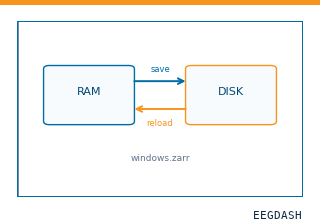 Save and reload prepared dataCache a windowed dataset to disk and reattach it without recompute.
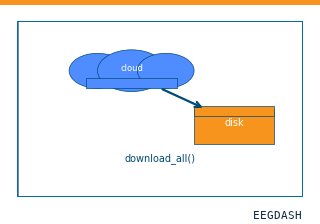 Download a dataset locallyPrefetch BIDS files to a local cache and validate the layout.
Swap any load_dataset(...) call for ds007222 to reproduce the tutorial on this dataset.
Citation
Jonel Morris, Kenneth Cruz, Raydeep Kainth, Daniel Ferris (19). Visual Occlusions with Treadmill Walking Speeds EEG. 10.18112/openneuro.ds007222.v1.0.0
Provenance
¹Contributed to openneuro in BIDS format.
²Curated & ingested by the EEGDash catalog; see CITATION.cff for canonical reference.
³Persistent identifier: 10.18112/openneuro.ds007222.v1.0.0.
See Also#
eegdash.dataset.EEGDashDataseteegdash.dataset