


DS005408: eeg dataset, 25 subjects#
The effect of speech masking on the human subcortical response to continuous speech
Access recordings and metadata through EEGDash.
Citation: Melissa J. Polonenko, Ross K. Maddox (2025). The effect of speech masking on the human subcortical response to continuous speech. 10.18112/openneuro.ds005408.v1.0.1
Modality: eeg Subjects: 25 Recordings: 29 License: CC0 Source: openneuro
Metadata: Complete (100%)
25-participant EEG dataset — The effect of speech masking on the human subcortical response to continuous speech.
Quickstart#
Install
pip install eegdash
Access the data
from eegdash.dataset import DS005408

dataset = DS005408(cache_dir="./data")
# Get the raw object of the first recording
raw = dataset.datasets[0].raw
print(raw.info)
Filter by subject
dataset = DS005408(cache_dir="./data", subject="01")
Advanced query
dataset = DS005408(
    cache_dir="./data",
    query={"subject": {"$in": ["01", "02"]}},
)
Iterate recordings
for rec in dataset:
    print(rec.subject, rec.raw.info['sfreq'])
If you use this dataset in your research, please cite the original authors.
BibTeX
@dataset{ds005408,
  title = {The effect of speech masking on the human subcortical response to continuous speech},
  author = {Melissa J. Polonenko and Ross K. Maddox},
  doi = {10.18112/openneuro.ds005408.v1.0.1},
  url = {https://doi.org/10.18112/openneuro.ds005408.v1.0.1},
}
About This Dataset#
- Please contact the following authors for further information:
Melissa Polonenko (email: mpolonen@umn.edu) [corresponding author] Ross Maddox (email: rkmaddox@med.umich.edu)
This is the “peaky_snr” dataset for the paper by
Polonenko MJ & Maddox RK, with citation listed below. eNeuro: Polonenko, M. J., & Maddox, R. K. (2025). The effect of speech masking on the human subcortical response to continuous speech. eNeuro 24 March 2025, 12 (4) ENEURO.0561-24.2025; https://doi.org/10.1523/ENEURO.0561-24.2025 BioRxiv: https://www.biorxiv.org/content/10.1101/2024.12.10.627771v1 Auditory brainstem responses (ABRs) were derived to continuous peaky speech from between one up to five simultaneously presented talkers and from clicks.
README
Details related to access to the data
Data was collected from June to July 2021. Goal: To better understand masking’s effects on the subcortical neural encoding of naturally uttered speech in human listeners.
To do this we leveraged our recently developed method for determining the
View full README
README
Details related to access to the data
Data was collected from June to July 2021. Goal: To better understand masking’s effects on the subcortical neural encoding of naturally uttered speech in human listeners.
To do this we leveraged our recently developed method for determining the auditory brainstem response (ABR) to speech (Polonenko and Maddox, 2021).
Whereas our previous work was aimed at encoding of single talkers, here we determined the ABR to speech in quiet as well as in the presence of varying numbers of other talkers.
The details of the experiment can be found at Polonenko & Maddox (2024). Stimuli:
1) randomized click trains at an average rate of 40 Hz, 60 x 10 s trials for a total of 10 minutes; 2) peaky speech for up to 5 male narrators. 30 minutes of each SNR (clean, 0 dB, -3 dB, -6 dB), corresponding to 1, 2, 3, and 5 talkers presented simultaneously, each set to 65 dB. NOTE: files for each story were completely randomized. Random combinations were created so that each story was equally represented in the data.
- The code for stimulus preprocessing and EEG analysis is available on Github:
Format
The dataset is formatted according to the EEG Brain Imaging Data Structure. It includes EEG recording from participant 01 to 25 in raw brainvision format (3 files: .eeg, .vhdr, .vmrk) and stimuli files in format of .hdf5. The stimuli files contain the audio (‘audio’), and regressors for the deconvolution (‘pinds’ are the pulse indices, ‘anm’ is an auditory nerve model regressor,
which was used during analyses but was not included as part of the article).
Generally, you can find detailed event data in the .tsv files and descriptions in the accompanying .json files. Raw eeg files are provided in the Brain Products format.
Participants
25 participants, mean ± SD age of 23.4 ± 5.5 years (19-37 years) Inclusion criteria:
Age between 18-40 years
Normal hearing: audiometric thresholds 20 dB HL or better from 500 to 8000 Hz
Speak English as their primary language
Please see participants.tsv for more information.
Apparatus
Participants sat in a darkened sound-isolating booth and rested or watched silent videos with closed captioning. Stimuli were presented at an average level of 65 dB SPL (per story; total for 5 talkers = 71 dB) and a sampling rate of 48 kHz through ER-2 insert earphones plugged into an RME Babyface Pro digital sound card. Custom python scripts using expyfun were used to control the experiment and stimulus presentation.
Details about the experiment
For a detailed description of the task, see Polonenko & Maddox (2024) and the
supplied task-peaky_snr_eeg.json file. The 4 SNR speech conditions and the
story tokens were randomized. This means that the participant would not be able
to follow the stories. For clicks the trials were not randomized
(already random clicks).
Trigger onset times in the tsv files have already been corrected for the tubing delay of the insert earphones (but not in the events of the raw files).
Triggers with values of “1” were recorded to the onset of the 10 s audio, and shortly after triggers with values of “4” or “8” were stamped to indicate info about the trial. This was done by converting the decimal trial number to bits, denoted b, then calculating 2 ** (b + 2). We’ve specified these trial triggers and more metadata of the events in each of the ‘*_eeg_events.tsv” file, which is sufficient to know which trial corresponded to which type of stimulus (clicks or speech), snr, and which files of which stories were presented. e.g., alice_000_peaky_diotic_regress.hdf5 for the first file of the story called ‘alice’ (Alice in Wonderland).
Cohort#
Dataset Statistics#
Age distribution (n=25, range 19–37 yr, mean 23.4 yr · sex per subject not reported)
Sex composition
Channel counts: 2 ch (n=29 recordings)
Sampling frequencies: 10000.0 Hz (n=29 recordings)
Total recording duration: 56 h
Signal · Electrodes & live trace#
Live trace viewer — sub-13 · task-peakysnr · run-01
Showing one representative recording out of
25 subjects and 29 recordings in this dataset.
Browse the full set on OpenNeuro;
drop any other _eeg.{set,edf,bdf,vhdr} file onto the
viewer (or pass ?eeg=<url>) to inspect it.
No scalp electrode layout is currently indexed for this dataset. Once the eegdash montage registry ingests it, the interactive viewer will appear here automatically.
NEMAR Processing Statistics#
The plots below are generated by NEMAR’s automated EEG pipeline. The histogram shows pipeline success for data cleaning and ICA decomposition, the percentage of data frames and EEG channels retained after artefact removal, line noise per channel (RMS, dB), and the age/gender distribution of participants.

HED event descriptors word cloud

Manifest#
File Explorer#
Browse the BIDS file structure of this dataset. Records are fetched on demand from the EEGDash catalog the first time you open the explorer.
Full dataset metadata table
Dataset ID |
|
Title |
The effect of speech masking on the human subcortical response to continuous speech |
Author (year) |
|
Canonical |
— |
Importable as |
|
Year |
2025 |
Authors |
Melissa J. Polonenko, Ross K. Maddox |
License |
CC0 |
Citation / DOI |
|
Source links |
Copy-paste BibTeX
@dataset{ds005408,
  title = {The effect of speech masking on the human subcortical response to continuous speech},
  author = {Melissa J. Polonenko and Ross K. Maddox},
  doi = {10.18112/openneuro.ds005408.v1.0.1},
  url = {https://doi.org/10.18112/openneuro.ds005408.v1.0.1},
}
API Reference#
eegdash.datasetEEGDashDatasetDS005408 · Polonenko2024_effect_speecheegdash/dataset/registry.py · [source ↗]- class eegdash.dataset.DS005408(cache_dir: str, query: dict | None = None, s3_bucket: str | None = None, **kwargs)[source]#
The effect of speech masking on the human subcortical response to continuous speech
- Study:
ds005408(OpenNeuro)- Author (year):
Polonenko2024_effect_speech- Canonical:
—
Also importable as:
DS005408,Polonenko2024_effect_speech.Modality:
eeg; Experiment type:Perception; Subject type:Healthy. Subjects: 25; recordings: 29; tasks: 1.- Parameters:
cache_dir (str | Path) – Directory where data are cached locally.
query (dict | None) – Additional MongoDB-style filters to AND with the dataset selection. Must not contain the key
dataset.s3_bucket (str | None) – Base S3 bucket used to locate the data.
**kwargs (dict) – Additional keyword arguments forwarded to
EEGDashDataset.
- data_dir#
Local dataset cache directory (
cache_dir / dataset_id).- Type:
Path
Notes
Each item is a recording; recording-level metadata are available via
dataset.description.querysupports MongoDB-style filters on fields inALLOWED_QUERY_FIELDSand is combined with the dataset filter. Dataset-specific caveats are not provided in the summary metadata.References
OpenNeuro dataset: https://openneuro.org/datasets/ds005408 NeMAR dataset: https://nemar.org/dataexplorer/detail?dataset_id=ds005408 DOI: https://doi.org/10.18112/openneuro.ds005408.v1.0.1
Examples
>>> from eegdash.dataset import DS005408
>>> dataset = DS005408(cache_dir="./data")
>>> recording = dataset[0]
>>> raw = recording.load()
- __init__(cache_dir: str, query: dict | None = None, s3_bucket: str | None = None, **kwargs)[source]#
- save(path: str, overwrite: bool = False, offset: int = 0)[source]#
Save datasets to files by creating one subdirectory for each dataset:
path/
    0/
        0-raw.fif | 0-epo.fif
        description.json
        raw_preproc_kwargs.json (if raws were preprocessed)
        window_kwargs.json (if this is a windowed dataset)
        window_preproc_kwargs.json  (if windows were preprocessed)
        target_name.json (if target_name is not None and dataset is raw)
    1/
        1-raw.fif | 1-epo.fif
        description.json
        raw_preproc_kwargs.json (if raws were preprocessed)
        window_kwargs.json (if this is a windowed dataset)
        window_preproc_kwargs.json  (if windows were preprocessed)
        target_name.json (if target_name is not None and dataset is raw)
- Parameters:
path (str) –
- Directory in which subdirectories are created to store
-raw.fif | -epo.fif and .json files to.
overwrite (bool) – Whether to delete old subdirectories that will be saved to in this call.
offset (int) – If provided, the integer is added to the id of the dataset in the concat. This is useful in the setting of very large datasets, where one dataset has to be processed and saved at a time to account for its original position.
BaseDataset from braindecode — windowed via create_windows_from_events.braindecodeDataLoader; supports parallel workers and on-the-fly augmentations.pytorchdatasets.load_dataset("EEGDash/ds005408").huggingface Find datasets with the EEGDash APIQuery the catalogue, filter by task or modality, list candidates.
 Load one EEG recordingResolve a single record to an MNE Raw with channels and events.
 EEG recording to PyTorch DataLoaderWrap braindecode windows in a DataLoader for model training.
 Preprocess EEG and create windowsFilter, resample, epoch — and persist the windowed dataset.
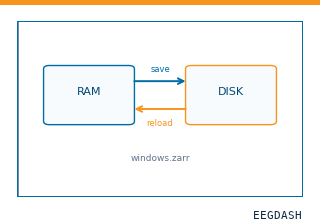 Save and reload prepared dataCache a windowed dataset to disk and reattach it without recompute.
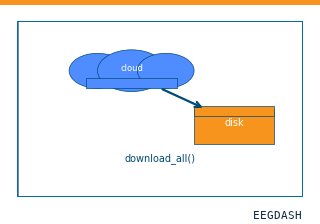 Download a dataset locallyPrefetch BIDS files to a local cache and validate the layout.
Swap any load_dataset(...) call for ds005408 to reproduce the tutorial on this dataset.
Citation
Melissa J. Polonenko, Ross K. Maddox (2025). The effect of speech masking on the human subcortical response to continuous speech. 10.18112/openneuro.ds005408.v1.0.1
Provenance
¹Contributed to openneuro in BIDS format.
²Curated & ingested by the EEGDash catalog; see CITATION.cff for canonical reference.
³Persistent identifier: 10.18112/openneuro.ds005408.v1.0.1.
See Also#
eegdash.dataset.EEGDashDataseteegdash.dataset