


DS004118: eeg dataset, 156 subjects#
BCIT Calibration Driving
Access recordings and metadata through EEGDash.
Citation: Jonathan Touryan (data and curation), Greg Apker (data), Brent Lance (data), Scott Kerick (data), Anthony Ries (data), Kaleb McDowell (data), Tony Johnson (curation), Kay Robbins (curation) (19). BCIT Calibration Driving. 10.18112/openneuro.ds004118.v1.0.1
Modality: eeg Subjects: 156 Recordings: 247 License: CC0 Source: openneuro Citations: 0.0
Metadata: Complete (100%)
156-participant EEG dataset — BCIT Calibration Driving.
Quickstart#
Install
pip install eegdash
Access the data
from eegdash.dataset import DS004118

dataset = DS004118(cache_dir="./data")
# Get the raw object of the first recording
raw = dataset.datasets[0].raw
print(raw.info)
Filter by subject
dataset = DS004118(cache_dir="./data", subject="01")
Advanced query
dataset = DS004118(
    cache_dir="./data",
    query={"subject": {"$in": ["01", "02"]}},
)
Iterate recordings
for rec in dataset:
    print(rec.subject, rec.raw.info['sfreq'])
If you use this dataset in your research, please cite the original authors.
BibTeX
@dataset{ds004118,
  title = {BCIT Calibration Driving},
  author = {Jonathan Touryan (data and curation) and Greg Apker (data) and Brent Lance (data) and Scott Kerick (data) and Anthony Ries (data) and Kaleb McDowell (data) and Tony Johnson (curation) and Kay Robbins (curation)},
  doi = {10.18112/openneuro.ds004118.v1.0.1},
  url = {https://doi.org/10.18112/openneuro.ds004118.v1.0.1},
}
About This Dataset#
Overview: The Calibration Driving study was intended to provide calibration data for applying
fatigue-based driver performance prediction algorithms. Calibration data sets were designed to be the first component of every recording session within the BCIT program, which featured multiple studies investigating fatigue.
Collectively, the Calibration Driving recordings comprise a ‘virtual’ study, in which driving performance
at the calibration level can be analyzed. When analyzed with other same-subject data, involving much longer tasks, the calibration data sets can be used as the basis for non-fatigue state performance.
BCIT Calibration Driving
Introduction
Further information is available on request from cancta.net. The task was performed using identical systems at three different sites: - Army Research Laboratory, Aberdeen MD (T1) - Teledyne Corporation, Durham, NC (T2) - Science Applications International Corporation (SAIC), Louisville, CO (T3)
View full README
BCIT Calibration Driving
Introduction
Further information is available on request from cancta.net. The task was performed using identical systems at three different sites: - Army Research Laboratory, Aberdeen MD (T1) - Teledyne Corporation, Durham, NC (T2) - Science Applications International Corporation (SAIC), Louisville, CO (T3)
All sites used identical driving simulator setups.
The data collected at site T1 used a 64-channel Biosemi EEG headset as did the data collected at site T2, while site T3 used a 256-channel Biosemi EEG headset.
Data from site T1 has legacy subject IDs in the range 1000 to 1999. Data from site T2 has legacy subject IDs in the range 2000 to 2999.
Data from site T3 has legacy subject IDs in the range 3000 to 3999. Legacy subject IDs are unique across the entire BCIT program.
Methods
Subjects: Subjects at Aberdeen Proving Grounds were recruited, on a voluntary basis from among the scientists and engineers working at APG.
Subjects recruited by Teledyne and SAIC were found via advertising and community outreach efforts, and primarily consisted of local college students. Apparatus: Driving simulator with steering wheel and brake / foot pedals (Real Time Technologies; Dearborn, MI);
Video Refresh Rate (VRR) = 900 Hz; Vehicle data log file Sampling Rate (SR) = 100 Hz); EEG (BioSemi 256 (+8) channel systems with 4 eye and 2 mastoid channels recorded; SR=1024 Hz); Eye Tracking (Sensomotoric Instruments (SMI); REDEYE250).
Initial setup: Upon arrival to the lab, subjects were given an introduction to the primary study for which they were recruited and provided informed consent and provided demographics information.
This was followed by a practice session, to acclimate the subject to the driving simulator. The driving practice task lasted 10-15 min, until asymptotic performance in steering and speed control was demonstrated and lack of motion sickness was reported.
Subjects were then outfitted and prepped for eye tracking and EEG acquisition. Task organization: The Calibration study featured a 15-minute trial, requiring the driver to control the steering of a simulated vehicle on a long, straight road in a visually sparse environment.
With the vehicle speed controlled by the driving simulator, the only task for the subject was to maintain the vehicle position in the center of the lane. The vehicle was periodically subject to lateral perturbing forces, which could be applied to either side of the vehicle, pushing the vehicle out of the center of the lane; and the subject was instructed to execute corrective steering actions to return the vehicle to the center of the lane. Independent variables: None. Dependent variables: Reaction times to perturbations, continuous performance based on vehicle log (steering wheel angle, lane position, heading error, etc.), Task-Induced Fatigue Scale (TIFS), Karolinska Sleepiness Scale (KSS), Visual Analog Scale of Fatigue (VAS-F). Note: questionnaire data is available upon request from cancta.net. Additional data acquired: Participant Enrollment Questionnaire, Subject Questionnaire for Current Session, Simulator Sickness Questionnaire. Experimental Locations: Army Research Laboratory, Aberdeen MD (site T1); Teledyne Corporation, Durham, NC (site T2); Science Applications International Corporation (SAIC), Louisville, CO (site T3). Note: This 15-minute task was performed prior to every run in the BCIT experimental series. Thus, the runs have corresponding runs in one or more of BCIT Advanced Guard Duty (ds004106), BCIT Basic Guard Duty (ds004119), BCIT Baseline Driving (ds004120), BCIT Mind Wandering (ds004121), BCIT Speed Control (ds004122) and Traffic Complexity (ds004123) that were conducted on the same subject during the same session. The Calibration Driving run was always conducted first.
Cohort#
Dataset Statistics#
Channel counts (ch)
Sampling frequencies (Hz)
Signal · Electrodes & live trace#
Live trace viewer — sub-13 · ses-01 · task-Drive · run-1
Showing one representative recording out of
156 subjects and 247 recordings in this dataset.
Browse the full set on OpenNeuro;
drop any other _eeg.{set,edf,bdf,vhdr} file onto the
viewer (or pass ?eeg=<url>) to inspect it.
Electrode layout — EEG · 256 sensors — 256 channels
NEMAR Processing Statistics#
The plots below are generated by NEMAR’s automated EEG pipeline. The histogram shows pipeline success for data cleaning and ICA decomposition, the percentage of data frames and EEG channels retained after artefact removal, line noise per channel (RMS, dB), and the age/gender distribution of participants.

HED event descriptors word cloud

Manifest#
File Explorer#
Browse the BIDS file structure of this dataset. Records are fetched on demand from the EEGDash catalog the first time you open the explorer.
Full dataset metadata table
Dataset ID |
|
Title |
BCIT Calibration Driving |
Author (year) |
|
Canonical |
— |
Importable as |
|
Year |
19 |
Authors |
Jonathan Touryan (data and curation), Greg Apker (data), Brent Lance (data), Scott Kerick (data), Anthony Ries (data), Kaleb McDowell (data), Tony Johnson (curation), Kay Robbins (curation) |
License |
CC0 |
Citation / DOI |
|
Source links |
Copy-paste BibTeX
@dataset{ds004118,
  title = {BCIT Calibration Driving},
  author = {Jonathan Touryan (data and curation) and Greg Apker (data) and Brent Lance (data) and Scott Kerick (data) and Anthony Ries (data) and Kaleb McDowell (data) and Tony Johnson (curation) and Kay Robbins (curation)},
  doi = {10.18112/openneuro.ds004118.v1.0.1},
  url = {https://doi.org/10.18112/openneuro.ds004118.v1.0.1},
}
API Reference#
eegdash.datasetEEGDashDatasetDS004118 · Touryan2022_BCIT_Calibrationeegdash/dataset/registry.py · [source ↗]- class eegdash.dataset.DS004118(cache_dir: str, query: dict | None = None, s3_bucket: str | None = None, **kwargs)[source]#
BCIT Calibration Driving
- Study:
ds004118(OpenNeuro)- Author (year):
Touryan2022_BCIT_Calibration- Canonical:
—
Also importable as:
DS004118,Touryan2022_BCIT_Calibration.Modality:
eeg; Experiment type:Attention; Subject type:Healthy. Subjects: 156; recordings: 247; tasks: 1.- Parameters:
cache_dir (str | Path) – Directory where data are cached locally.
query (dict | None) – Additional MongoDB-style filters to AND with the dataset selection. Must not contain the key
dataset.s3_bucket (str | None) – Base S3 bucket used to locate the data.
**kwargs (dict) – Additional keyword arguments forwarded to
EEGDashDataset.
- data_dir#
Local dataset cache directory (
cache_dir / dataset_id).- Type:
Path
Notes
Each item is a recording; recording-level metadata are available via
dataset.description.querysupports MongoDB-style filters on fields inALLOWED_QUERY_FIELDSand is combined with the dataset filter. Dataset-specific caveats are not provided in the summary metadata.References
OpenNeuro dataset: https://openneuro.org/datasets/ds004118 NeMAR dataset: https://nemar.org/dataexplorer/detail?dataset_id=ds004118 DOI: https://doi.org/10.18112/openneuro.ds004118.v1.0.1 NEMAR citation count: 0
Examples
>>> from eegdash.dataset import DS004118
>>> dataset = DS004118(cache_dir="./data")
>>> recording = dataset[0]
>>> raw = recording.load()
- __init__(cache_dir: str, query: dict | None = None, s3_bucket: str | None = None, **kwargs)[source]#
- save(path: str, overwrite: bool = False, offset: int = 0)[source]#
Save datasets to files by creating one subdirectory for each dataset:
path/
    0/
        0-raw.fif | 0-epo.fif
        description.json
        raw_preproc_kwargs.json (if raws were preprocessed)
        window_kwargs.json (if this is a windowed dataset)
        window_preproc_kwargs.json  (if windows were preprocessed)
        target_name.json (if target_name is not None and dataset is raw)
    1/
        1-raw.fif | 1-epo.fif
        description.json
        raw_preproc_kwargs.json (if raws were preprocessed)
        window_kwargs.json (if this is a windowed dataset)
        window_preproc_kwargs.json  (if windows were preprocessed)
        target_name.json (if target_name is not None and dataset is raw)
- Parameters:
path (str) –
- Directory in which subdirectories are created to store
-raw.fif | -epo.fif and .json files to.
overwrite (bool) – Whether to delete old subdirectories that will be saved to in this call.
offset (int) – If provided, the integer is added to the id of the dataset in the concat. This is useful in the setting of very large datasets, where one dataset has to be processed and saved at a time to account for its original position.
BaseDataset from braindecode — windowed via create_windows_from_events.braindecodeDataLoader; supports parallel workers and on-the-fly augmentations.pytorchdatasets.load_dataset("EEGDash/ds004118").huggingface Find datasets with the EEGDash APIQuery the catalogue, filter by task or modality, list candidates.
 Load one EEG recordingResolve a single record to an MNE Raw with channels and events.
 EEG recording to PyTorch DataLoaderWrap braindecode windows in a DataLoader for model training.
 Preprocess EEG and create windowsFilter, resample, epoch — and persist the windowed dataset.
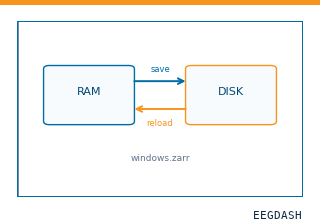 Save and reload prepared dataCache a windowed dataset to disk and reattach it without recompute.
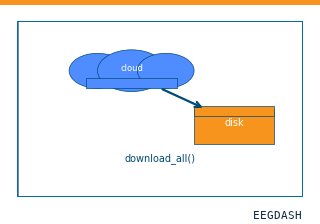 Download a dataset locallyPrefetch BIDS files to a local cache and validate the layout.
Swap any load_dataset(...) call for ds004118 to reproduce the tutorial on this dataset.
Citation
Jonathan Touryan (data and curation), Greg Apker (data), Brent Lance (data), Scott Kerick (data), Anthony Ries (data), … (19). BCIT Calibration Driving. 10.18112/openneuro.ds004118.v1.0.1
Provenance
¹Contributed to openneuro in BIDS format.
²Curated & ingested by the EEGDash catalog; see CITATION.cff for canonical reference.
³Persistent identifier: 10.18112/openneuro.ds004118.v1.0.1.
See Also#
eegdash.dataset.EEGDashDataseteegdash.dataset