


DS001785: eeg dataset, 18 subjects#
Evidence accumulation relates to perceptual consciousness and monitoring
Access recordings and metadata through EEGDash.
Citation: Michael Pereira, Pierre Mégevand, Mi Xue Tan, Wenwen Chang, Shuo Wang, Ali Rezai, Margitta Seeck, Marco Corniola, Shahan Momjian, Fosco Bernasconi, Olaf Blanke, Nathan Faivre (20). Evidence accumulation relates to perceptual consciousness and monitoring. 10.18112/openneuro.ds001785.v1.1.1
Modality: eeg Subjects: 18 Recordings: 54 License: CC0 Source: openneuro Citations: 2.0
Metadata: Complete (100%)
18-participant EEG dataset — Evidence accumulation relates to perceptual consciousness and monitoring.
Quickstart#
Install
pip install eegdash
Access the data
from eegdash.dataset import DS001785

dataset = DS001785(cache_dir="./data")
# Get the raw object of the first recording
raw = dataset.datasets[0].raw
print(raw.info)
Filter by subject
dataset = DS001785(cache_dir="./data", subject="01")
Advanced query
dataset = DS001785(
    cache_dir="./data",
    query={"subject": {"$in": ["01", "02"]}},
)
Iterate recordings
for rec in dataset:
    print(rec.subject, rec.raw.info['sfreq'])
If you use this dataset in your research, please cite the original authors.
BibTeX
@dataset{ds001785,
  title = {Evidence accumulation relates to perceptual consciousness and monitoring},
  author = {Michael Pereira and Pierre Mégevand and Mi Xue Tan and Wenwen Chang and Shuo Wang and Ali Rezai and Margitta Seeck and Marco Corniola and Shahan Momjian and Fosco Bernasconi and Olaf Blanke and Nathan Faivre},
  doi = {10.18112/openneuro.ds001785.v1.1.1},
  url = {https://doi.org/10.18112/openneuro.ds001785.v1.1.1},
}
About This Dataset#
This dataset contains the EEG used in the paper: Evidence accumulation relates to perceptual consciousness and monitoring, 2021, Nature Communications
Participants:
Twenty healthy participants (7 woman; age: 25.2, SD = 4.1) participated in this study for a 40 CHF compensation. Subjects gave written informed consent prior to participating and all experimental procedures were approved by the Commission Cantonale d’Ethique de la Recherche de la République et Canton de Genève (2015-00092 15-273).
One patient with intractable epilepsy. The patient provided informed written consent for the present study which was approved by the Commission Cantonale d’Ethique de la Recherche de la République et Canton de Genève (2016-01856). Stimuli were applied on the lateral palmar side of the right wrist using a MMC3 Haptuator vibrotactile device from TactileLabs Inc. (Montreal, Canada) driven by a 230 Hz sinusoid audio signal lasting 100 ms. Experiments started by a simple estimation of the individual detection threshold. The tactile stimulus was applied with decreasing intensity with steps corresponding to 2% of the initial intensity until the participant reported not feeling it anymore three times in a row. We then repeated the same procedure but with increasing intensity and until the participant reported feeling the vibration three times in a row. The perceptual threshold was estimated to be the average between the two thresholds found using this procedure. This approximation was then used as a seed value for an adaptive staircase during the main experiment.
Participants sat in front of a computer screen. A white fixation cross appeared in the middle of the screen for 2 s. From the moment the fixation cross turned green, participants were told that a tactile stimulus could be applied at any moment during the next 2 s. During this period, stimulus onset was uniformly distributed in 80% of trials, the 20% remaining trials served as catch trials. In all trials, 1 second after the green cross disappeared, participants were prompted to answer with the keyboard whether they felt the stimulus or not. Following a 500 ms stimulus onset asynchrony, participants were asked to report the confidence in their first order response by moving a slider on a visual analog scale with marks at 0 (certainty that the first-order response was erroneous), 0.5 (unsure about the first-order response) and 1.0 (certainty that the first-order response was correct). Detection and confidence reports were provided with the left (non-stimulated) hand, using different keys. The total experiment included 500 trials divided in 10 blocks and lasted about 2 hours. Recordings:
Electroencephalographic data were acquired from 62 active electrodes (10-20 montage) using a WaveGuard EEG cap and amplifier (ANTNeuro, Hengelo, The Netherlands) and digitized at a sampling rate of 1024 Hz. Horizontal and vertical electrooculography (EOG) was derived using bipolar referenced electrodes placed around participants’ eyes. The audio signal driving the vibrotactile actuator was recorded as an extra channel to precisely realign data to stimulus onset.
For the patient, electrocorticographical data was obtained through a 24 electrode ECoG grid (Ad-Tech Medical) covering the left hemisphere from the premotor cortex to the superior parietal lobule. The electrodes had a 4 mm diameter with 2.3 mm exposed corresponding to an area of 4.15 mm2. The data was amplified and sampled at 2048 Hz (Brain Quick LTM, Micromed, Treviso, Italy).
Cohort#
Dataset Statistics#
Age distribution by gender (n=18, range 18–34 yr, mean 25.5 yr)
Sex composition
Channel counts: 71 ch (n=54 recordings)
Sampling frequencies (Hz)
Total recording duration: 25 h
Signal · Electrodes & live trace#
Live trace viewer — sub-13 · ses-01 · task-thrdown · run-01
Showing one representative recording out of
18 subjects and 54 recordings in this dataset.
Browse the full set on OpenNeuro;
drop any other _eeg.{set,edf,bdf,vhdr} file onto the
viewer (or pass ?eeg=<url>) to inspect it.
Electrode layout — EEG · 63 sensors — 63 channels
NEMAR Processing Statistics#
The plots below are generated by NEMAR’s automated EEG pipeline. The histogram shows pipeline success for data cleaning and ICA decomposition, the percentage of data frames and EEG channels retained after artefact removal, line noise per channel (RMS, dB), and the age/gender distribution of participants.

HED event descriptors word cloud

Manifest#
File Explorer#
Browse the BIDS file structure of this dataset. Records are fetched on demand from the EEGDash catalog the first time you open the explorer.
Full dataset metadata table
Dataset ID |
|
Title |
Evidence accumulation relates to perceptual consciousness and monitoring |
Author (year) |
|
Canonical |
— |
Importable as |
|
Year |
20 |
Authors |
Michael Pereira, Pierre Mégevand, Mi Xue Tan, Wenwen Chang, Shuo Wang, Ali Rezai, Margitta Seeck, Marco Corniola, Shahan Momjian, Fosco Bernasconi, Olaf Blanke, Nathan Faivre |
License |
CC0 |
Citation / DOI |
|
Source links |
Copy-paste BibTeX
@dataset{ds001785,
  title = {Evidence accumulation relates to perceptual consciousness and monitoring},
  author = {Michael Pereira and Pierre Mégevand and Mi Xue Tan and Wenwen Chang and Shuo Wang and Ali Rezai and Margitta Seeck and Marco Corniola and Shahan Momjian and Fosco Bernasconi and Olaf Blanke and Nathan Faivre},
  doi = {10.18112/openneuro.ds001785.v1.1.1},
  url = {https://doi.org/10.18112/openneuro.ds001785.v1.1.1},
}
API Reference#
eegdash.datasetEEGDashDatasetDS001785 · Pereira2019_Evidenceeegdash/dataset/registry.py · [source ↗]- class eegdash.dataset.DS001785(cache_dir: str, query: dict | None = None, s3_bucket: str | None = None, **kwargs)[source]#
Evidence accumulation relates to perceptual consciousness and monitoring
- Study:
ds001785(OpenNeuro)- Author (year):
Pereira2019_Evidence- Canonical:
—
Also importable as:
DS001785,Pereira2019_Evidence.Modality:
eeg; Experiment type:Perception; Subject type:Healthy. Subjects: 18; recordings: 54; tasks: 3.- Parameters:
cache_dir (str | Path) – Directory where data are cached locally.
query (dict | None) – Additional MongoDB-style filters to AND with the dataset selection. Must not contain the key
dataset.s3_bucket (str | None) – Base S3 bucket used to locate the data.
**kwargs (dict) – Additional keyword arguments forwarded to
EEGDashDataset.
- data_dir#
Local dataset cache directory (
cache_dir / dataset_id).- Type:
Path
Notes
Each item is a recording; recording-level metadata are available via
dataset.description.querysupports MongoDB-style filters on fields inALLOWED_QUERY_FIELDSand is combined with the dataset filter. Dataset-specific caveats are not provided in the summary metadata.References
OpenNeuro dataset: https://openneuro.org/datasets/ds001785 NeMAR dataset: https://nemar.org/dataexplorer/detail?dataset_id=ds001785 DOI: https://doi.org/10.18112/openneuro.ds001785.v1.1.1 NEMAR citation count: 2
Examples
>>> from eegdash.dataset import DS001785
>>> dataset = DS001785(cache_dir="./data")
>>> recording = dataset[0]
>>> raw = recording.load()
- __init__(cache_dir: str, query: dict | None = None, s3_bucket: str | None = None, **kwargs)[source]#
- save(path: str, overwrite: bool = False, offset: int = 0)[source]#
Save datasets to files by creating one subdirectory for each dataset:
path/
    0/
        0-raw.fif | 0-epo.fif
        description.json
        raw_preproc_kwargs.json (if raws were preprocessed)
        window_kwargs.json (if this is a windowed dataset)
        window_preproc_kwargs.json  (if windows were preprocessed)
        target_name.json (if target_name is not None and dataset is raw)
    1/
        1-raw.fif | 1-epo.fif
        description.json
        raw_preproc_kwargs.json (if raws were preprocessed)
        window_kwargs.json (if this is a windowed dataset)
        window_preproc_kwargs.json  (if windows were preprocessed)
        target_name.json (if target_name is not None and dataset is raw)
- Parameters:
path (str) –
- Directory in which subdirectories are created to store
-raw.fif | -epo.fif and .json files to.
overwrite (bool) – Whether to delete old subdirectories that will be saved to in this call.
offset (int) – If provided, the integer is added to the id of the dataset in the concat. This is useful in the setting of very large datasets, where one dataset has to be processed and saved at a time to account for its original position.
BaseDataset from braindecode — windowed via create_windows_from_events.braindecodeDataLoader; supports parallel workers and on-the-fly augmentations.pytorchdatasets.load_dataset("EEGDash/ds001785").huggingface Find datasets with the EEGDash APIQuery the catalogue, filter by task or modality, list candidates.
 Load one EEG recordingResolve a single record to an MNE Raw with channels and events.
 EEG recording to PyTorch DataLoaderWrap braindecode windows in a DataLoader for model training.
 Preprocess EEG and create windowsFilter, resample, epoch — and persist the windowed dataset.
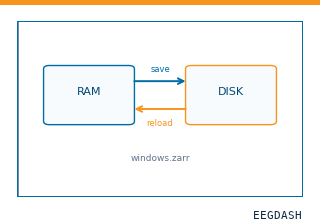 Save and reload prepared dataCache a windowed dataset to disk and reattach it without recompute.
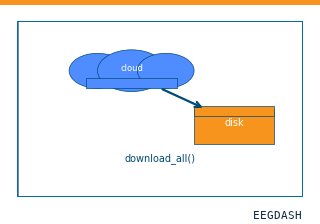 Download a dataset locallyPrefetch BIDS files to a local cache and validate the layout.
Swap any load_dataset(...) call for ds001785 to reproduce the tutorial on this dataset.
Citation
Michael Pereira, Pierre Mégevand, Mi Xue Tan, Wenwen Chang, Shuo Wang, … (20). Evidence accumulation relates to perceptual consciousness and monitoring. 10.18112/openneuro.ds001785.v1.1.1
Provenance
¹Contributed to openneuro in BIDS format.
²Curated & ingested by the EEGDash catalog; see CITATION.cff for canonical reference.
³Persistent identifier: 10.18112/openneuro.ds001785.v1.1.1.
See Also#
eegdash.dataset.EEGDashDataseteegdash.dataset