


DS003392: meg dataset, 12 subjects#
NeuroSpin hMT+ Localizer DATA (MEG & aMRI)
Access recordings and metadata through EEGDash.
Citation: Nicolas Zilber, Philippe Ciuciu, Alexandre Gramfort, Leila Azizi, Virginie van Wassenhove (2014). NeuroSpin hMT+ Localizer DATA (MEG & aMRI). 10.18112/openneuro.ds003392.v1.0.4
Modality: meg Subjects: 12 Recordings: 33 License: CC0 Source: openneuro Citations: 0.0
Metadata: Complete (100%)
12-participant MEG dataset — NeuroSpin hMT+ Localizer DATA (MEG & aMRI).
Quickstart#
Install
pip install eegdash
Access the data
from eegdash.dataset import DS003392

dataset = DS003392(cache_dir="./data")
# Get the raw object of the first recording
raw = dataset.datasets[0].raw
print(raw.info)
Filter by subject
dataset = DS003392(cache_dir="./data", subject="01")
Advanced query
dataset = DS003392(
    cache_dir="./data",
    query={"subject": {"$in": ["01", "02"]}},
)
Iterate recordings
for rec in dataset:
    print(rec.subject, rec.raw.info['sfreq'])
If you use this dataset in your research, please cite the original authors.
BibTeX
@dataset{ds003392,
  title = {NeuroSpin hMT+ Localizer DATA (MEG & aMRI)},
  author = {Nicolas Zilber and Philippe Ciuciu and Alexandre Gramfort and Leila Azizi and Virginie van Wassenhove},
  doi = {10.18112/openneuro.ds003392.v1.0.4},
  url = {https://doi.org/10.18112/openneuro.ds003392.v1.0.4},
}
About This Dataset#
Dataset description: Magnetoencephalography (MEG) dataset recorded during a hMT+ (human visual motion area) localizer task
Published in:
Zilber, N., Ciuciu, P., Gramfort, A., Azizi, L., & Van Wassenhove, V. (2014). Supramodal processing optimizes visual perceptual learning and plasticity. Neuroimage, 93, 32-46.
Data curation: Sophie Herbst, Alexandre Gramfort This MEG dataset was prepared in the Brain Imaging Data Structure (MEG-BIDS, Niso et al. 2018) format using MNE-BIDS (Appelhoff et al. 2019).
The dataset contains 10 of the 12 participants from the vision-only training group. Two participants were removed, one due to problems with the trigger channel, and one due to different settings in the acquisition preventing us from processing the dataset without prior adjustment.
EXPERIMENT
Participants were presented with a cloud of moving dots, always starting with incoherent movement (up or down result in equal display, due to the incoherence).
View full README
Data curation: Sophie Herbst, Alexandre Gramfort This MEG dataset was prepared in the Brain Imaging Data Structure (MEG-BIDS, Niso et al. 2018) format using MNE-BIDS (Appelhoff et al. 2019).
The dataset contains 10 of the 12 participants from the vision-only training group. Two participants were removed, one due to problems with the trigger channel, and one due to different settings in the acquisition preventing us from processing the dataset without prior adjustment.
EXPERIMENT
Participants were presented with a cloud of moving dots, always starting with incoherent movement (up or down result in equal display, due to the incoherence).
After 500 ms, the movement became coherent in 50% of the trials (95% coherence, up or down) and remained incoherent in the other 50%, lasting for 1000 ms. Participants were instructed to passively view the stimuli for a total of 120 trials. Events: 1: coherent / down 2: coherent / up 3: incoherent / down 4: incoherent / up
MEG
Brain magnetic fields were recorded in a MSR using a 306 MEG system (Neuromag Elekta LTD, Helsinki). MEG recordings were sampled at 2 kHz and band-pass filtered between 0.03 and 600 Hz.
Four head position coils (HPI) measured the head position of participants before each block; three fiducial markers (nasion and pre-auricular points) were used for digitization and anatomicalMRI (aMRI) immediately following MEG acquisition.
Electrooculograms (EOG, horizontal and vertical eye movements) and electrocardiogram (ECG) were simultaneously recorded.
Prior to the session, 5 min of empty room recordings was acquired for the computation of the noise covariance matrix.
Bad MEG channels were marked manually.
MRI
The T1 weighted aMRI was recorded using a 3-T Siemens Trio MRI scanner. Parameters of the sequence were: voxel size: 1.0 × 1.0 × 1.1 mm; acquisition time: 466 s; repetition time TR = 2300 ms; and echo time TE = 2.98 ms
References
Zilber, N., Ciuciu, P., Gramfort, A., Azizi, L., & Van Wassenhove, V. (2014). Supramodal processing optimizes visual perceptual learning and plasticity. Neuroimage, 93, 32-46.
Appelhoff, S., Sanderson, M., Brooks, T., Vliet, M., Quentin, R., Holdgraf, C., Chaumon, M., Mikulan, E., Tavabi, K., Höchenberger, R., Welke, D., Brunner, C., Rockhill, A., Larson, E., Gramfort, A. and Jas, M. (2019). MNE-BIDS: Organizing electrophysiological data into the BIDS format and facilitating their analysis. Journal of Open Source Software 4: (1896). https://doi.org/10.21105/joss.01896 Niso, G., Gorgolewski, K. J., Bock, E., Brooks, T. L., Flandin, G., Gramfort, A., Henson, R. N., Jas, M., Litvak, V., Moreau, J., Oostenveld, R., Schoffelen, J., Tadel, F., Wexler, J., Baillet, S. (2018). MEG-BIDS, the brain imaging data structure extended to magnetoencephalography. Scientific Data, 5, 180110. http://doi.org/10.1038/sdata.2018.110
Cohort#
Dataset Statistics#
Channel counts: 320 ch (n=22 recordings)
Sampling frequencies: 2000.0 Hz (n=22 recordings)
Total recording duration: 1 h 13 min
Signal · Electrodes & live trace#
Live trace viewer — sub-12 · task-localizer
Showing one representative recording out of
12 subjects and 33 recordings in this dataset.
Browse the full set on OpenNeuro;
drop any other _meg.{set,edf,bdf,vhdr} file onto the
viewer (or pass ?meg=<url>) to inspect it.
Electrode layout — MEG · 306 sensors — 306 channels
NEMAR Processing Statistics#
The plots below are generated by NEMAR’s automated EEG pipeline. The histogram shows pipeline success for data cleaning and ICA decomposition, the percentage of data frames and EEG channels retained after artefact removal, line noise per channel (RMS, dB), and the age/gender distribution of participants.

HED event descriptors word cloud

Manifest#
File Explorer#
Browse the BIDS file structure of this dataset. Records are fetched on demand from the EEGDash catalog the first time you open the explorer.
Full dataset metadata table
Dataset ID |
|
Title |
NeuroSpin hMT+ Localizer DATA (MEG & aMRI) |
Author (year) |
|
Canonical |
— |
Importable as |
|
Year |
2014 |
Authors |
Nicolas Zilber, Philippe Ciuciu, Alexandre Gramfort, Leila Azizi, Virginie van Wassenhove |
License |
CC0 |
Citation / DOI |
|
Source links |
OpenNeuro | NeMAR | Source URL |
Copy-paste BibTeX
@dataset{ds003392,
  title = {NeuroSpin hMT+ Localizer DATA (MEG & aMRI)},
  author = {Nicolas Zilber and Philippe Ciuciu and Alexandre Gramfort and Leila Azizi and Virginie van Wassenhove},
  doi = {10.18112/openneuro.ds003392.v1.0.4},
  url = {https://doi.org/10.18112/openneuro.ds003392.v1.0.4},
}
API Reference#
eegdash.datasetEEGDashDatasetDS003392 · Zilber2020eegdash/dataset/registry.py · [source ↗]- class eegdash.dataset.DS003392(cache_dir: str, query: dict | None = None, s3_bucket: str | None = None, **kwargs)[source]#
NeuroSpin hMT+ Localizer DATA (MEG & aMRI)
- Study:
ds003392(OpenNeuro)- Author (year):
Zilber2020- Canonical:
—
Also importable as:
DS003392,Zilber2020.Modality:
meg; Experiment type:Perception; Subject type:Healthy. Subjects: 12; recordings: 33; tasks: 2.- Parameters:
cache_dir (str | Path) – Directory where data are cached locally.
query (dict | None) – Additional MongoDB-style filters to AND with the dataset selection. Must not contain the key
dataset.s3_bucket (str | None) – Base S3 bucket used to locate the data.
**kwargs (dict) – Additional keyword arguments forwarded to
EEGDashDataset.
- data_dir#
Local dataset cache directory (
cache_dir / dataset_id).- Type:
Path
Notes
Each item is a recording; recording-level metadata are available via
dataset.description.querysupports MongoDB-style filters on fields inALLOWED_QUERY_FIELDSand is combined with the dataset filter. Dataset-specific caveats are not provided in the summary metadata.References
OpenNeuro dataset: https://openneuro.org/datasets/ds003392 NeMAR dataset: https://nemar.org/dataexplorer/detail?dataset_id=ds003392 DOI: https://doi.org/10.18112/openneuro.ds003392.v1.0.4 NEMAR citation count: 0
Examples
>>> from eegdash.dataset import DS003392
>>> dataset = DS003392(cache_dir="./data")
>>> recording = dataset[0]
>>> raw = recording.load()
- __init__(cache_dir: str, query: dict | None = None, s3_bucket: str | None = None, **kwargs)[source]#
- save(path: str, overwrite: bool = False, offset: int = 0)[source]#
Save datasets to files by creating one subdirectory for each dataset:
path/
    0/
        0-raw.fif | 0-epo.fif
        description.json
        raw_preproc_kwargs.json (if raws were preprocessed)
        window_kwargs.json (if this is a windowed dataset)
        window_preproc_kwargs.json  (if windows were preprocessed)
        target_name.json (if target_name is not None and dataset is raw)
    1/
        1-raw.fif | 1-epo.fif
        description.json
        raw_preproc_kwargs.json (if raws were preprocessed)
        window_kwargs.json (if this is a windowed dataset)
        window_preproc_kwargs.json  (if windows were preprocessed)
        target_name.json (if target_name is not None and dataset is raw)
- Parameters:
path (str) –
- Directory in which subdirectories are created to store
-raw.fif | -epo.fif and .json files to.
overwrite (bool) – Whether to delete old subdirectories that will be saved to in this call.
offset (int) – If provided, the integer is added to the id of the dataset in the concat. This is useful in the setting of very large datasets, where one dataset has to be processed and saved at a time to account for its original position.
BaseDataset from braindecode — windowed via create_windows_from_events.braindecodeDataLoader; supports parallel workers and on-the-fly augmentations.pytorchdatasets.load_dataset("EEGDash/ds003392").huggingface Find datasets with the EEGDash APIQuery the catalogue, filter by task or modality, list candidates.
 Load one EEG recordingResolve a single record to an MNE Raw with channels and events.
 EEG recording to PyTorch DataLoaderWrap braindecode windows in a DataLoader for model training.
 Preprocess EEG and create windowsFilter, resample, epoch — and persist the windowed dataset.
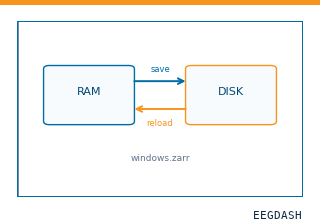 Save and reload prepared dataCache a windowed dataset to disk and reattach it without recompute.
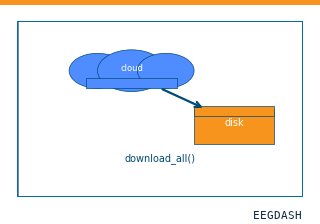 Download a dataset locallyPrefetch BIDS files to a local cache and validate the layout.
Swap any load_dataset(...) call for ds003392 to reproduce the tutorial on this dataset.
Citation
Nicolas Zilber, Philippe Ciuciu, Alexandre Gramfort, Leila Azizi, Virginie van Wassenhove (2014). NeuroSpin hMT+ Localizer DATA (MEG & aMRI). 10.18112/openneuro.ds003392.v1.0.4
Provenance
¹Contributed to openneuro in BIDS format.
²Curated & ingested by the EEGDash catalog; see CITATION.cff for canonical reference.
³Persistent identifier: 10.18112/openneuro.ds003392.v1.0.4.
See Also#
eegdash.dataset.EEGDashDataseteegdash.dataset