


DS006012: meg dataset, 21 subjects#
A geometric shape regularity effect in the human brain: MEG dataset
Access recordings and metadata through EEGDash.
Citation: Mathias Sablé-Meyer, Lucas Benjamin, Cassandra Potier Watkins, Chenxi He, Maxence Pajot, Théo Morfoisse, Fosca Al Roumi, Stanislas Dehaene (20). A geometric shape regularity effect in the human brain: MEG dataset. 10.18112/openneuro.ds006012.v1.0.1
Modality: meg Subjects: 21 Recordings: 193 License: CC0 Source: openneuro
Metadata: Complete (100%)
21-participant MEG dataset — A geometric shape regularity effect in the human brain: MEG dataset.
Quickstart#
Install
pip install eegdash
Access the data
from eegdash.dataset import DS006012

dataset = DS006012(cache_dir="./data")
# Get the raw object of the first recording
raw = dataset.datasets[0].raw
print(raw.info)
Filter by subject
dataset = DS006012(cache_dir="./data", subject="01")
Advanced query
dataset = DS006012(
    cache_dir="./data",
    query={"subject": {"$in": ["01", "02"]}},
)
Iterate recordings
for rec in dataset:
    print(rec.subject, rec.raw.info['sfreq'])
If you use this dataset in your research, please cite the original authors.
BibTeX
@dataset{ds006012,
  title = {A geometric shape regularity effect in the human brain: MEG dataset},
  author = {Mathias Sablé-Meyer and Lucas Benjamin and Cassandra Potier Watkins and Chenxi He and Maxence Pajot and Théo Morfoisse and Fosca Al Roumi and Stanislas Dehaene},
  doi = {10.18112/openneuro.ds006012.v1.0.1},
  url = {https://doi.org/10.18112/openneuro.ds006012.v1.0.1},
}
About This Dataset#
Authors:
Mathias Sablé-Meyer * Lucas Benjamin * Cassandra Potier Watkins * Chenxi He * Maxence Pajot * Théo Morfoisse * Fosca Al Roumi * Stanislas Dehaene
*Corresponding author: mathias.sable-meyer@ucl.ac.uk
A geometric shape regularity effect in the human brain: MEG dataset
Abstract
The perception and production of regular geometric shapes is a characteristic trait of human cultures since prehistory, whose neural mechanisms are unknown. Behavioral studies suggest that humans are attuned to discrete regularities such as symmetries and parallelism, and rely on their combinations to encode regular geometric shapes in a compressed form. To identify the relevant brain systems and their dynamics, we collected functional MRI and magnetoencephalography data in both adults and six-year-olds during the perception of simple shapes such as hexagons, triangles and quadrilaterals. The results revealed that geometric shapes, relative to other visual categories, induce a hypoactivation of ventral visual areas and an overactivation of the intraparietal and inferior temporal regions also involved in mathematical processing, whose activation is modulated by geometric regularity. While convolutional neural networks captured the early visual activity evoked by geometric shapes, they failed to account for subsequent dorsal parietal and prefrontal signals, which could only be captured by discrete geometric features or by more advanced transformer models of vision. We propose that the perception of abstract geometric regularities engages an additional symbolic mode of visual perception.
Notes about this dataset
We separately share the fMRI dataset at https://openneuro.org/datasets/ds006010. Below are some notes about the MEG dataset of N=20 participants:
View full README
A geometric shape regularity effect in the human brain: MEG dataset
Abstract
The perception and production of regular geometric shapes is a characteristic trait of human cultures since prehistory, whose neural mechanisms are unknown. Behavioral studies suggest that humans are attuned to discrete regularities such as symmetries and parallelism, and rely on their combinations to encode regular geometric shapes in a compressed form. To identify the relevant brain systems and their dynamics, we collected functional MRI and magnetoencephalography data in both adults and six-year-olds during the perception of simple shapes such as hexagons, triangles and quadrilaterals. The results revealed that geometric shapes, relative to other visual categories, induce a hypoactivation of ventral visual areas and an overactivation of the intraparietal and inferior temporal regions also involved in mathematical processing, whose activation is modulated by geometric regularity. While convolutional neural networks captured the early visual activity evoked by geometric shapes, they failed to account for subsequent dorsal parietal and prefrontal signals, which could only be captured by discrete geometric features or by more advanced transformer models of vision. We propose that the perception of abstract geometric regularities engages an additional symbolic mode of visual perception.
Notes about this dataset
We separately share the fMRI dataset at https://openneuro.org/datasets/ds006010. Below are some notes about the MEG dataset of N=20 participants: * The code for the analyses associated to
https://doi.org/10.1101/2024.03.13.584141 are provided at mathias-sm/AGeometricShapeRegularityEffectHumanBrain. However, these analyses have been performed on pre-processed data _without_ this defacing steps. I am not publishing this raw data, but should there be discrepancies or problems coming from the defacing, I have a copy of the following information, which I may ask for permission to share in specific cases:
The original data
The seed used for the anonymization procedure
The shuffling information.
- * Anonymization (including defacing of the
anatfolder) has been performed using the following command:
python -c 'import mne_bids; mne_bids.anonymize_dataset("<input>", "<output>", random_state=<number>, daysback=<number>)'This has shuffled the participant order, changed the dates, defaced the anatomy, and stripped gender information from the dataset.- * The data was pre-processed with the configuration file provided at
mathias-sm/AGeometricShapeRegularityEffectHumanBrain for
mne-bids-pipelinewith the development version at the time,bce60a79241731bdd03fccffa6cf315a35b33ab2on mne-tools/mne-bids-pipeline
Cohort#
Dataset Statistics#
Age distribution by gender (n=20, range 20–42 yr, mean 26.1 yr)
Channel counts (ch)
Sampling frequencies: 1000.0 Hz (n=173 recordings)
Total recording duration: 15 h 35 min
Signal · Electrodes & live trace#
Live trace viewer — sub-13 · task-POGS · run-06
Showing one representative recording out of
21 subjects and 193 recordings in this dataset.
Browse the full set on OpenNeuro;
drop any other _meg.{set,edf,bdf,vhdr} file onto the
viewer (or pass ?meg=<url>) to inspect it.
Electrode layout — MEG · 306 sensors — 306 channels
NEMAR Processing Statistics#
The plots below are generated by NEMAR’s automated EEG pipeline. The histogram shows pipeline success for data cleaning and ICA decomposition, the percentage of data frames and EEG channels retained after artefact removal, line noise per channel (RMS, dB), and the age/gender distribution of participants.

HED event descriptors word cloud

Manifest#
File Explorer#
Browse the BIDS file structure of this dataset. Records are fetched on demand from the EEGDash catalog the first time you open the explorer.
Full dataset metadata table
Dataset ID |
|
Title |
A geometric shape regularity effect in the human brain: MEG dataset |
Author (year) |
|
Canonical |
— |
Importable as |
|
Year |
20 |
Authors |
Mathias Sablé-Meyer, Lucas Benjamin, Cassandra Potier Watkins, Chenxi He, Maxence Pajot, Théo Morfoisse, Fosca Al Roumi, Stanislas Dehaene |
License |
CC0 |
Citation / DOI |
|
Source links |
Copy-paste BibTeX
@dataset{ds006012,
  title = {A geometric shape regularity effect in the human brain: MEG dataset},
  author = {Mathias Sablé-Meyer and Lucas Benjamin and Cassandra Potier Watkins and Chenxi He and Maxence Pajot and Théo Morfoisse and Fosca Al Roumi and Stanislas Dehaene},
  doi = {10.18112/openneuro.ds006012.v1.0.1},
  url = {https://doi.org/10.18112/openneuro.ds006012.v1.0.1},
}
API Reference#
eegdash.datasetEEGDashDatasetDS006012 · SableMeyer2025eegdash/dataset/registry.py · [source ↗]- class eegdash.dataset.DS006012(cache_dir: str, query: dict | None = None, s3_bucket: str | None = None, **kwargs)[source]#
A geometric shape regularity effect in the human brain: MEG dataset
- Study:
ds006012(OpenNeuro)- Author (year):
SableMeyer2025- Canonical:
—
Also importable as:
DS006012,SableMeyer2025.Modality:
meg; Experiment type:Perception; Subject type:Healthy. Subjects: 21; recordings: 193; tasks: 2.- Parameters:
cache_dir (str | Path) – Directory where data are cached locally.
query (dict | None) – Additional MongoDB-style filters to AND with the dataset selection. Must not contain the key
dataset.s3_bucket (str | None) – Base S3 bucket used to locate the data.
**kwargs (dict) – Additional keyword arguments forwarded to
EEGDashDataset.
- data_dir#
Local dataset cache directory (
cache_dir / dataset_id).- Type:
Path
Notes
Each item is a recording; recording-level metadata are available via
dataset.description.querysupports MongoDB-style filters on fields inALLOWED_QUERY_FIELDSand is combined with the dataset filter. Dataset-specific caveats are not provided in the summary metadata.References
OpenNeuro dataset: https://openneuro.org/datasets/ds006012 NeMAR dataset: https://nemar.org/dataexplorer/detail?dataset_id=ds006012 DOI: https://doi.org/10.18112/openneuro.ds006012.v1.0.1
Examples
>>> from eegdash.dataset import DS006012
>>> dataset = DS006012(cache_dir="./data")
>>> recording = dataset[0]
>>> raw = recording.load()
- __init__(cache_dir: str, query: dict | None = None, s3_bucket: str | None = None, **kwargs)[source]#
- save(path: str, overwrite: bool = False, offset: int = 0)[source]#
Save datasets to files by creating one subdirectory for each dataset:
path/
    0/
        0-raw.fif | 0-epo.fif
        description.json
        raw_preproc_kwargs.json (if raws were preprocessed)
        window_kwargs.json (if this is a windowed dataset)
        window_preproc_kwargs.json  (if windows were preprocessed)
        target_name.json (if target_name is not None and dataset is raw)
    1/
        1-raw.fif | 1-epo.fif
        description.json
        raw_preproc_kwargs.json (if raws were preprocessed)
        window_kwargs.json (if this is a windowed dataset)
        window_preproc_kwargs.json  (if windows were preprocessed)
        target_name.json (if target_name is not None and dataset is raw)
- Parameters:
path (str) –
- Directory in which subdirectories are created to store
-raw.fif | -epo.fif and .json files to.
overwrite (bool) – Whether to delete old subdirectories that will be saved to in this call.
offset (int) – If provided, the integer is added to the id of the dataset in the concat. This is useful in the setting of very large datasets, where one dataset has to be processed and saved at a time to account for its original position.
BaseDataset from braindecode — windowed via create_windows_from_events.braindecodeDataLoader; supports parallel workers and on-the-fly augmentations.pytorchdatasets.load_dataset("EEGDash/ds006012").huggingface Find datasets with the EEGDash APIQuery the catalogue, filter by task or modality, list candidates.
 Load one EEG recordingResolve a single record to an MNE Raw with channels and events.
 EEG recording to PyTorch DataLoaderWrap braindecode windows in a DataLoader for model training.
 Preprocess EEG and create windowsFilter, resample, epoch — and persist the windowed dataset.
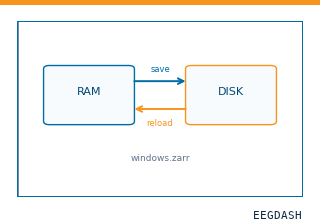 Save and reload prepared dataCache a windowed dataset to disk and reattach it without recompute.
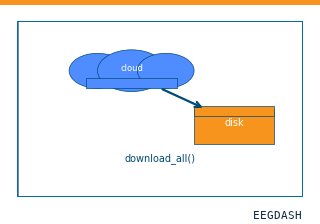 Download a dataset locallyPrefetch BIDS files to a local cache and validate the layout.
Swap any load_dataset(...) call for ds006012 to reproduce the tutorial on this dataset.
Citation
Mathias Sablé-Meyer, Lucas Benjamin, Cassandra Potier Watkins, Chenxi He, Maxence Pajot, … (20). A geometric shape regularity effect in the human brain: MEG dataset. 10.18112/openneuro.ds006012.v1.0.1
Provenance
¹Contributed to openneuro in BIDS format.
²Curated & ingested by the EEGDash catalog; see CITATION.cff for canonical reference.
³Persistent identifier: 10.18112/openneuro.ds006012.v1.0.1.
See Also#
eegdash.dataset.EEGDashDataseteegdash.dataset