


DS004279: eeg dataset, 56 subjects#
Large Spanish EEG
Access recordings and metadata through EEGDash.
Citation: Carlos Valle Araya, Carolina Mendez-Orellana, Maria Rodriguez-Fernandez (2024). Large Spanish EEG. 10.18112/openneuro.ds004279.v1.1.2
Modality: eeg Subjects: 56 Recordings: 60 License: CC0 Source: openneuro Citations: 1.0
Metadata: Complete (100%)
56-participant EEG dataset — Large Spanish EEG.
Quickstart#
Install
pip install eegdash
Access the data
from eegdash.dataset import DS004279

dataset = DS004279(cache_dir="./data")
# Get the raw object of the first recording
raw = dataset.datasets[0].raw
print(raw.info)
Filter by subject
dataset = DS004279(cache_dir="./data", subject="01")
Advanced query
dataset = DS004279(
    cache_dir="./data",
    query={"subject": {"$in": ["01", "02"]}},
)
Iterate recordings
for rec in dataset:
    print(rec.subject, rec.raw.info['sfreq'])
If you use this dataset in your research, please cite the original authors.
BibTeX
@dataset{ds004279,
  title = {Large Spanish EEG},
  author = {Carlos Valle Araya and Carolina Mendez-Orellana and Maria Rodriguez-Fernandez},
  doi = {10.18112/openneuro.ds004279.v1.1.2},
  url = {https://doi.org/10.18112/openneuro.ds004279.v1.1.2},
}
About This Dataset#
EEG: silent and perceive speech on 30 Spanish sentences
Large Spanish Speech EEG dataset Authors <ul>
<li>Carlos Valle</li> <li>Carolina Mendez-Orellana</li> <li>María Rodríguez-Fernández</li>
</ul>
Resources: <ul>
<li>Code availaible at: cgvalle/Large_Spanish_EEG</li> <li>Publication: Valle, C., Mendez-Orellana, C., Herff, C., & Rodriguez-Fernandez, M. (2024). Identification of perceived sentences using deep neural networks in EEG. Journal of neural engineering, 21(5), 056044. </li>
</ul> Abstract:
Decoding speech from brain activity can enable communication for individuals with speech disorders. Deep neural networks have shown great potential for speech decoding applications, but the large data sets required for these models are usually not available for neural recordings of speech impaired subjects. Harnessing data from other participants would thus be ideal to create speech neuroprostheses without the need of patient-specific training data.
In this study, we recorded 60 sessions from 56 healthy participants using 64 EEG channels and developed a neural network capable of subject-independent classification of perceived sentences. We found that sentence identity can be decoded from subjects without prior training achieving higher accuracy than mixed-subject models. The development of subject-independent models eliminates the need to collect data from a target subject, reducing time and data collection costs during deployment. These results open new avenues for creating speech neuroprostheses when subjects cannot provide training data.
Experiment Design:
We investigated the neural signals recorded using a 64-channel EEG system during speech perception and silent speech production tasks involving 30 daily use sentences in Spanish. The participants were instructed to listen to a spoken sentence from an audio recording and then silently repeat the sentence without any motor action.
The experimental design, a modified version of a previous study (Dash, et al), comprises four segments: rest, perception, preparation, and silent speech production. The rest segment lasted five seconds, presenting a fixation cross (+) before the stimulus onset. During the perception section, the participants listened to the stimulus. Prior to subject S18, the perception section lasted 4 s, with each sentence being repeated 7 times. From subject S19 onward, the duration of the perception segment was increased to 5 s to match the duration of the silent speech production segment and the number of repetitions per sentence was decreased to 6 in order to maintain the overall length of the experiment. The preparation segment lasted one second and presented a blank screen, serving as a separation marker between the perception and silent speech production tasks. In the silent speech production segment lasting five seconds, subjects were instructed to silently repeat the previously heard stimulus without motor action only once. It is important to note that this study exclusively focuses on the outcomes derived from the speech perception task.
Trials for each block of the 30 stimuli were presented in a randomized order to prevent anticipation and learning biases. Contact:
Please contact us at this e-mail address if you have any question: cgvalle@uc.cl
Cohort#
Dataset Statistics#
Age distribution by gender (n=56, range 19–29 yr, mean 22.5 yr)
Sex composition
Channel counts: 69 ch (n=60 recordings)
Sampling frequencies: 1000.0 Hz (n=60 recordings)
Total recording duration: 53 h
Signal · Electrodes & live trace#
Live trace viewer — sub-021 · ses-01 · task-sentences
Showing one representative recording out of
56 subjects and 60 recordings in this dataset.
Browse the full set on OpenNeuro;
drop any other _eeg.{set,edf,bdf,vhdr} file onto the
viewer (or pass ?eeg=<url>) to inspect it.
Electrode layout — EEG · 62 sensors — 62 channels
NEMAR Processing Statistics#
The plots below are generated by NEMAR’s automated EEG pipeline. The histogram shows pipeline success for data cleaning and ICA decomposition, the percentage of data frames and EEG channels retained after artefact removal, line noise per channel (RMS, dB), and the age/gender distribution of participants.

HED event descriptors word cloud

Manifest#
File Explorer#
Browse the BIDS file structure of this dataset. Records are fetched on demand from the EEGDash catalog the first time you open the explorer.
Full dataset metadata table
Dataset ID |
|
Title |
Large Spanish EEG |
Author (year) |
|
Canonical |
— |
Importable as |
|
Year |
2024 |
Authors |
Carlos Valle Araya, Carolina Mendez-Orellana, Maria Rodriguez-Fernandez |
License |
CC0 |
Citation / DOI |
|
Source links |
OpenNeuro | NeMAR | Source URL |
Copy-paste BibTeX
@dataset{ds004279,
  title = {Large Spanish EEG},
  author = {Carlos Valle Araya and Carolina Mendez-Orellana and Maria Rodriguez-Fernandez},
  doi = {10.18112/openneuro.ds004279.v1.1.2},
  url = {https://doi.org/10.18112/openneuro.ds004279.v1.1.2},
}
API Reference#
eegdash.datasetEEGDashDatasetDS004279 · Araya2022eegdash/dataset/registry.py · [source ↗]- class eegdash.dataset.DS004279(cache_dir: str, query: dict | None = None, s3_bucket: str | None = None, **kwargs)[source]#
Large Spanish EEG
- Study:
ds004279(OpenNeuro)- Author (year):
Araya2022- Canonical:
—
Also importable as:
DS004279,Araya2022.Modality:
eeg; Experiment type:Perception; Subject type:Healthy. Subjects: 56; recordings: 60; tasks: 1.- Parameters:
cache_dir (str | Path) – Directory where data are cached locally.
query (dict | None) – Additional MongoDB-style filters to AND with the dataset selection. Must not contain the key
dataset.s3_bucket (str | None) – Base S3 bucket used to locate the data.
**kwargs (dict) – Additional keyword arguments forwarded to
EEGDashDataset.
- data_dir#
Local dataset cache directory (
cache_dir / dataset_id).- Type:
Path
Notes
Each item is a recording; recording-level metadata are available via
dataset.description.querysupports MongoDB-style filters on fields inALLOWED_QUERY_FIELDSand is combined with the dataset filter. Dataset-specific caveats are not provided in the summary metadata.References
OpenNeuro dataset: https://openneuro.org/datasets/ds004279 NeMAR dataset: https://nemar.org/dataexplorer/detail?dataset_id=ds004279 DOI: https://doi.org/10.18112/openneuro.ds004279.v1.1.2 NEMAR citation count: 1
Examples
>>> from eegdash.dataset import DS004279
>>> dataset = DS004279(cache_dir="./data")
>>> recording = dataset[0]
>>> raw = recording.load()
- __init__(cache_dir: str, query: dict | None = None, s3_bucket: str | None = None, **kwargs)[source]#
- save(path: str, overwrite: bool = False, offset: int = 0)[source]#
Save datasets to files by creating one subdirectory for each dataset:
path/
    0/
        0-raw.fif | 0-epo.fif
        description.json
        raw_preproc_kwargs.json (if raws were preprocessed)
        window_kwargs.json (if this is a windowed dataset)
        window_preproc_kwargs.json  (if windows were preprocessed)
        target_name.json (if target_name is not None and dataset is raw)
    1/
        1-raw.fif | 1-epo.fif
        description.json
        raw_preproc_kwargs.json (if raws were preprocessed)
        window_kwargs.json (if this is a windowed dataset)
        window_preproc_kwargs.json  (if windows were preprocessed)
        target_name.json (if target_name is not None and dataset is raw)
- Parameters:
path (str) –
- Directory in which subdirectories are created to store
-raw.fif | -epo.fif and .json files to.
overwrite (bool) – Whether to delete old subdirectories that will be saved to in this call.
offset (int) – If provided, the integer is added to the id of the dataset in the concat. This is useful in the setting of very large datasets, where one dataset has to be processed and saved at a time to account for its original position.
BaseDataset from braindecode — windowed via create_windows_from_events.braindecodeDataLoader; supports parallel workers and on-the-fly augmentations.pytorchdatasets.load_dataset("EEGDash/ds004279").huggingface Find datasets with the EEGDash APIQuery the catalogue, filter by task or modality, list candidates.
 Load one EEG recordingResolve a single record to an MNE Raw with channels and events.
 EEG recording to PyTorch DataLoaderWrap braindecode windows in a DataLoader for model training.
 Preprocess EEG and create windowsFilter, resample, epoch — and persist the windowed dataset.
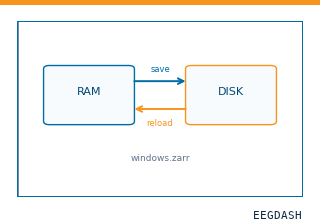 Save and reload prepared dataCache a windowed dataset to disk and reattach it without recompute.
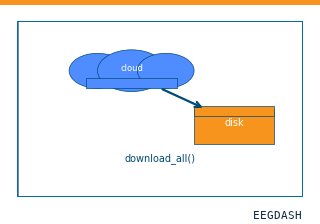 Download a dataset locallyPrefetch BIDS files to a local cache and validate the layout.
Swap any load_dataset(...) call for ds004279 to reproduce the tutorial on this dataset.
Citation
Carlos Valle Araya, Carolina Mendez-Orellana, Maria Rodriguez-Fernandez (2024). Large Spanish EEG. 10.18112/openneuro.ds004279.v1.1.2
Provenance
¹Contributed to openneuro in BIDS format.
²Curated & ingested by the EEGDash catalog; see CITATION.cff for canonical reference.
³Persistent identifier: 10.18112/openneuro.ds004279.v1.1.2.
See Also#
eegdash.dataset.EEGDashDataseteegdash.dataset