


DS003343: eeg dataset, 20 subjects#
Disentangling the percepts of illusory movement and sensory stimulation during tendon vibration in the EEG
Access recordings and metadata through EEGDash.
Citation: Christoph Schneider, Renaud Marquis, Jane Johr, Marina Da Silva Lopes, Philippe Ryvlin, Andrea Serino, Marzia De Lucia, Karin Diserens (2003). Disentangling the percepts of illusory movement and sensory stimulation during tendon vibration in the EEG. 10.18112/openneuro.ds003343.v2.0.1
Modality: eeg Subjects: 20 Recordings: 59 License: CC0 Source: openneuro Citations: 1.0
Metadata: Complete (100%)
20-participant EEG dataset — Disentangling the percepts of illusory movement and sensory stimulation during tendon vibration in the EEG.
Quickstart#
Install
pip install eegdash
Access the data
from eegdash.dataset import DS003343

dataset = DS003343(cache_dir="./data")
# Get the raw object of the first recording
raw = dataset.datasets[0].raw
print(raw.info)
Filter by subject
dataset = DS003343(cache_dir="./data", subject="01")
Advanced query
dataset = DS003343(
    cache_dir="./data",
    query={"subject": {"$in": ["01", "02"]}},
)
Iterate recordings
for rec in dataset:
    print(rec.subject, rec.raw.info['sfreq'])
If you use this dataset in your research, please cite the original authors.
BibTeX
@dataset{ds003343,
  title = {Disentangling the percepts of illusory movement and sensory stimulation during tendon vibration in the EEG},
  author = {Christoph Schneider and Renaud Marquis and Jane Johr and Marina Da Silva Lopes and Philippe Ryvlin and Andrea Serino and Marzia De Lucia and Karin Diserens},
  doi = {10.18112/openneuro.ds003343.v2.0.1},
  url = {https://doi.org/10.18112/openneuro.ds003343.v2.0.1},
}
About This Dataset#
This dataset contains the EEG data used for the study: “Disentangling the percepts of illusory movement and sensory stimulation during tendon vibration in the EEG” (Schneider, C., Marquis, R., Jöhr, J., Da Lopes Silva, M., Ryvlin, P., Serino, A., De Lucia, M., Diserens, K. Unpublished [fill according to following pattern: Journal (Year). https://doi.org/….])
Participants:
Twenty healthy participants (twelve female, eight male), age 24.6 ± 3.2 years, all right-handed. All subjects participated voluntarily and consented in writing to the experiment. The study was covered by the ethical protocol No. 142/09 from the Commission cantonale d’éthique de la recherche sur l’être humain (CER -VD) and in agreement with the Declaration of Helsinki.
Experimental setup:
The subjects sat comfortably in a chair facing towards their right side so to not see the stimulated left arm, which could have hampered the illusion of movement created during the tendon vibration. While their right arm rested comfortably in the lap, the left arm was supported by a movable forearm rest which allowed two degrees of freedom in the horizontal plane. The reason for this was that proprioceptive feedback of the arm touching an immobile object can prevent the motor illusion from forming.
Subjects wore an EEG cap with built-in wireless amplifier (g.tec Nautilus, g.tec medical engineering, Graz, Austria) with 16 electrodes covering the sensorimotor cortex in the international 10-10 system at positions (Fz, FC3, FC2, FCz, FC2, FC4, C3, C1, Cz, C2, C4, CP3, CP1, CPz, CP2, CP4). The signals were recorded at 500Hz with a hardware-implemented bandpass filter between 0.1 and 100 Hz and sent to a computer in the same room. The reference electrode was placed on the right earlobe. Tendon vibration was achieved with electromechanical wireless vibrators set into a soft, elastic brace on the left elbow joint (Vibramoov, Techno Concept, Manosque, France). The left arm was chosen since it was demonstrated that illusions start faster and are more vivid in the non-dominant extremity. One vibrator was sitting against the distal biceps tendon and the other against the distal triceps tendon on the same arm. Time information about the beginning of each stimulation was sent via a cable link to the computer and stored with the EEG data.
Study protocol:
EEG was recorded continuously while delivering stimulation sequences consisting of two different vibration types. The first elicited an illusion of elbow extension and was produced by vibrating the distal biceps tendon at 90Hz and the distal triceps tendon at 50Hz. The second produced only a vibration sensation without any movement illusion and consisted of stimulating both tendons at 70Hz. So, the average frequency of stimulation delivered to the agonist-antagonist pair was the same between conditions, but one condition was designed to induce a clear illusion and the other no illusion at all (control).
Each stimulation lasted three seconds and consisted of one second of linear frequency ramp-up, one second of a stable frequency interval and one second of linear frequency ramp-down. The linear ramps started and ended 10 Hz below the target frequency for each stimulation type. The amplitude of the vibration was 2-3 mm. These parameters were based on Romaiguère et al. (2003) and the perception of illusory movement across all subjects was ensured in a pre-screening procedure. This setting was kept constant throughout the whole recording session. Each subject underwent three blocks of 72 vibrations (36 illusion, 36 control), arranged randomly and different for each block. The same stimulus sequences were employed for each participant. Inter stimulus intervals varied between one and three seconds and were randomized within and between blocks in order to minimize stimulus onset anticipation.
Cohort#
Dataset Statistics#
Age distribution by gender (n=20, range 20–32 yr, mean 24.5 yr)
Sex composition
Channel counts: 20 ch (n=59 recordings)
Sampling frequencies: 500.0 Hz (n=59 recordings)
Total recording duration: 6 h 26 min
Signal · Electrodes & live trace#
Live trace viewer — sub-13 · ses-01 · task-fps · run-01
Showing one representative recording out of
20 subjects and 59 recordings in this dataset.
Browse the full set on OpenNeuro;
drop any other _eeg.{set,edf,bdf,vhdr} file onto the
viewer (or pass ?eeg=<url>) to inspect it.
Electrode layout — EEG · 16 sensors — 16 channels
NEMAR Processing Statistics#
The plots below are generated by NEMAR’s automated EEG pipeline. The histogram shows pipeline success for data cleaning and ICA decomposition, the percentage of data frames and EEG channels retained after artefact removal, line noise per channel (RMS, dB), and the age/gender distribution of participants.

HED event descriptors word cloud

Manifest#
File Explorer#
Browse the BIDS file structure of this dataset. Records are fetched on demand from the EEGDash catalog the first time you open the explorer.
Full dataset metadata table
Dataset ID |
|
Title |
Disentangling the percepts of illusory movement and sensory stimulation during tendon vibration in the EEG |
Author (year) |
|
Canonical |
— |
Importable as |
|
Year |
2003 |
Authors |
Christoph Schneider, Renaud Marquis, Jane Johr, Marina Da Silva Lopes, Philippe Ryvlin, Andrea Serino, Marzia De Lucia, Karin Diserens |
License |
CC0 |
Citation / DOI |
|
Source links |
Copy-paste BibTeX
@dataset{ds003343,
  title = {Disentangling the percepts of illusory movement and sensory stimulation during tendon vibration in the EEG},
  author = {Christoph Schneider and Renaud Marquis and Jane Johr and Marina Da Silva Lopes and Philippe Ryvlin and Andrea Serino and Marzia De Lucia and Karin Diserens},
  doi = {10.18112/openneuro.ds003343.v2.0.1},
  url = {https://doi.org/10.18112/openneuro.ds003343.v2.0.1},
}
API Reference#
eegdash.datasetEEGDashDatasetDS003343 · Schneider2020eegdash/dataset/registry.py · [source ↗]- class eegdash.dataset.DS003343(cache_dir: str, query: dict | None = None, s3_bucket: str | None = None, **kwargs)[source]#
Disentangling the percepts of illusory movement and sensory stimulation during tendon vibration in the EEG
- Study:
ds003343(OpenNeuro)- Author (year):
Schneider2020- Canonical:
—
Also importable as:
DS003343,Schneider2020.Modality:
eeg; Experiment type:Perception; Subject type:Healthy. Subjects: 20; recordings: 59; tasks: 1.- Parameters:
cache_dir (str | Path) – Directory where data are cached locally.
query (dict | None) – Additional MongoDB-style filters to AND with the dataset selection. Must not contain the key
dataset.s3_bucket (str | None) – Base S3 bucket used to locate the data.
**kwargs (dict) – Additional keyword arguments forwarded to
EEGDashDataset.
- data_dir#
Local dataset cache directory (
cache_dir / dataset_id).- Type:
Path
Notes
Each item is a recording; recording-level metadata are available via
dataset.description.querysupports MongoDB-style filters on fields inALLOWED_QUERY_FIELDSand is combined with the dataset filter. Dataset-specific caveats are not provided in the summary metadata.References
OpenNeuro dataset: https://openneuro.org/datasets/ds003343 NeMAR dataset: https://nemar.org/dataexplorer/detail?dataset_id=ds003343 DOI: https://doi.org/10.18112/openneuro.ds003343.v2.0.1 NEMAR citation count: 1
Examples
>>> from eegdash.dataset import DS003343
>>> dataset = DS003343(cache_dir="./data")
>>> recording = dataset[0]
>>> raw = recording.load()
- __init__(cache_dir: str, query: dict | None = None, s3_bucket: str | None = None, **kwargs)[source]#
- save(path: str, overwrite: bool = False, offset: int = 0)[source]#
Save datasets to files by creating one subdirectory for each dataset:
path/
    0/
        0-raw.fif | 0-epo.fif
        description.json
        raw_preproc_kwargs.json (if raws were preprocessed)
        window_kwargs.json (if this is a windowed dataset)
        window_preproc_kwargs.json  (if windows were preprocessed)
        target_name.json (if target_name is not None and dataset is raw)
    1/
        1-raw.fif | 1-epo.fif
        description.json
        raw_preproc_kwargs.json (if raws were preprocessed)
        window_kwargs.json (if this is a windowed dataset)
        window_preproc_kwargs.json  (if windows were preprocessed)
        target_name.json (if target_name is not None and dataset is raw)
- Parameters:
path (str) –
- Directory in which subdirectories are created to store
-raw.fif | -epo.fif and .json files to.
overwrite (bool) – Whether to delete old subdirectories that will be saved to in this call.
offset (int) – If provided, the integer is added to the id of the dataset in the concat. This is useful in the setting of very large datasets, where one dataset has to be processed and saved at a time to account for its original position.
BaseDataset from braindecode — windowed via create_windows_from_events.braindecodeDataLoader; supports parallel workers and on-the-fly augmentations.pytorchdatasets.load_dataset("EEGDash/ds003343").huggingface Find datasets with the EEGDash APIQuery the catalogue, filter by task or modality, list candidates.
 Load one EEG recordingResolve a single record to an MNE Raw with channels and events.
 EEG recording to PyTorch DataLoaderWrap braindecode windows in a DataLoader for model training.
 Preprocess EEG and create windowsFilter, resample, epoch — and persist the windowed dataset.
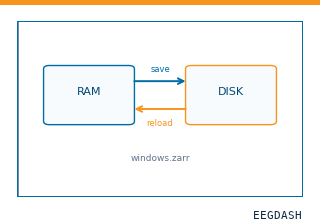 Save and reload prepared dataCache a windowed dataset to disk and reattach it without recompute.
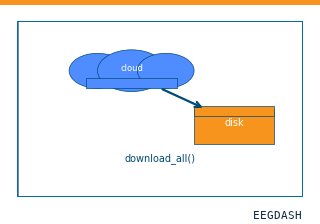 Download a dataset locallyPrefetch BIDS files to a local cache and validate the layout.
Swap any load_dataset(...) call for ds003343 to reproduce the tutorial on this dataset.
Citation
Christoph Schneider, Renaud Marquis, Jane Johr, Marina Da Silva Lopes, Philippe Ryvlin, … (2003). Disentangling the percepts of illusory movement and sensory stimulation during tendon vibration in the EEG. 10.18112/openneuro.ds003343.v2.0.1
Provenance
¹Contributed to openneuro in BIDS format.
²Curated & ingested by the EEGDash catalog; see CITATION.cff for canonical reference.
³Persistent identifier: 10.18112/openneuro.ds003343.v2.0.1.
See Also#
eegdash.dataset.EEGDashDataseteegdash.dataset