


DS006979: eeg dataset, 53 subjects#
Examining Perceptual Grouping on Stages of Processing in Visual Working Memory: An ERP Study
Access recordings and metadata through EEGDash.
Citation: Hanane Ramzaoui, Melissa Beck (20). Examining Perceptual Grouping on Stages of Processing in Visual Working Memory: An ERP Study. 10.18112/openneuro.ds006979.v1.0.1
Modality: eeg Subjects: 53 Recordings: 56 License: CC0 Source: openneuro
Metadata: Complete (100%)
53-participant EEG dataset — Examining Perceptual Grouping on Stages of Processing in Visual Working Memory: An ERP Study.
Quickstart#
Install
pip install eegdash
Access the data
from eegdash.dataset import DS006979

dataset = DS006979(cache_dir="./data")
# Get the raw object of the first recording
raw = dataset.datasets[0].raw
print(raw.info)
Filter by subject
dataset = DS006979(cache_dir="./data", subject="01")
Advanced query
dataset = DS006979(
    cache_dir="./data",
    query={"subject": {"$in": ["01", "02"]}},
)
Iterate recordings
for rec in dataset:
    print(rec.subject, rec.raw.info['sfreq'])
If you use this dataset in your research, please cite the original authors.
BibTeX
@dataset{ds006979,
  title = {Examining Perceptual Grouping on Stages of Processing in Visual Working Memory: An ERP Study},
  author = {Hanane Ramzaoui and Melissa Beck},
  doi = {10.18112/openneuro.ds006979.v1.0.1},
  url = {https://doi.org/10.18112/openneuro.ds006979.v1.0.1},
}
About This Dataset#
We present an electrophysiological dataset recorded from fifty-three subjects performing a bilateral change-detection task to investigate how perceptual grouping, based on color repetition, influences Visual Working Memory (VWM) processing efficiency.
The study is designed to temporally isolate and measure the neural correlates of several critical VWM stages: **individuation encoding**, **maintenance**, **initial comparison**, **percept-memory comparison**, and **decision making/late comparison**. This is achieved using specific **Event-Related Potential (ERP) markers** (N2pc, CDA, N2, FN400).
BIDS-EEG Dataset: Examining Perceptual Grouping on Stages of Processing in Visual Working Memory: An ERP Study
Authors: Hanane Ramzaoui, Melissa Beck
1. Description: Project Overview
2. Experimental Task and Conditions
Subjects were cued to encode the colors of 2 or 3 squares in one visual hemifield. After a maintenance period, a single-item probe was presented to determine if its color had changed.
View full README
BIDS-EEG Dataset: Examining Perceptual Grouping on Stages of Processing in Visual Working Memory: An ERP Study
Authors: Hanane Ramzaoui, Melissa Beck
1. Description: Project Overview
2. Experimental Task and Conditions
Subjects were cued to encode the colors of 2 or 3 squares in one visual hemifield. After a maintenance period, a single-item probe was presented to determine if its color had changed.
Key Manipulations
The memory array contained four primary conditions: *\*Unrepeated (UR):* Arrays with 2 or 3 unique colors (2-UR, 3-UR). *\*Repeated (R):* Arrays with 3 items, where two colors were repeated. This condition was further subdivided based on spatial arrangement: * Two repeated colors with strong spatial proximity **(3-RSP)**. * Two repeated colors with weak spatial proximity **(3-RWP)**.
The Probe in Repeated Conditions In the repeated conditions (3-RSP and 3-RWP), the single-item probe could test two different item types for change detection: *\*Repeated Item:* The probe tests one of the two squares that share the same color. *\*Unrepeated Item (Singleton):* The probe tests the single square with the unique color.
3. Primary Neurophysiological Measurements
The study leverages the following ERP components to index different VWM processing stages:
| VWM Stage | ERP Marker | Event Locking |
| :--- | :--- | :--- |
| **Individuation Encoding** | **N2pc** | Stimulus-Locked |
| **Maintenance/Load** | **CDA** (Contralateral Delay Activity) | Stimulus-Locked |
| **Initial Comparison** | **N2pc** | Probe-Locked |
| **Percept-Memory Comparison** | **N2** | Probe-Locked |
| **Decision Making/Late Comparison** | **FN400** | Probe-Locked |
4. Acquisition Details and Structure
Acquisition Parameters
| Parameter | Detail |
| :--- | :--- |
| **Subjects (N)** | 53 (N=39 used for stimulus-locked ERPs, see `participants.tsv` for details) |
| **Electrode System** | BioSemi ActiveTwo System |
| **Number of Channels** | 71 (64 scalp, 3 EOG, 2 Mastoid, 1 CMS/DRL) |
| **Sampling Rate (Acquisition)** | 512 Hz |
| **Total Trials** | 1248 trials |
BIDS Compliance
The data is structured following the Brain Imaging Data Structure (BIDS) standard for EEG. *\*Acquisition Parameters:* Detailed recording specifications (e.g., 512 Hz sampling rate, Sinc filter details) are provided in the task-level BIDS JSON files (task-myexperiment_eeg.json). *\*Methodology:* Comprehensive details on offline preprocessing (e.g., re-referencing to average mastoids, ICA artifact removal, 0.1 Hz high-pass filtering) and the precise analysis plan (e.g., ERP measurement windows, HEOG artifact thresholds, channel clusters) are provided in the stage 1 protocol on OSF (https://doi.org/10.17605/OSF.IO/8ZS96).
5. Event Codes/Triggers
The following table maps the trigger codes recorded in the EEG data to the specific experimental events. *\*Acronym Key:* UR = Unrepeated; RWP = Repeated Weak Proximity; RSP = Repeated Strong Proximity.
| Trigger Code | Event Description |
| :---: | :--- |
| "11" | Stimulus: 2-UR \| Left Cue \| Change \| Unrepeated Probe |
| "12" | Stimulus: 3-UR \| Left Cue \| Change \| Unrepeated Probe |
| "13" | Stimulus: 3-RWP \| Left Cue \| Change \| Unrepeated Probe |
| "14" | Stimulus: 3-RSP \| Left Cue \| Change \| Unrepeated Probe |
| "17" | Stimulus: 3-RWP \| Left Cue \| Change \| Repeated Probe |
| "18" | Stimulus: 3-RSP \| Left Cue \| Change \| Repeated Probe |
| "19" | Stimulus: 2-UR \| Left Cue \| No-Change \| Unrepeated Probe |
| "20" | Stimulus: 3-UR \| Left Cue \| No-Change \| Unrepeated Probe |
| "21" | Stimulus: 3-RWP \| Left Cue \| No-Change \| Unrepeated Probe |
| "22" | Stimulus: 3-RSP \| Left Cue \| No-Change \| Unrepeated Probe |
| "25" | Stimulus: 3-RWP \| Left Cue \| No-Change \| Repeated Probe |
| "26" | Stimulus: 3-RSP \| Left Cue \| No-Change \| Repeated Probe |
| "27" | Stimulus: 2-UR \| Right Cue \| Change \| Unrepeated Probe |
| "28" | Stimulus: 3-UR \| Right Cue \| Change \| Unrepeated Probe |
| "29" | Stimulus: 3-RWP \| Right Cue \| Change \| Unrepeated Probe |
| "30" | Stimulus: 3-RSP \| Right Cue \| Change \| Unrepeated Probe |
| "33" | Stimulus: 3-RWP \| Right Cue \| Change \| Repeated Probe |
| "34" | Stimulus: 3-RSP \| Right Cue \| Change \| Repeated Probe |
| "35" | Stimulus: 2-UR \| Right Cue \| No-Change \| Unrepeated Probe |
| "36" | Stimulus: 3-UR \| Right Cue \| No-Change \| Unrepeated Probe |
| "37" | Stimulus: 3-RWP \| Right Cue \| No-Change \| Unrepeated Probe |
| "38" | Stimulus: 3-RSP \| Right Cue \| No-Change \| Unrepeated Probe |
| "41" | Stimulus: 3-RWP \| Right Cue \| No-Change \| Repeated Probe |
| "42" | Stimulus: 3-RSP \| Right Cue \| No-Change \| Repeated Probe |
| "51" | Probe Onset event: 2-UR \| Left Cue |
| "52" | Probe Onset event: 3-UR \| Left Cue |
| "53" | Probe Onset event: 3-RWP \| Left Cue |
| "54" | Probe Onset event: 3-RSP \| Left Cue |
| "55" | Probe Onset event: 2-UR \| Right Cue |
| "56" | Probe Onset event: 3-UR \| Right Cue |
| "57" | Probe Onset event: 3-RWP \| Right Cue |
| "58" | Probe Onset event: 3-RSP \| Right Cue |
| "120" | Manual Response: Correct. |
| "121" | Manual Response: Incorrect. |
6. Protocol Registration and Reference
For this dataset project, the approved Stage 1 protocol (registered report) can be found at this OSF link (2024, October 15): https://doi.org/10.17605/OSF.IO/8ZS96
7. Contact and Ethics
*\*Affiliation:* Louisiana State University *\*Ethical Approval:* Institutional Review Board of Louisiana State University (IRBAM-23-0273 from March 1, 2023) *\*Contact:* hramzaoui@lsu.edu
Cohort#
Dataset Statistics#
Age distribution by gender (n=53, range 18–33 yr)
Channel counts (ch)
Sampling frequencies (Hz)
Total recording duration: 81 h
Signal · Electrodes & live trace#
Live trace viewer — sub-13 · task-visualworkingmemorytask
Showing one representative recording out of
53 subjects and 56 recordings in this dataset.
Browse the full set on OpenNeuro;
drop any other _eeg.{set,edf,bdf,vhdr} file onto the
viewer (or pass ?eeg=<url>) to inspect it.
Electrode layout — EEG · 64 sensors — 64 channels
NEMAR Processing Statistics#
The plots below are generated by NEMAR’s automated EEG pipeline. The histogram shows pipeline success for data cleaning and ICA decomposition, the percentage of data frames and EEG channels retained after artefact removal, line noise per channel (RMS, dB), and the age/gender distribution of participants.

HED event descriptors word cloud

Manifest#
File Explorer#
Browse the BIDS file structure of this dataset. Records are fetched on demand from the EEGDash catalog the first time you open the explorer.
Full dataset metadata table
Dataset ID |
|
Title |
Examining Perceptual Grouping on Stages of Processing in Visual Working Memory: An ERP Study |
Author (year) |
|
Canonical |
— |
Importable as |
|
Year |
20 |
Authors |
Hanane Ramzaoui, Melissa Beck |
License |
CC0 |
Citation / DOI |
|
Source links |
OpenNeuro | NeMAR | Source URL |
Copy-paste BibTeX
@dataset{ds006979,
  title = {Examining Perceptual Grouping on Stages of Processing in Visual Working Memory: An ERP Study},
  author = {Hanane Ramzaoui and Melissa Beck},
  doi = {10.18112/openneuro.ds006979.v1.0.1},
  url = {https://doi.org/10.18112/openneuro.ds006979.v1.0.1},
}
API Reference#
eegdash.datasetEEGDashDatasetDS006979 · Ramzaoui2025eegdash/dataset/registry.py · [source ↗]- class eegdash.dataset.DS006979(cache_dir: str, query: dict | None = None, s3_bucket: str | None = None, **kwargs)[source]#
Examining Perceptual Grouping on Stages of Processing in Visual Working Memory: An ERP Study
- Study:
ds006979(OpenNeuro)- Author (year):
Ramzaoui2025- Canonical:
—
Also importable as:
DS006979,Ramzaoui2025.Modality:
eeg; Experiment type:Memory; Subject type:Healthy. Subjects: 53; recordings: 56; tasks: 3.- Parameters:
cache_dir (str | Path) – Directory where data are cached locally.
query (dict | None) – Additional MongoDB-style filters to AND with the dataset selection. Must not contain the key
dataset.s3_bucket (str | None) – Base S3 bucket used to locate the data.
**kwargs (dict) – Additional keyword arguments forwarded to
EEGDashDataset.
- data_dir#
Local dataset cache directory (
cache_dir / dataset_id).- Type:
Path
Notes
Each item is a recording; recording-level metadata are available via
dataset.description.querysupports MongoDB-style filters on fields inALLOWED_QUERY_FIELDSand is combined with the dataset filter. Dataset-specific caveats are not provided in the summary metadata.References
OpenNeuro dataset: https://openneuro.org/datasets/ds006979 NeMAR dataset: https://nemar.org/dataexplorer/detail?dataset_id=ds006979 DOI: https://doi.org/10.18112/openneuro.ds006979.v1.0.1
Examples
>>> from eegdash.dataset import DS006979
>>> dataset = DS006979(cache_dir="./data")
>>> recording = dataset[0]
>>> raw = recording.load()
- __init__(cache_dir: str, query: dict | None = None, s3_bucket: str | None = None, **kwargs)[source]#
- save(path: str, overwrite: bool = False, offset: int = 0)[source]#
Save datasets to files by creating one subdirectory for each dataset:
path/
    0/
        0-raw.fif | 0-epo.fif
        description.json
        raw_preproc_kwargs.json (if raws were preprocessed)
        window_kwargs.json (if this is a windowed dataset)
        window_preproc_kwargs.json  (if windows were preprocessed)
        target_name.json (if target_name is not None and dataset is raw)
    1/
        1-raw.fif | 1-epo.fif
        description.json
        raw_preproc_kwargs.json (if raws were preprocessed)
        window_kwargs.json (if this is a windowed dataset)
        window_preproc_kwargs.json  (if windows were preprocessed)
        target_name.json (if target_name is not None and dataset is raw)
- Parameters:
path (str) –
- Directory in which subdirectories are created to store
-raw.fif | -epo.fif and .json files to.
overwrite (bool) – Whether to delete old subdirectories that will be saved to in this call.
offset (int) – If provided, the integer is added to the id of the dataset in the concat. This is useful in the setting of very large datasets, where one dataset has to be processed and saved at a time to account for its original position.
BaseDataset from braindecode — windowed via create_windows_from_events.braindecodeDataLoader; supports parallel workers and on-the-fly augmentations.pytorchdatasets.load_dataset("EEGDash/ds006979").huggingface Find datasets with the EEGDash APIQuery the catalogue, filter by task or modality, list candidates.
 Load one EEG recordingResolve a single record to an MNE Raw with channels and events.
 EEG recording to PyTorch DataLoaderWrap braindecode windows in a DataLoader for model training.
 Preprocess EEG and create windowsFilter, resample, epoch — and persist the windowed dataset.
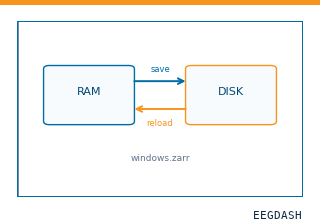 Save and reload prepared dataCache a windowed dataset to disk and reattach it without recompute.
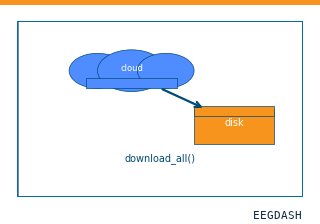 Download a dataset locallyPrefetch BIDS files to a local cache and validate the layout.
Swap any load_dataset(...) call for ds006979 to reproduce the tutorial on this dataset.
Citation
Hanane Ramzaoui, Melissa Beck (20). Examining Perceptual Grouping on Stages of Processing in Visual Working Memory: An ERP Study. 10.18112/openneuro.ds006979.v1.0.1
Provenance
¹Contributed to openneuro in BIDS format.
²Curated & ingested by the EEGDash catalog; see CITATION.cff for canonical reference.
³Persistent identifier: 10.18112/openneuro.ds006979.v1.0.1.
See Also#
eegdash.dataset.EEGDashDataseteegdash.dataset