Evaluation and Benchmarking#

Estimated reading time:3 minutes

Five lessons that treat decoding evaluation as a core skill, drawing on MOABB (Chevallier, Aristimunha et al. 2024) and the evaluation guidance in Cisotto and Chicco (2024). Difficulty 2-3; assumes the core workflow track and the leakage-safe split lesson in particular.

Evaluation is where most EEG decoding claims fall apart: the model trained on a single subject does not generalize to a held-out one, the single-split accuracy hides session drift, and a paired comparison between two pipelines is replaced by a bar chart with no statistics. This category builds, in order, from a single within-subject split toward a benchmark-grade paired comparison: which evaluation regime is honest for your claim, and how do you report it.

Evaluation Checklist#

  • Subject Disjointness. Always split by subject when testing generalization. Use GroupKFold(groups=subjects).

  • Fit Isolation. Keep all preprocessing and feature fit steps (e.g., CAR, ASR, Scaler) inside the training fold.

  • Chance Awareness. Report both accuracy and the majority-class chance level for your specific test set.

  • Statistical Rigor. Use paired subject-level statistics (e.g., Wilcoxon) when comparing pipelines.

  • Reproducibility. Save random seeds, dataset versions, and hardware specifications.

What you will learn:

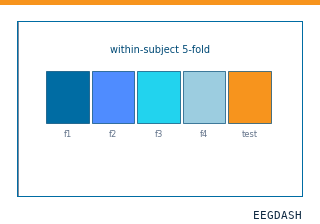
  • When within-subject diagnostics are appropriate, and when they are marketing.

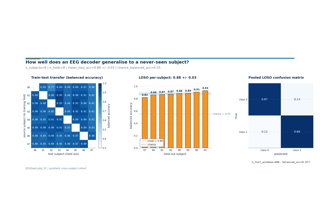
  • How to run a cross-subject evaluation – the gold standard for any generalization claim – with GroupKFold and EEGDash’s split helpers.

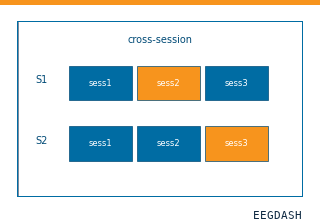
  • How to detect calibration drift across sessions of the same subject.

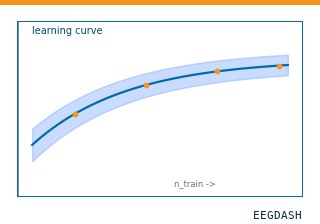
  • How to plot a learning curve as a function of training subjects, trials, or windows, and read it for sample-efficiency claims.

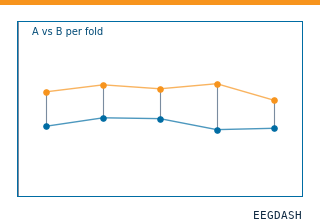
  • How to compare two pipelines on the same split and report the paired-Wilcoxon p-value the right way.

Run the lessons in order:

  1. plot_50_within_subject_evaluation.py – single-subject diagnostics.

  2. plot_51_cross_subject_evaluation.py – the gold standard for generalization.

  3. plot_52_cross_session_evaluation.py – calibration drift across sessions.

  4. plot_53_learning_curves.py – performance vs training data size.

  5. plot_54_compare_two_pipelines.py – paired comparison with the Wilcoxon test.

Within-subject decoding evaluation

Within-subject decoding evaluation

Cross-subject decoding evaluation

Cross-subject decoding evaluation

Cross-session decoding evaluation

Cross-session decoding evaluation

Decoding accuracy learning curves

Decoding accuracy learning curves

Compare two decoding pipelines

Compare two decoding pipelines

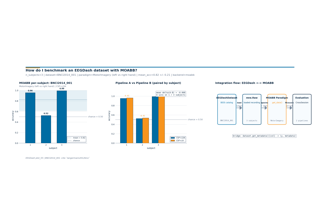
Benchmark EEGDash with MOABB

Benchmark EEGDash with MOABB