Core Decoding Workflow#
The canonical EEG decoding pipeline in four lessons: preprocess and window, split without subject leakage, train a baseline against chance, then persist prepared data so you do not pay the windowing cost on every rerun. Difficulty 1-2; assumes the Start Here trio.
This category encodes the mistakes EEG decoding papers most often make
– random window splits that leak subjects across train and test,
baselines that beat chance only because of a confound, and re-windowing
every session because nothing was cached. The leakage-safe split lesson
is the rubric anchor for E3.27 invariants and tracks the evaluation
guidance in Cisotto and Chicco (2024). Sourced from
docs/tutorial_restructure_plan.md Category B (lines 380-410).
What you will learn:
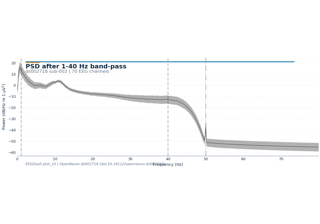
How to compose preprocessing as a list of Braindecode preprocessors (filtering, resampling, channel selection, scaling) and apply it consistently across recordings.
How to cut continuous signal into fixed-length and event-locked windows.
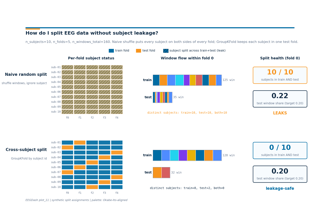
Why subject-aware splitting is non-negotiable for generalisation claims, and how to implement one with EEGDash’s split helpers.
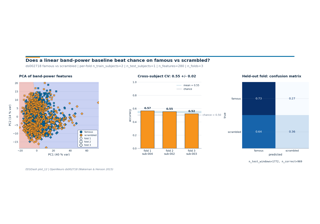
How to train a small baseline model against an explicit chance level and report a confidence interval.
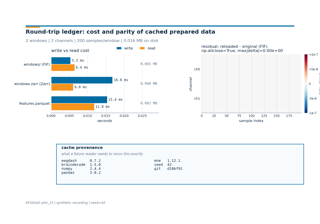
How to persist windows or features to disk and reload them in a later session without redoing the pipeline.
Run the lessons in order:
plot_10_preprocess_and_window.py– preprocessing pipeline and window construction.plot_11_leakage_safe_split.py– subject-aware train / val / test split.plot_12_train_a_baseline.py– a small model versus the chance level.plot_13_save_and_reuse_prepared_data.py– save once, reuse many.
How do I preprocess EEG and create model-ready windows?
How do I train a leakage-safe baseline classifier on EEG?
How do I save and reload prepared windows + features?