


Transfer, Foundation Models, and EEG2025#
Six lessons using recorded EEG, observed targets, and explicit evaluation boundaries. Challenge examples use small R5 mini participant subsets; their scores describe these instructional splits rather than the full leaderboard.
plot_70_challenge_dataset_basics.py– inspect challenge metadata and distinguish participant counts from recording counts.plot_71_cross_task_transfer.py– pretrain on observed resting eye-state cues and adapt to reaction-time regression, excluding the test participant from both training stages.plot_72_subject_invariant_regression.py– evaluate observed p-factor with exactly one held-out prediction per participant.plot_73_finetune_pretrained_model.py– adapt the published CBraMod checkpoint; six subject-grouped folds score each of eighteen participants once and compare scratch, linear probe and fine-tuning.plot_74_neuroai_interop.py– extract actual voltage windows through NeuralSet Segmenter and EegExtractor and batch them with PyTorch DataLoader.plot_75_finetune_reve.py– adapt the published REVE-Base checkpoint (gated weights) to motor imagery vs rest from OpenNeuro ds003810 with Braindecode’sEEGClassifier: linear probe with early stopping on a CPU, full fine-tuning when a GPU is available, runs held out rather than windows.
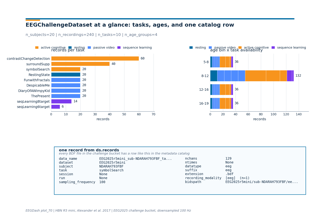
Which recordings belong to an EEG2025 mini release?
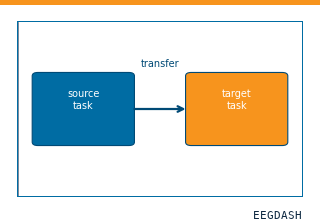
Does resting-state pretraining transfer to reaction time?
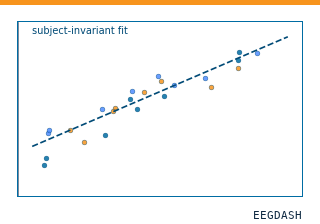
How do I evaluate participant-level p-factor regression?
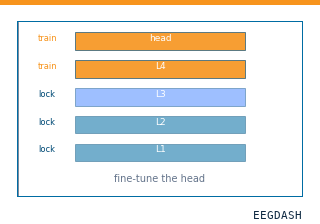
How do I fine-tune a published pretrained EEG encoder?
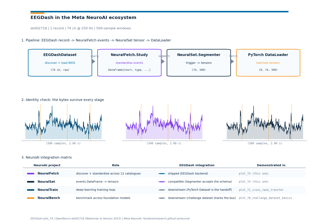
How do I export recorded EEG for NeuroAI interoperability?
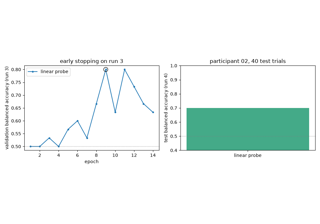
How do I fine-tune a published EEG foundation model (REVE)?