


Note
Go to the end to download the full example code or to run this example in your browser via Binder.
How do I fine-tune a published pretrained EEG encoder?#
Adapt the published CBraMod checkpoint to real HBN eyes-open/closed cues. The checkpoint is https://huggingface.co/braindecode/cbramod-pretrained (documented by Braindecode’s CBraMod model). It was pretrained on TUH EEG; this example uses the distinct HBN R5 mini cohort. It downloads about 20 MB of weights and eighteen challenge recordings (roughly 320 MB total).
Six subject-grouped folds each hold three participants out for testing while three others select the epoch and twelve train, so every participant is scored exactly once. Compare scratch, a frozen encoder with a learned linear head, and fine-tuning. The small fixed budget demonstrates adaptation, not a foundation-model benchmark.
Before you start#
Use EEGDash, Braindecode, PyTorch, NumPy, SciPy, scikit-learn and Matplotlib.
The public checkpoint requires network access on first use;
from_pretrained caches its weights separately from EEGDASH_CACHE_DIR,
which caches the eighteen EEG recordings. The revision below pins the actual
checkpoint rather than relying on a changing default branch.
The executable comparison answers a narrow question: what happens when the same downstream task is learned from random weights, a frozen published representation, or an adaptable published representation? It does not repeat the checkpoint’s large-scale pretraining. For the architecture and checkpoint contract, consult Braindecode’s pretrained-model example.
import copy
import os
from pathlib import Path

import matplotlib.pyplot as plt
import numpy as np
import torch
from braindecode.models import CBraMod
from braindecode.preprocessing import (
    Preprocessor,
    create_windows_from_events,
    preprocess,
)
from scipy.stats import wilcoxon
from sklearn.metrics import balanced_accuracy_score

from eegdash import EEGChallengeDataset
from eegdash.const import SUBJECT_MINI_RELEASE_MAP

CACHE_DIR = Path(os.environ.get("EEGDASH_CACHE_DIR", "~/.eegdash_cache")).expanduser()
CHANNELS = ["E70", "E75", "E83"]  # three posterior (occipital) channels
SFREQ = 200  # CBraMod expects 200 Hz: one-second patches of 200 samples
# Steady-state window (start, stop) in seconds after each cue, as in the eyes-open/closed tutorial
CUE_WINDOW = {"instructed_toOpenEyes": (5, 19), "instructed_toCloseEyes": (15, 29)}
Match the real signal to the encoder input#
E70, E75 and E83 are an explicit small posterior-channel subset, not a claim that the complete HBN montage is interchangeable with the pretraining montage. The source challenge derivative has already been filtered and sampled at 100 Hz; resampling to 200 Hz satisfies CBraMod’s one-second, 200-sample patch contract but cannot recover information above the source Nyquist frequency.
Two of the twenty mini-release recordings have flat or saturated posterior electrodes (found by inspecting per-channel amplitudes) and are excluded by ID. Posterior amplitudes still differ by orders of magnitude across the remaining recordings, so each recording is standardized per channel with its own mean and standard deviation. That step uses no labels and is applied identically to every recording.
Windows sample the steady state of each eye condition rather than the instruction transient, following the eyes-open/closed tutorial: seven two-second windows from 5 to 19 s after an open-eyes cue (the open block lasts 20 s) and from 15 to 29 s after a close-eyes cue (the closed block lasts 40 s). The final open-eyes cue falls a few seconds before the recording ends and cannot supply a full window; Braindecode refuses such a cue, so it is removed first. Labels represent the observed open/close instructions, not eye tracking.
# Load the resting-state recordings of the HBN R5 mini release, except two with
# flat or saturated posterior channels
BAD_RECORDINGS = ["NDARAP785CTE", "NDARCA740UC8"]
subjects = [
    s for s in sorted(SUBJECT_MINI_RELEASE_MAP["R5"]) if s not in BAD_RECORDINGS
]
dataset = EEGChallengeDataset(
    release="R5", mini=True, task="RestingState", subject=subjects, cache_dir=CACHE_DIR
)


def drop_late_cues(raw):
    """The last eyes-open cue comes ~5 s before the end and cannot supply a full window."""
    fits = (
        raw.annotations.onset + max(stop for _, stop in CUE_WINDOW.values())
        < raw.times[-1]
    )
    return raw.set_annotations(raw.annotations[fits])


preprocess(
    dataset,
    [
        Preprocessor("pick", picks=CHANNELS),
        Preprocessor("resample", sfreq=SFREQ),
        # standardize each channel of each recording with its own mean and std (uses no labels)
        Preprocessor(
            lambda x: (x - x.mean(axis=1, keepdims=True)) / x.std(axis=1, keepdims=True)
        ),
        Preprocessor(drop_late_cues, apply_on_array=False),
    ],
)

# Cut 2 s windows: label 0 = eyes open, 1 = eyes closed
windows = create_windows_from_events(
    dataset,
    mapping={"instructed_toOpenEyes": 0, "instructed_toCloseEyes": 1},
    trial_start_offset_samples={
        cue: start * SFREQ for cue, (start, _) in CUE_WINDOW.items()
    },
    trial_stop_offset_samples={
        cue: stop * SFREQ for cue, (_, stop) in CUE_WINDOW.items()
    },
    window_size_samples=2 * SFREQ,
    window_stride_samples=2 * SFREQ,
)
╭────────────────────── EEG 2025 Competition Data Notice ──────────────────────╮
│ This object loads the HBN dataset that has been preprocessed for the EEG     │
│ Challenge:                                                                   │
│   * Downsampled from 500Hz to 100Hz                                          │
│   * Bandpass filtered (0.5-50 Hz)                                            │
│                                                                              │
│ For full preprocessing applied for competition details, see:                 │
│   https://github.com/eeg2025/downsample-datasets                             │
│                                                                              │
│ The HBN dataset have some preprocessing applied by the HBN team:             │
│   * Re-reference (Cz Channel)                                                │
│                                                                              │
│ IMPORTANT: The data accessed via `EEGChallengeDataset` is NOT identical to   │
│ what you get from EEGDashDataset directly.                                   │
│ If you are participating in the competition, always use                      │
│ `EEGChallengeDataset` to ensure consistency with the challenge data.         │
╰──────────────────────── Source: EEGChallengeDataset ─────────────────────────╯
[09/16/26 20:48:50] INFO     Auto-corrected misrouted             dataset.py:561
                             storage.base for dataset
                             EEG2025r5mini: None ->
                             s3://nemar/EEG2025r5mini
/home/runner/work/EEGDash/EEGDash/.venv/lib/python3.12/site-packages/braindecode/preprocessing/preprocess.py:78: UserWarning: apply_on_array can only be True if fn is a callable function. Automatically correcting to apply_on_array=False.
  warn(
/home/runner/work/EEGDash/EEGDash/.venv/lib/python3.12/site-packages/braindecode/preprocessing/preprocess.py:76: UserWarning: Preprocessing choices with lambda functions cannot be saved.
  warn("Preprocessing choices with lambda functions cannot be saved.")

Downloading sub-NDARBF851NH6_task-RestingState_eeg.bdf:   0%|          | 0.00/13.4M [00:00<?, ?B/s]
Downloading sub-NDARBF851NH6_task-RestingState_eeg.bdf:   0%|          | 0.00/13.4M [00:00<?, ?B/s]
Downloading sub-NDARBF851NH6_task-RestingState_eeg.bdf:   7%|▋         | 1.00M/13.4M [00:00<00:03, 3.96MB/s]
Downloading sub-NDARBF851NH6_task-RestingState_eeg.bdf: 100%|██████████| 13.4M/13.4M [00:00<00:00, 32.8MB/s]

Downloading sub-NDARBF851NH6_task-RestingState_channels.tsv:   0%|          | 0.00/3.34k [00:00<?, ?B/s]
Downloading sub-NDARBF851NH6_task-RestingState_channels.tsv:   0%|          | 0.00/3.34k [00:00<?, ?B/s]
Downloading sub-NDARBF851NH6_task-RestingState_channels.tsv: 100%|██████████| 3.34k/3.34k [00:00<00:00, 60.6kB/s]

Downloading sub-NDARBF851NH6_task-RestingState_events.tsv:   0%|          | 0.00/526 [00:00<?, ?B/s]
Downloading sub-NDARBF851NH6_task-RestingState_events.tsv:   0%|          | 0.00/526 [00:00<?, ?B/s]
Downloading sub-NDARBF851NH6_task-RestingState_events.tsv: 100%|██████████| 526/526 [00:00<00:00, 11.7kB/s]

Downloading sub-NDARBF851NH6_task-RestingState_eeg.json:   0%|          | 0.00/231 [00:00<?, ?B/s]
Downloading sub-NDARBF851NH6_task-RestingState_eeg.json:   0%|          | 0.00/231 [00:00<?, ?B/s]
Downloading sub-NDARBF851NH6_task-RestingState_eeg.json: 100%|██████████| 231/231 [00:00<00:00, 5.18kB/s]

Downloading sub-NDARBH228RDW_task-RestingState_eeg.bdf:   0%|          | 0.00/13.2M [00:00<?, ?B/s]
Downloading sub-NDARBH228RDW_task-RestingState_eeg.bdf:   0%|          | 0.00/13.2M [00:00<?, ?B/s]
Downloading sub-NDARBH228RDW_task-RestingState_eeg.bdf:  15%|█▌        | 2.00M/13.2M [00:00<00:01, 9.34MB/s]
Downloading sub-NDARBH228RDW_task-RestingState_eeg.bdf: 100%|██████████| 13.2M/13.2M [00:00<00:00, 47.0MB/s]

Downloading sub-NDARBH228RDW_task-RestingState_channels.tsv:   0%|          | 0.00/3.34k [00:00<?, ?B/s]
Downloading sub-NDARBH228RDW_task-RestingState_channels.tsv:   0%|          | 0.00/3.34k [00:00<?, ?B/s]
Downloading sub-NDARBH228RDW_task-RestingState_channels.tsv: 100%|██████████| 3.34k/3.34k [00:00<00:00, 51.7kB/s]

Downloading sub-NDARBH228RDW_task-RestingState_events.tsv:   0%|          | 0.00/527 [00:00<?, ?B/s]
Downloading sub-NDARBH228RDW_task-RestingState_events.tsv:   0%|          | 0.00/527 [00:00<?, ?B/s]
Downloading sub-NDARBH228RDW_task-RestingState_events.tsv: 100%|██████████| 527/527 [00:00<00:00, 13.7kB/s]

Downloading sub-NDARBH228RDW_task-RestingState_eeg.json:   0%|          | 0.00/231 [00:00<?, ?B/s]
Downloading sub-NDARBH228RDW_task-RestingState_eeg.json:   0%|          | 0.00/231 [00:00<?, ?B/s]
Downloading sub-NDARBH228RDW_task-RestingState_eeg.json: 100%|██████████| 231/231 [00:00<00:00, 5.17kB/s]

Downloading sub-NDARBJ674TVU_task-RestingState_eeg.bdf:   0%|          | 0.00/12.9M [00:00<?, ?B/s]
Downloading sub-NDARBJ674TVU_task-RestingState_eeg.bdf:   0%|          | 0.00/12.9M [00:00<?, ?B/s]
Downloading sub-NDARBJ674TVU_task-RestingState_eeg.bdf:   8%|▊         | 1.00M/12.9M [00:00<00:02, 4.39MB/s]
Downloading sub-NDARBJ674TVU_task-RestingState_eeg.bdf: 100%|██████████| 12.9M/12.9M [00:00<00:00, 37.6MB/s]

Downloading sub-NDARBJ674TVU_task-RestingState_channels.tsv:   0%|          | 0.00/3.34k [00:00<?, ?B/s]
Downloading sub-NDARBJ674TVU_task-RestingState_channels.tsv:   0%|          | 0.00/3.34k [00:00<?, ?B/s]
Downloading sub-NDARBJ674TVU_task-RestingState_channels.tsv: 100%|██████████| 3.34k/3.34k [00:00<00:00, 89.7kB/s]

Downloading sub-NDARBJ674TVU_task-RestingState_events.tsv:   0%|          | 0.00/523 [00:00<?, ?B/s]
Downloading sub-NDARBJ674TVU_task-RestingState_events.tsv:   0%|          | 0.00/523 [00:00<?, ?B/s]
Downloading sub-NDARBJ674TVU_task-RestingState_events.tsv: 100%|██████████| 523/523 [00:00<00:00, 13.3kB/s]

Downloading sub-NDARBJ674TVU_task-RestingState_eeg.json:   0%|          | 0.00/231 [00:00<?, ?B/s]
Downloading sub-NDARBJ674TVU_task-RestingState_eeg.json:   0%|          | 0.00/231 [00:00<?, ?B/s]
Downloading sub-NDARBJ674TVU_task-RestingState_eeg.json: 100%|██████████| 231/231 [00:00<00:00, 5.01kB/s]

Downloading sub-NDARBM433VER_task-RestingState_eeg.bdf:   0%|          | 0.00/13.0M [00:00<?, ?B/s]
Downloading sub-NDARBM433VER_task-RestingState_eeg.bdf:   0%|          | 0.00/13.0M [00:00<?, ?B/s]
Downloading sub-NDARBM433VER_task-RestingState_eeg.bdf:   8%|▊         | 1.00M/13.0M [00:00<00:02, 4.59MB/s]
Downloading sub-NDARBM433VER_task-RestingState_eeg.bdf: 100%|██████████| 13.0M/13.0M [00:00<00:00, 36.3MB/s]

Downloading sub-NDARBM433VER_task-RestingState_channels.tsv:   0%|          | 0.00/3.34k [00:00<?, ?B/s]
Downloading sub-NDARBM433VER_task-RestingState_channels.tsv:   0%|          | 0.00/3.34k [00:00<?, ?B/s]
Downloading sub-NDARBM433VER_task-RestingState_channels.tsv: 100%|██████████| 3.34k/3.34k [00:00<00:00, 55.9kB/s]

Downloading sub-NDARBM433VER_task-RestingState_events.tsv:   0%|          | 0.00/523 [00:00<?, ?B/s]
Downloading sub-NDARBM433VER_task-RestingState_events.tsv:   0%|          | 0.00/523 [00:00<?, ?B/s]
Downloading sub-NDARBM433VER_task-RestingState_events.tsv: 100%|██████████| 523/523 [00:00<00:00, 10.2kB/s]

Downloading sub-NDARBM433VER_task-RestingState_eeg.json:   0%|          | 0.00/231 [00:00<?, ?B/s]
Downloading sub-NDARBM433VER_task-RestingState_eeg.json:   0%|          | 0.00/231 [00:00<?, ?B/s]
Downloading sub-NDARBM433VER_task-RestingState_eeg.json: 100%|██████████| 231/231 [00:00<00:00, 3.49kB/s]

Downloading sub-NDARCU633GCZ_task-RestingState_eeg.bdf:   0%|          | 0.00/12.8M [00:00<?, ?B/s]
Downloading sub-NDARCU633GCZ_task-RestingState_eeg.bdf:   0%|          | 0.00/12.8M [00:00<?, ?B/s]
Downloading sub-NDARCU633GCZ_task-RestingState_eeg.bdf:  16%|█▌        | 2.00M/12.8M [00:00<00:01, 9.33MB/s]
Downloading sub-NDARCU633GCZ_task-RestingState_eeg.bdf: 100%|██████████| 12.8M/12.8M [00:00<00:00, 45.1MB/s]

Downloading sub-NDARCU633GCZ_task-RestingState_channels.tsv:   0%|          | 0.00/3.34k [00:00<?, ?B/s]
Downloading sub-NDARCU633GCZ_task-RestingState_channels.tsv:   0%|          | 0.00/3.34k [00:00<?, ?B/s]
Downloading sub-NDARCU633GCZ_task-RestingState_channels.tsv: 100%|██████████| 3.34k/3.34k [00:00<00:00, 74.9kB/s]

Downloading sub-NDARCU633GCZ_task-RestingState_events.tsv:   0%|          | 0.00/517 [00:00<?, ?B/s]
Downloading sub-NDARCU633GCZ_task-RestingState_events.tsv:   0%|          | 0.00/517 [00:00<?, ?B/s]
Downloading sub-NDARCU633GCZ_task-RestingState_events.tsv: 100%|██████████| 517/517 [00:00<00:00, 12.5kB/s]

Downloading sub-NDARCU633GCZ_task-RestingState_eeg.json:   0%|          | 0.00/231 [00:00<?, ?B/s]
Downloading sub-NDARCU633GCZ_task-RestingState_eeg.json:   0%|          | 0.00/231 [00:00<?, ?B/s]
Downloading sub-NDARCU633GCZ_task-RestingState_eeg.json: 100%|██████████| 231/231 [00:00<00:00, 6.27kB/s]

Downloading sub-NDARCU736GZ1_task-RestingState_eeg.bdf:   0%|          | 0.00/13.0M [00:00<?, ?B/s]
Downloading sub-NDARCU736GZ1_task-RestingState_eeg.bdf:   0%|          | 0.00/13.0M [00:00<?, ?B/s]
Downloading sub-NDARCU736GZ1_task-RestingState_eeg.bdf:  15%|█▌        | 2.00M/13.0M [00:00<00:01, 9.56MB/s]
Downloading sub-NDARCU736GZ1_task-RestingState_eeg.bdf: 100%|██████████| 13.0M/13.0M [00:00<00:00, 45.2MB/s]

Downloading sub-NDARCU736GZ1_task-RestingState_channels.tsv:   0%|          | 0.00/3.34k [00:00<?, ?B/s]
Downloading sub-NDARCU736GZ1_task-RestingState_channels.tsv:   0%|          | 0.00/3.34k [00:00<?, ?B/s]
Downloading sub-NDARCU736GZ1_task-RestingState_channels.tsv: 100%|██████████| 3.34k/3.34k [00:00<00:00, 68.2kB/s]

Downloading sub-NDARCU736GZ1_task-RestingState_events.tsv:   0%|          | 0.00/527 [00:00<?, ?B/s]
Downloading sub-NDARCU736GZ1_task-RestingState_events.tsv:   0%|          | 0.00/527 [00:00<?, ?B/s]
Downloading sub-NDARCU736GZ1_task-RestingState_events.tsv: 100%|██████████| 527/527 [00:00<00:00, 15.3kB/s]

Downloading sub-NDARCU736GZ1_task-RestingState_eeg.json:   0%|          | 0.00/231 [00:00<?, ?B/s]
Downloading sub-NDARCU736GZ1_task-RestingState_eeg.json:   0%|          | 0.00/231 [00:00<?, ?B/s]
Downloading sub-NDARCU736GZ1_task-RestingState_eeg.json: 100%|██████████| 231/231 [00:00<00:00, 6.63kB/s]

Downloading sub-NDARCU744XWL_task-RestingState_eeg.bdf:   0%|          | 0.00/16.1M [00:00<?, ?B/s]
Downloading sub-NDARCU744XWL_task-RestingState_eeg.bdf:   0%|          | 0.00/16.1M [00:00<?, ?B/s]
Downloading sub-NDARCU744XWL_task-RestingState_eeg.bdf:   6%|▌         | 1.00M/16.1M [00:00<00:03, 4.94MB/s]
Downloading sub-NDARCU744XWL_task-RestingState_eeg.bdf: 100%|██████████| 16.1M/16.1M [00:00<00:00, 48.1MB/s]

Downloading sub-NDARCU744XWL_task-RestingState_channels.tsv:   0%|          | 0.00/3.34k [00:00<?, ?B/s]
Downloading sub-NDARCU744XWL_task-RestingState_channels.tsv:   0%|          | 0.00/3.34k [00:00<?, ?B/s]
Downloading sub-NDARCU744XWL_task-RestingState_channels.tsv: 100%|██████████| 3.34k/3.34k [00:00<00:00, 82.3kB/s]

Downloading sub-NDARCU744XWL_task-RestingState_events.tsv:   0%|          | 0.00/529 [00:00<?, ?B/s]
Downloading sub-NDARCU744XWL_task-RestingState_events.tsv:   0%|          | 0.00/529 [00:00<?, ?B/s]
Downloading sub-NDARCU744XWL_task-RestingState_events.tsv: 100%|██████████| 529/529 [00:00<00:00, 13.6kB/s]

Downloading sub-NDARCU744XWL_task-RestingState_eeg.json:   0%|          | 0.00/231 [00:00<?, ?B/s]
Downloading sub-NDARCU744XWL_task-RestingState_eeg.json:   0%|          | 0.00/231 [00:00<?, ?B/s]
Downloading sub-NDARCU744XWL_task-RestingState_eeg.json: 100%|██████████| 231/231 [00:00<00:00, 5.78kB/s]

Downloading sub-NDARDH086ZKK_task-RestingState_eeg.bdf:   0%|          | 0.00/13.2M [00:00<?, ?B/s]
Downloading sub-NDARDH086ZKK_task-RestingState_eeg.bdf:   0%|          | 0.00/13.2M [00:00<?, ?B/s]
Downloading sub-NDARDH086ZKK_task-RestingState_eeg.bdf:   8%|▊         | 1.00M/13.2M [00:00<00:02, 4.90MB/s]
Downloading sub-NDARDH086ZKK_task-RestingState_eeg.bdf: 100%|██████████| 13.2M/13.2M [00:00<00:00, 41.0MB/s]

Downloading sub-NDARDH086ZKK_task-RestingState_channels.tsv:   0%|          | 0.00/3.34k [00:00<?, ?B/s]
Downloading sub-NDARDH086ZKK_task-RestingState_channels.tsv:   0%|          | 0.00/3.34k [00:00<?, ?B/s]
Downloading sub-NDARDH086ZKK_task-RestingState_channels.tsv: 100%|██████████| 3.34k/3.34k [00:00<00:00, 61.1kB/s]

Downloading sub-NDARDH086ZKK_task-RestingState_events.tsv:   0%|          | 0.00/527 [00:00<?, ?B/s]
Downloading sub-NDARDH086ZKK_task-RestingState_events.tsv:   0%|          | 0.00/527 [00:00<?, ?B/s]
Downloading sub-NDARDH086ZKK_task-RestingState_events.tsv: 100%|██████████| 527/527 [00:00<00:00, 12.8kB/s]

Downloading sub-NDARDH086ZKK_task-RestingState_eeg.json:   0%|          | 0.00/231 [00:00<?, ?B/s]
Downloading sub-NDARDH086ZKK_task-RestingState_eeg.json:   0%|          | 0.00/231 [00:00<?, ?B/s]
Downloading sub-NDARDH086ZKK_task-RestingState_eeg.json: 100%|██████████| 231/231 [00:00<00:00, 5.83kB/s]

Downloading sub-NDARDL305BT8_task-RestingState_eeg.bdf:   0%|          | 0.00/13.1M [00:00<?, ?B/s]
Downloading sub-NDARDL305BT8_task-RestingState_eeg.bdf:   0%|          | 0.00/13.1M [00:00<?, ?B/s]
Downloading sub-NDARDL305BT8_task-RestingState_eeg.bdf:   8%|▊         | 1.00M/13.1M [00:00<00:02, 4.58MB/s]
Downloading sub-NDARDL305BT8_task-RestingState_eeg.bdf: 100%|██████████| 13.1M/13.1M [00:00<00:00, 39.3MB/s]

Downloading sub-NDARDL305BT8_task-RestingState_channels.tsv:   0%|          | 0.00/3.34k [00:00<?, ?B/s]
Downloading sub-NDARDL305BT8_task-RestingState_channels.tsv:   0%|          | 0.00/3.34k [00:00<?, ?B/s]
Downloading sub-NDARDL305BT8_task-RestingState_channels.tsv: 100%|██████████| 3.34k/3.34k [00:00<00:00, 78.5kB/s]

Downloading sub-NDARDL305BT8_task-RestingState_events.tsv:   0%|          | 0.00/527 [00:00<?, ?B/s]
Downloading sub-NDARDL305BT8_task-RestingState_events.tsv:   0%|          | 0.00/527 [00:00<?, ?B/s]
Downloading sub-NDARDL305BT8_task-RestingState_events.tsv: 100%|██████████| 527/527 [00:00<00:00, 14.1kB/s]

Downloading sub-NDARDL305BT8_task-RestingState_eeg.json:   0%|          | 0.00/231 [00:00<?, ?B/s]
Downloading sub-NDARDL305BT8_task-RestingState_eeg.json:   0%|          | 0.00/231 [00:00<?, ?B/s]
Downloading sub-NDARDL305BT8_task-RestingState_eeg.json: 100%|██████████| 231/231 [00:00<00:00, 5.89kB/s]

Downloading sub-NDARDU853XZ6_task-RestingState_eeg.bdf:   0%|          | 0.00/13.0M [00:00<?, ?B/s]
Downloading sub-NDARDU853XZ6_task-RestingState_eeg.bdf:   0%|          | 0.00/13.0M [00:00<?, ?B/s]
Downloading sub-NDARDU853XZ6_task-RestingState_eeg.bdf:   8%|▊         | 1.00M/13.0M [00:00<00:02, 4.91MB/s]
Downloading sub-NDARDU853XZ6_task-RestingState_eeg.bdf: 100%|██████████| 13.0M/13.0M [00:00<00:00, 41.7MB/s]

Downloading sub-NDARDU853XZ6_task-RestingState_channels.tsv:   0%|          | 0.00/3.34k [00:00<?, ?B/s]
Downloading sub-NDARDU853XZ6_task-RestingState_channels.tsv:   0%|          | 0.00/3.34k [00:00<?, ?B/s]
Downloading sub-NDARDU853XZ6_task-RestingState_channels.tsv: 100%|██████████| 3.34k/3.34k [00:00<00:00, 61.7kB/s]

Downloading sub-NDARDU853XZ6_task-RestingState_events.tsv:   0%|          | 0.00/524 [00:00<?, ?B/s]
Downloading sub-NDARDU853XZ6_task-RestingState_events.tsv:   0%|          | 0.00/524 [00:00<?, ?B/s]
Downloading sub-NDARDU853XZ6_task-RestingState_events.tsv: 100%|██████████| 524/524 [00:00<00:00, 9.68kB/s]

Downloading sub-NDARDU853XZ6_task-RestingState_eeg.json:   0%|          | 0.00/231 [00:00<?, ?B/s]
Downloading sub-NDARDU853XZ6_task-RestingState_eeg.json:   0%|          | 0.00/231 [00:00<?, ?B/s]
Downloading sub-NDARDU853XZ6_task-RestingState_eeg.json: 100%|██████████| 231/231 [00:00<00:00, 5.68kB/s]

Downloading sub-NDARDV245WJG_task-RestingState_eeg.bdf:   0%|          | 0.00/13.8M [00:00<?, ?B/s]
Downloading sub-NDARDV245WJG_task-RestingState_eeg.bdf:   0%|          | 0.00/13.8M [00:00<?, ?B/s]
Downloading sub-NDARDV245WJG_task-RestingState_eeg.bdf:   7%|▋         | 1.00M/13.8M [00:00<00:02, 4.79MB/s]
Downloading sub-NDARDV245WJG_task-RestingState_eeg.bdf: 100%|██████████| 13.8M/13.8M [00:00<00:00, 44.0MB/s]

Downloading sub-NDARDV245WJG_task-RestingState_channels.tsv:   0%|          | 0.00/3.34k [00:00<?, ?B/s]
Downloading sub-NDARDV245WJG_task-RestingState_channels.tsv:   0%|          | 0.00/3.34k [00:00<?, ?B/s]
Downloading sub-NDARDV245WJG_task-RestingState_channels.tsv: 100%|██████████| 3.34k/3.34k [00:00<00:00, 87.3kB/s]

Downloading sub-NDARDV245WJG_task-RestingState_events.tsv:   0%|          | 0.00/527 [00:00<?, ?B/s]
Downloading sub-NDARDV245WJG_task-RestingState_events.tsv:   0%|          | 0.00/527 [00:00<?, ?B/s]
Downloading sub-NDARDV245WJG_task-RestingState_events.tsv: 100%|██████████| 527/527 [00:00<00:00, 13.1kB/s]

Downloading sub-NDARDV245WJG_task-RestingState_eeg.json:   0%|          | 0.00/231 [00:00<?, ?B/s]
Downloading sub-NDARDV245WJG_task-RestingState_eeg.json:   0%|          | 0.00/231 [00:00<?, ?B/s]
Downloading sub-NDARDV245WJG_task-RestingState_eeg.json: 100%|██████████| 231/231 [00:00<00:00, 3.46kB/s]
Reserve participants, not windows#
X has shape (windows, 3, 400) and y contains the two integer
instruction classes. Participants, rather than windows, determine the folds:
six subject-grouped folds each hold out three participants for testing, three
others select the epoch, and the remaining twelve train. Every participant is
tested exactly once.
All checkpoint selection uses validation balanced accuracy. Test labels are read only for the final score of each prespecified regime. Reporting several regimes is not permission to choose a winning configuration on test performance and call that a new independent result.
# Arrays for PyTorch: X = (windows, channels, samples), y = label, subject = participant of each window
X = np.stack([x for x, _, _ in windows]).astype("float32")
metadata = windows.get_metadata()
y = metadata["target"].to_numpy()
subject = metadata["subject"].to_numpy()
print(f"X {X.shape} | classes {np.bincount(y)} | participants {len(subjects)}")

# Six folds of three participants each; every participant is tested exactly once
folds = np.array_split(np.array(subjects), 6)
X (1260, 3, 400) | classes [630 630] | participants 18
Load the checkpoint and understand the head dimensions#
return_encoder_output=True exposes CBraMod’s patch representations.
For three channels and two one-second patches, each with 200 representation
coordinates, flattening gives 3 × 2 × 200 = 1200 inputs to the two-class
linear head. The head returns logits; cross-entropy consumes logits directly,
so no softmax is inserted in the training loop.
If you change channels or duration, derive the new head width from a real
encoder forward pass. Merely changing n_outputs cannot fix a mismatched
feature shape. The same principle is illustrated in Braindecode’s
foundation-model fine-tuning walkthrough.
# Download the published checkpoint (about 20 MB); the revision pins the exact weights
pretrained = CBraMod.from_pretrained(
    "braindecode/cbramod-pretrained",
    revision="584cdc415913739a05d84bf0c1cb3db397764507",
    return_encoder_output=True,  # return the patch features instead of class scores
    n_chans=len(CHANNELS),
    n_times=2 * SFREQ,
    sfreq=SFREQ,
)
Compare optimization regimes with validation-only selection#
Three small functions keep the loop readable. make_model builds the
encoder plus a linear head: the scratch model has the same encoder
architecture but no downloaded weights, the linear probe freezes the
pretrained encoder so that only the head learns, and fine-tuning lets both
change. fit trains with AdamW, reshuffles the mini-batches every epoch
(the windows are otherwise ordered by participant and cue, which would make
consecutive batches nearly single-class), and keeps the weights of the epoch
with the best validation score. For the probe it also puts the frozen encoder
in evaluation mode, because freezing gradients alone would not switch off its
dropout. predict returns the predicted class of each window.
The learning rate is 1e-4 for the scratch and fine-tune regimes and
1e-3 for the linear head alone. Six epochs per fold keep CPU execution to
a few minutes; they are not a recommended training budget. Each regime is
scored once per held-out participant, as the balanced accuracy over that
participant’s windows.
REGIMES = ["scratch", "linear probe", "fine-tune"]


def make_model(regime):
    """CBraMod encoder + linear head. 3 channels x 2 patches x 200 features = 1200 inputs."""
    if regime == "scratch":
        encoder = CBraMod(
            n_chans=len(CHANNELS),
            n_times=2 * SFREQ,
            sfreq=SFREQ,
            return_encoder_output=True,
        )
    else:
        encoder = copy.deepcopy(pretrained)
    if regime == "linear probe":
        encoder.requires_grad_(False)  # freeze the encoder: only the head learns
    return torch.nn.Sequential(encoder, torch.nn.Flatten(), torch.nn.Linear(1200, 2))


def predict(model, X):
    model.eval()
    with torch.no_grad():
        return model(torch.from_numpy(X)).argmax(1).numpy()


def fit(model, train, valid, lr, frozen, n_epochs=6, batch_size=16):
    """Train with AdamW; return the model with the weights of the best validation epoch."""
    optimizer = torch.optim.AdamW(
        [p for p in model.parameters() if p.requires_grad], lr=lr
    )
    best_score, best_state = -1, None
    for epoch in range(n_epochs):
        model.train()
        if frozen:
            model[0].eval()  # frozen encoder: also switch off its dropout
        for batch in torch.randperm(int(train.sum())).split(
            batch_size
        ):  # shuffled mini-batches
            idx = np.flatnonzero(train)[batch.numpy()]
            loss = torch.nn.functional.cross_entropy(
                model(torch.from_numpy(X[idx])), torch.from_numpy(y[idx])
            )
            optimizer.zero_grad()
            loss.backward()
            optimizer.step()
        score = balanced_accuracy_score(y[valid], predict(model, X[valid]))
        if score > best_score:
            best_score, best_state = score, copy.deepcopy(model.state_dict())
    model.load_state_dict(best_state)
    return model


torch.manual_seed(0)
scores = {
    regime: [] for regime in REGIMES
}  # one balanced accuracy per held-out participant
for test_subjects in folds:
    others = [s for s in subjects if s not in test_subjects]
    train = np.isin(subject, others[:-3])  # 12 participants train
    valid = np.isin(subject, others[-3:])  # 3 participants select the epoch
    test = np.isin(subject, test_subjects)  # 3 participants are scored once
    for regime in REGIMES:
        frozen = regime == "linear probe"
        model = fit(
            make_model(regime), train, valid, lr=1e-3 if frozen else 1e-4, frozen=frozen
        )
        pred = predict(model, X[test])
        for s in test_subjects:
            m = subject[test] == s
            scores[regime].append(balanced_accuracy_score(y[test][m], pred[m]))
    n = len(test_subjects)
    print(
        f"held out {test_subjects.tolist()}: "
        + " | ".join(f"{r} {np.mean(scores[r][-n:]):.2f}" for r in REGIMES)
    )
held out ['NDARAH793FBF', 'NDARAJ689BVN', 'NDARAU708TL8']: scratch 0.64 | linear probe 0.66 | fine-tune 0.74
held out ['NDARBE091BGD', 'NDARBE103DHM', 'NDARBF851NH6']: scratch 0.54 | linear probe 0.72 | fine-tune 0.88
held out ['NDARBH228RDW', 'NDARBJ674TVU', 'NDARBM433VER']: scratch 0.50 | linear probe 0.53 | fine-tune 0.52
held out ['NDARCU633GCZ', 'NDARCU736GZ1', 'NDARCU744XWL']: scratch 0.59 | linear probe 0.65 | fine-tune 0.74
held out ['NDARDC843HHM', 'NDARDH086ZKK', 'NDARDL305BT8']: scratch 0.60 | linear probe 0.69 | fine-tune 0.61
held out ['NDARDU853XZ6', 'NDARDV245WJG', 'NDAREC480KFA']: scratch 0.52 | linear probe 0.64 | fine-tune 0.63
Statistics over participants (one score each) and a figure with one dot per participant
for regime in REGIMES:
    s = np.array(scores[regime])
    p = wilcoxon(s - 0.5, alternative="greater").pvalue
    print(
        f"{regime:13s} mean {s.mean():.3f} | above chance in {(s > 0.5).sum()}/{len(s)} | Wilcoxon p = {p:.1e}"
    )
p = wilcoxon(scores["fine-tune"], scores["scratch"], alternative="greater").pvalue
print(f"fine-tune > scratch (paired over participants): p = {p:.1e}")

fig, ax = plt.subplots(figsize=(6, 4))
jitter = np.linspace(
    -0.2, 0.2, len(subjects)
)  # spread the dots; scores stay in participant order
for i, regime in enumerate(REGIMES):
    ax.bar(i, np.mean(scores[regime]), color="lightgray")
    ax.scatter(i + jitter, scores[regime], s=18, color="k", zorder=3)
ax.axhline(0.5, ls="--", color="gray")  # chance level
ax.set(
    xticks=range(len(REGIMES)),
    xticklabels=REGIMES,
    ylim=(0, 1),
    ylabel="Balanced accuracy per held-out participant",
)
plt.show()
scratch       mean 0.564 | above chance in 15/18 | Wilcoxon p = 2.1e-03
linear probe  mean 0.648 | above chance in 16/18 | Wilcoxon p = 5.9e-04
fine-tune     mean 0.687 | above chance in 14/18 | Wilcoxon p = 4.9e-04
fine-tune > scratch (paired over participants): p = 4.8e-03
Read the final bars and design the next experiment#
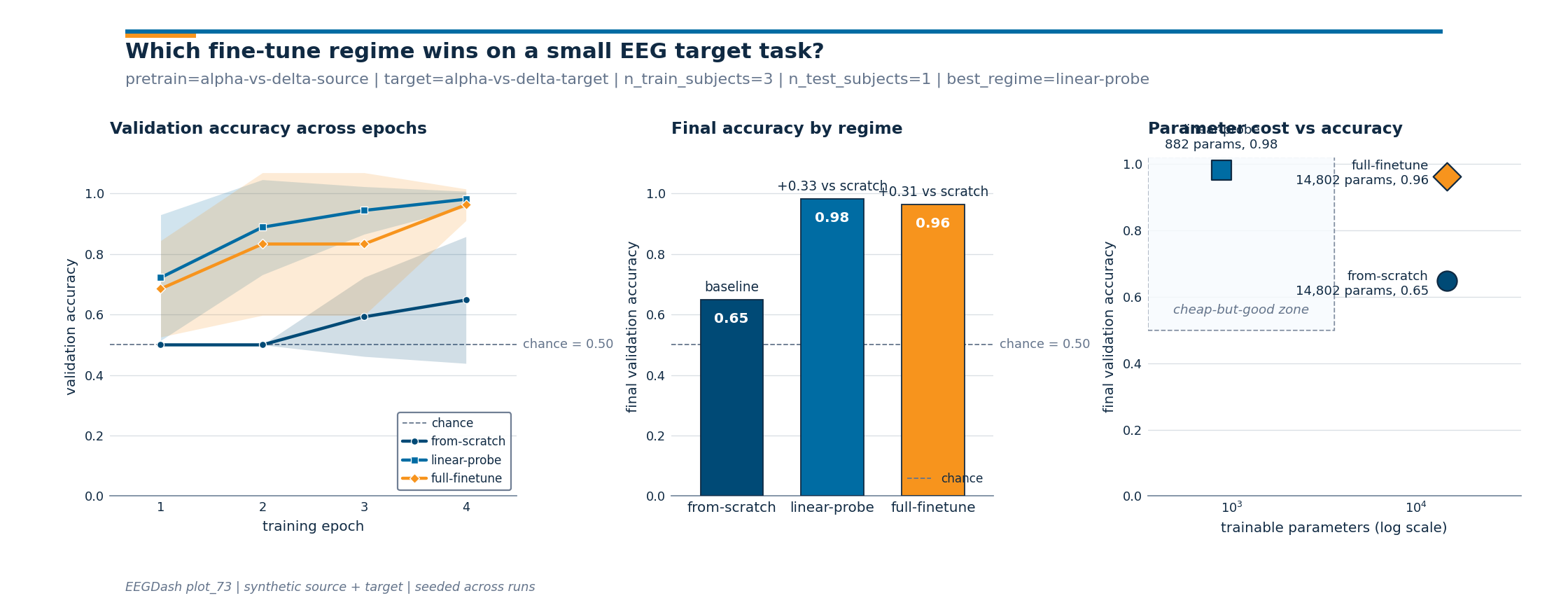
Each dot is one held-out participant, scored on that participant’s windows alone; the bar is the mean across the eighteen participants and the dashed line is the two-class chance level. Random weights stay close to chance. The frozen published representation already separates the two eye states for most participants, and fine-tuning does best. The paired test between fine-tuning and scratch is the evidence that the pretrained weights matter, because the two regimes share folds, windows, budget and seed. A few participants sit near 0.5 under every regime; those recordings show little alpha reactivity in the selected channels, which is a data property to inspect, not a modeling failure to tune away.
For a stronger comparison, add repeated seeds and prespecify longer budgets. Compare equal head initializations when estimating the effect of pretrained weights. Inspect per-participant confusion matrices and channel quality before attributing a change to the encoder. Save the selected weights together with the checkpoint revision, channel order, rate, window offsets, standardization rule and subject lists if you extend this page into a reusable trained model; weights alone omit the input contract.
Total running time of the script: (6 minutes 53.084 seconds)
