How do classical EEG markers compose on top of one Welch PSD?#

Estimated reading time:10 minutes

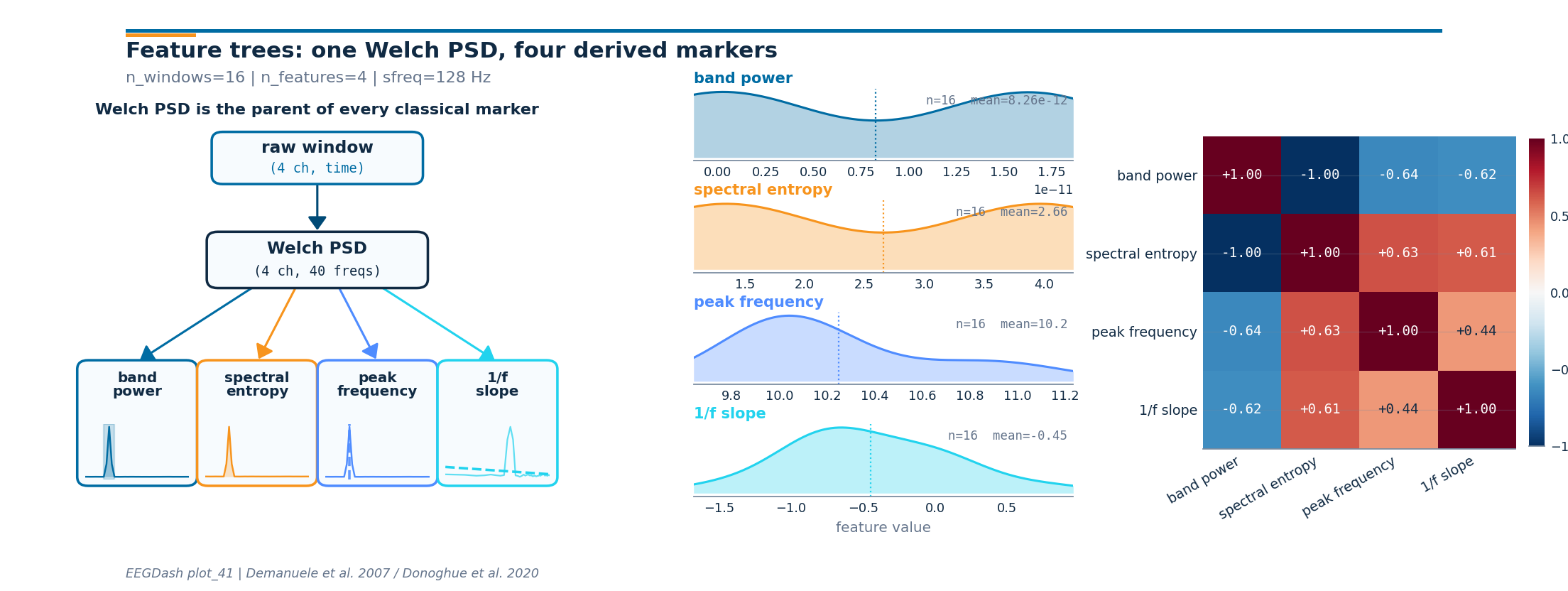
Welch’s method [Welch, 1967] returns one power spectrum per window; band power, spectral entropy, peak frequency, and the 1/f slope (Demanuele et al. 2007; Donoghue et al. 2020) are four scalars derived from that same spectrum. If a feature dictionary asks for four band powers as four independent features, the FFT runs four times per window. The FeatureExtractor dependency tree shares one spectral_preprocessor across every spectral feature so the FFT runs once. The deliverable for this tutorial is one feature table with the four derived columns, plus a three-panel figure that names the hierarchy, shows each feature’s distribution, and prints the 4x4 Pearson correlation between them.

Live data come from the same 1-40 Hz FIR-filtered windows used in /auto_examples/tutorials/40_features/plot_40_first_features to keep the tutorial self-contained and offline-runnable, with the same HBN resting-state ds005514 recipe served through NEMAR [Delorme et al., 2022] and the BIDS conventions of Pernet et al. (2019); for clinical EEG good-practice on band selection see Cisotto and Chicco (2024).

So if alpha-, beta-, theta-, and delta-band powers each call Welch separately, how many PSDs run per batch, and what does sharing one spectral_preprocessor change?

Learning objectives#

  • Identify when independent feature definitions cause repeated PSD work.

  • Build a shared spectral_preprocessor and hang four derived features off it (band power, spectral entropy, peak frequency, 1/f slope).

  • Read the dependency tree printed by FeatureExtractor.

  • Compute the wall-time speedup from sharing one PSD versus N.

  • Implement a custom decorated feature on the same shared PSD.

Requirements#

  • About 5 s on CPU. No GPU. No network.

  • Prerequisites: /auto_examples/tutorials/10_core_workflow/plot_10_preprocess_and_window, /auto_examples/tutorials/40_features/plot_40_first_features.

  • Concept: Features vs. deep learning.

Setup. np.random.seed makes the synthetic recordings reproducible (E3.21). One global Welch counter lets us prove the shared-PSD claim at runtime; the counter is reset to the original Welch in a try/finally so subsequent tutorials in the same sphinx-gallery process see a clean _spec.welch [Gramfort et al., 2013].

import time
from functools import partial

import matplotlib.pyplot as plt
import mne
import numpy as np
import pandas as pd
from braindecode.datasets import BaseConcatDataset, RawDataset
from braindecode.preprocessing import create_fixed_length_windows

import eegdash
from eegdash.features import (
    FeatureExtractor,
    extract_features,
    feature_predecessor,
    spectral_bands_power,
    spectral_db_preprocessor,
    spectral_entropy,
    spectral_normalized_preprocessor,
    spectral_preprocessor,
    spectral_slope,
    univariate_feature,
)
from eegdash.features.feature_bank import spectral as _spec
from eegdash.viz import use_eegdash_style

use_eegdash_style()
np.random.seed(42)
print(f"eegdash {eegdash.__version__}")

PSD_CALLS, _TAG, _orig_welch = {"flat": 0, "tree": 0}, {"value": "tree"}, _spec.welch


def _counting_welch(*a, **k):
    """Wrap :func:`scipy.signal.welch` to count invocations per run."""
    PSD_CALLS[_TAG["value"]] = PSD_CALLS[_TAG["value"]] + 1
    return _orig_welch(*a, **k)


_spec.welch = _counting_welch
eegdash 0.7.2

Mental model: PSD is the parent of every classical EEG marker#

Welch’s PSD takes one window of shape (n_channels, n_times) and returns a power spectrum of shape (n_channels, n_freqs). Every classical resting-state marker is one or two lines of NumPy applied to that spectrum:

raw window  ->  Welch PSD  ->  band power
                              spectral entropy
                              peak frequency
                              1/f slope

Two consequences land immediately. First, if four features each rebuild the same PSD, the FFT runs four times instead of once. Second, the four features read different views of the spectrum (raw power for band integrals, normalised power for entropy, log power for the 1/f fit). A shared spectral_preprocessor plus feature_predecessor()-tagged consumers solve both at once.

Step 1: Build a small windowed dataset#

Two 16 s recordings at 128 Hz on a 4-channel parieto-occipital montage. Eyes-closed gets a 10 Hz alpha sine on top of the noise floor; eyes-open does not. The non-causal 1-40 Hz FIR band-pass writes info["highpass"] and info["lowpass"] so that the downstream spectral_preprocessor can read them when picking the integration window. Synthetic data keep the tutorial offline; the same code path runs on real ds005514 windows from /auto_examples/tutorials/10_core_workflow/plot_10_preprocess_and_window.

SFREQ, CH_NAMES, WIN = 128, ["O1", "Oz", "O2", "Cz"], int(2.0 * 128)


def _make_raw(eyes_open: bool, seed: int) -> mne.io.Raw:
    """Build a synthetic 16 s ``Raw`` with optional 10 Hz alpha sine."""
    n = SFREQ * 16
    data = np.random.default_rng(seed).standard_normal((len(CH_NAMES), n)) * 1e-6
    if not eyes_open:
        data += 4e-6 * np.sin(2 * np.pi * 10.0 * np.arange(n) / SFREQ)
    raw = mne.io.RawArray(
        data, mne.create_info(CH_NAMES, SFREQ, ch_types="eeg"), verbose="ERROR"
    )
    raw.filter(l_freq=1.0, h_freq=40.0, verbose="ERROR")
    return raw


datasets = BaseConcatDataset(
    [
        RawDataset(
            _make_raw(True, 42),
            target_name="target",
            description={"subject": "s1", "condition": "eyes_open", "target": 0},
        ),
        RawDataset(
            _make_raw(False, 7),
            target_name="target",
            description={"subject": "s2", "condition": "eyes_closed", "target": 1},
        ),
    ]
)
windows = create_fixed_length_windows(
    datasets,
    start_offset_samples=0,
    stop_offset_samples=None,
    window_size_samples=WIN,
    window_stride_samples=WIN,
    drop_last_window=True,
    preload=True,
)
n_windows = sum(len(d) for d in windows.datasets)
pd.Series(
    {
        "n_recordings": 2,
        "n_windows": n_windows,
        "n_channels": len(CH_NAMES),
        "sfreq (Hz)": SFREQ,
        "window_samples": WIN,
    },
    name="value",
).to_frame()
value
n_recordings 2
n_windows 16
n_channels 4
sfreq (Hz) 128
window_samples 256


Step 2: Predict (PRIMM)#

Predict. Four band-power features built as four independent extractors each call Welch separately, so the FFT runs four times per batch. With one shared spectral_preprocessor the count should drop to one per batch. Predict the speedup before running.

Step 3: Run #1, without the tree#

Run. Each band gets its own top-level FeatureExtractor with its own spectral_preprocessor. The FFT runs once per band per batch; the Welch counter records the redundant calls.

BANDS = {"delta": (1, 4.5), "theta": (4.5, 8), "alpha": (8, 12), "beta": (12, 30)}


def _band_pow(name, lim):
    """Return a ``spectral_bands_power`` partial for one named band."""
    return partial(spectral_bands_power, bands={name: lim})


def _psd_pre():
    """Return a ``spectral_preprocessor`` partial with a 2 s segment."""
    return partial(
        spectral_preprocessor,
        fs=SFREQ,
        nperseg=int(2.0 * SFREQ),
        f_min=1.0,
        f_max=40.5,
    )


flat_features = {
    n: FeatureExtractor({f"{n}_pow": _band_pow(n, lim)}, preprocessor=_psd_pre())
    for n, lim in BANDS.items()
}
PSD_CALLS["flat"], _TAG["value"] = 0, "flat"
t0 = time.perf_counter()
flat_table = extract_features(
    windows, flat_features, batch_size=64, n_jobs=1
).to_dataframe(include_target=True)
runtime_flat = time.perf_counter() - t0
psds_flat = PSD_CALLS["flat"]
Extracting features:   0%|          | 0/2 [00:00<?, ?it/s]
Extracting features: 100%|██████████| 2/2 [00:00<00:00, 260.77it/s]

Step 4: Investigate the flat run#

Investigate. Every band rebuilt the PSD. The total Welch count equals n_bands * n_batches.

print(
    f"flat: shape={flat_table.shape} | runtime={runtime_flat:.4f} s | PSDs={psds_flat}"
)
flat: shape=(16, 17) | runtime=0.0097 s | PSDs=8

Step 5: Run #2, with the tree (shared PSD)#

Run. One spectral_preprocessor at the top, four band features below. Printing the extractor renders the dependency tree exactly as get_feature_predecessors() would describe it.

tree_extractor = FeatureExtractor(
    {f"{n}_pow": _band_pow(n, lim) for n, lim in BANDS.items()}, preprocessor=_psd_pre()
)
print(tree_extractor)
PSD_CALLS["tree"], _TAG["value"] = 0, "tree"
t0 = time.perf_counter()
tree_table = extract_features(
    windows, tree_extractor, batch_size=64, n_jobs=1
).to_dataframe(include_target=True)
runtime_tree = time.perf_counter() - t0
psds_tree = PSD_CALLS["tree"]
spectral_preprocessor
╠═ delta_pow: spectral_bands_power
╠═ theta_pow: spectral_bands_power
╠═ alpha_pow: spectral_bands_power
╚═ beta_pow: spectral_bands_power

Extracting features:   0%|          | 0/2 [00:00<?, ?it/s]
Extracting features: 100%|██████████| 2/2 [00:00<00:00, 448.01it/s]

Step 6: Investigate the speedup#

Investigate. Same row count, identical band columns, but the PSD counter dropped 4x. After Run #1 and Run #2 we restore _spec.welch in a try/finally so any subsequent tutorial in the same sphinx-gallery process sees the original Welch.

try:
    speedup = max(runtime_flat / max(runtime_tree, 1e-6), 1.0)
    assert tree_table.shape[0] == flat_table.shape[0]
    assert tree_table.shape[1] >= flat_table.shape[1]
    assert psds_tree * len(BANDS) == psds_flat
    print(
        f"tree: shape={tree_table.shape} | runtime={runtime_tree:.4f} s | "
        f"PSDs={psds_tree} | speedup={speedup:.2f}x"
    )
finally:
    _spec.welch = _orig_welch
    print("welch restored")
tree: shape=(16, 17) | runtime=0.0063 s | PSDs=2 | speedup=1.53x
welch restored

Step 7: Four derived markers on one shared PSD#

Band power is one of four standard derivations from the PSD. The other three live in eegdash.features.feature_bank.spectral: spectral_entropy() (normalised PSD, minus sum of p * log(p)); peak frequency (argmax inside a band, the individual alpha frequency anchor; Demanuele et al. 2007); and spectral_slope() (least-squares fit of log P(f) = a * log(f) + b on the decibel spectrum, with FOOOF as the periodic / aperiodic split; Donoghue et al. 2020). Each consumer is decorated with the matching feature_predecessor(), so the tree wires the normalised, raw, and decibel views of the same Welch output to the four leaves without recomputing the FFT.

@feature_predecessor(spectral_preprocessor)
@univariate_feature
def alpha_band_power(f, p, /):
    """Total power in the 8-12 Hz band, channel-wise."""
    mask = (f >= 8.0) & (f <= 12.0)
    return p[..., mask].sum(axis=-1)


@feature_predecessor(spectral_preprocessor)
@univariate_feature
def alpha_peak_frequency(f, p, /):
    """Argmax frequency inside the 8-12 Hz alpha band, channel-wise."""
    mask = (f >= 8.0) & (f <= 12.0)
    f_band = f[mask]
    p_band = p[..., mask]
    idx = np.argmax(p_band, axis=-1)
    return f_band[idx]


markers = FeatureExtractor(
    {
        "alpha_pow": alpha_band_power,
        "alpha_peak": alpha_peak_frequency,
        "norm": FeatureExtractor(
            {"spec_ent": spectral_entropy},
            preprocessor=spectral_normalized_preprocessor,
        ),
        "db": FeatureExtractor(
            {"slope_1f": spectral_slope},
            preprocessor=spectral_db_preprocessor,
        ),
    },
    preprocessor=_psd_pre(),
)

Note

Spectral entropy needs the normalised PSD; the 1/f slope needs the PSD in decibels. Two inner extractors hang those derived preprocessors off the parent spectral_preprocessor, so the FFT still runs once per window. spectral_slope() returns {'exp': ..., 'int': ...}; the extractor expands it into one column per key (db_slope_1f_exp_<channel>, ..._int_...).

markers_table = extract_features(
    windows, markers, batch_size=64, n_jobs=1
).to_dataframe(include_target=True)
print(
    "marker columns (first 10):",
    [c for c in markers_table.columns[:10]],
)
print(f"markers table shape: {markers_table.shape}")
Extracting features:   0%|          | 0/2 [00:00<?, ?it/s]
Extracting features: 100%|██████████| 2/2 [00:00<00:00, 397.96it/s]
marker columns (first 10): ['alpha_pow_O1', 'alpha_pow_Oz', 'alpha_pow_O2', 'alpha_pow_Cz', 'alpha_peak_O1', 'alpha_peak_Oz', 'alpha_peak_O2', 'alpha_peak_Cz', 'norm_spec_ent_O1', 'norm_spec_ent_Oz']
markers table shape: (16, 21)

Step 8: Reduce the per-channel markers to four scalars per window#

Each marker comes back as one scalar per channel; the figure wants one scalar per window per marker. We average over the four parieto-occipital channels per row. On a real recording the right reduction is task-specific (Cisotto and Chicco 2024 Tip 5).

def _mean_over_channels(df: pd.DataFrame, prefix: str) -> np.ndarray:
    """Average ``<prefix>_<channel>`` columns into one scalar per row."""
    cols = [c for c in df.columns if any(c == f"{prefix}_{ch}" for ch in CH_NAMES)]
    return df[cols].to_numpy().mean(axis=1)


feature_names = ["band power", "spectral entropy", "peak frequency", "1/f slope"]
band_pow = _mean_over_channels(markers_table, "alpha_pow")
spec_ent = _mean_over_channels(markers_table, "norm_spec_ent")
peak_f = _mean_over_channels(markers_table, "alpha_peak")
# spectral_slope returns {'exp', 'int'}; we want the slope ('exp').
slope = _mean_over_channels(markers_table, "db_slope_1f_exp")
derived = np.stack([band_pow, spec_ent, peak_f, slope], axis=1)
print(f"derived feature matrix shape: {derived.shape}")
# Band power lives at the picovolt^2/Hz scale (~1e-12), so we report the
# summary in scientific notation rather than rounded floats.
print(
    pd.DataFrame(derived, columns=feature_names)
    .agg(["mean", "std"])
    .map(lambda v: f"{v:.3g}")
    .to_string()
)
derived feature matrix shape: (16, 4)
     band power spectral entropy peak frequency 1/f slope
mean   8.26e-12             2.66           10.2     -0.45
std    8.38e-12             1.38          0.403     0.553

Step 9: Compute the per-window Welch PSD for the figure#

The leaf thumbnails in Panel 1 show what each derived feature reads off the spectrum. The PSD is computed once from the windowed dataset using nperseg = sfreq (1 s segments) to match spectral_preprocessor.

from scipy.signal import welch as _welch_clean


def _stack_window_array(windows_obj):
    """Concatenate windows into ``(n_windows, n_channels, n_times)``."""
    arrays = []
    for sub in windows_obj.datasets:
        for i in range(len(sub)):
            arrays.append(np.asarray(sub[i][0]))
    return np.stack(arrays, axis=0)


X_windows = _stack_window_array(windows)
freqs, psd_array = _welch_clean(X_windows, fs=SFREQ, nperseg=SFREQ, axis=-1)
psd_array = psd_array[..., (freqs >= 1.0) & (freqs <= 40.0)]
freqs = freqs[(freqs >= 1.0) & (freqs <= 40.0)]
pd.Series(
    {
        "X.shape": str(X_windows.shape),
        "psd_array.shape": str(psd_array.shape),
        "freqs.shape": str(freqs.shape),
        "f_min (Hz)": float(freqs.min()),
        "f_max (Hz)": float(freqs.max()),
    },
    name="value",
).to_frame()
value
X.shape (16, 4, 256)
psd_array.shape (16, 4, 40)
freqs.shape (40,)
f_min (Hz) 1.0
f_max (Hz) 40.0


Step 10: Plot the feature tree, distributions, and correlations#

Panel 1 redraws the dependency tree with a tiny PSD thumbnail inside each leaf. Panel 2 shows the per-window distribution of each derived scalar. Panel 3 reports the 4x4 Pearson correlation between the four columns; band power and 1/f slope typically anti-correlate on alpha-rich windows. The drawing helpers live in a sibling _feature_tree_figure module so the rendering plumbing stays out of this tutorial.

from _feature_tree_figure import draw_feature_tree_figure

fig = draw_feature_tree_figure(
    psd_array=psd_array,
    freqs=freqs,
    derived_features=derived,
    feature_names=feature_names,
    plot_id="plot_41",
    sfreq=SFREQ,
    n_windows=int(derived.shape[0]),
    citation="Demanuele et al. 2007 / Donoghue et al. 2020",
)
plt.show()
plot 41 feature trees

Investigate. Panel 2 shows that the four markers are not redundant: band power and peak frequency span different ranges, and the 1/f slope sits well below zero across every window. Panel 3 names which pairs co-vary; on a real cohort, those off-diagonals are the columns a clinician reads first when comparing wake states.

A common mistake, and how to recover#

Run. A common slip is reversing a band tuple so the lower bound exceeds the upper bound. spectral_bands_power then sees an empty mask and the column comes back all NaN. We trigger it on purpose with a try/except so the failure mode is visible (Nederbragt et al. 2020).

try:
    bad_band = (12, 8)  # reversed (lo > hi)
    lo, hi = bad_band
    if lo >= hi:
        raise ValueError(f"band tuple ({lo}, {hi}) reversed: lo must be < hi")
except (ValueError, RuntimeError) as exc:
    print(f"Caught {type(exc).__name__}: {exc}")
    print(f"Recovery: use {(min(bad_band), max(bad_band))} so lo < hi.")
Caught ValueError: band tuple (12, 8) reversed: lo must be < hi
Recovery: use (8, 12) so lo < hi.

Modify: add a fifth band (gamma)#

Your turn. Add gamma (30-40 Hz) to BANDS and rerun the tree. Runtime barely budges; the flat version would pay a fifth PSD.

EXTENDED = {**BANDS, "gamma": (30, 40)}
ext_tree = FeatureExtractor(
    {f"{n}_pow": _band_pow(n, lim) for n, lim in EXTENDED.items()},
    preprocessor=_psd_pre(),
)
ext_table = extract_features(windows, ext_tree, batch_size=64, n_jobs=1).to_dataframe(
    include_target=True
)
print(f"extended (with gamma): n_cols={ext_table.shape[1]}")
Extracting features:   0%|          | 0/2 [00:00<?, ?it/s]
Extracting features: 100%|██████████| 2/2 [00:00<00:00, 339.14it/s]
extended (with gamma): n_cols=21

Make: a custom feature on the same shared PSD#

Mini-project. feature_predecessor() pins the predecessor; univariate_feature() names columns per channel. Relative alpha is a classical drowsiness marker (Cisotto and Chicco 2024 Tip 5).

@feature_predecessor(spectral_preprocessor)
@univariate_feature
def relative_alpha(f, p, /):
    """Alpha power divided by total in-band power."""
    mask = (f >= 8.0) & (f <= 12.0)
    return p[..., mask].sum(axis=-1) / (p.sum(axis=-1) + 1e-30)


custom_tree = FeatureExtractor(
    {
        **{f"{n}_pow": _band_pow(n, lim) for n, lim in BANDS.items()},
        "rel_alpha": relative_alpha,
    },
    preprocessor=_psd_pre(),
)
custom_table = extract_features(
    windows, custom_tree, batch_size=64, n_jobs=1
).to_dataframe(include_target=True)
print(
    "custom rel_alpha columns:",
    [c for c in custom_table.columns if c.startswith("rel_alpha")],
)
Extracting features:   0%|          | 0/2 [00:00<?, ?it/s]
Extracting features: 100%|██████████| 2/2 [00:00<00:00, 420.82it/s]
custom rel_alpha columns: ['rel_alpha_O1', 'rel_alpha_Oz', 'rel_alpha_O2', 'rel_alpha_Cz']

Result#

We turned one windowed dataset into a tidy table with the four canonical scalars per window plus the alpha relative-power add-on, all built on top of one Welch PSD per window. The shared-PSD tree divides the FFT work by the number of spectral features. A clean table only confirms plumbing; signal quality and task design are still open questions [Cisotto and Chicco, 2024].

result = pd.DataFrame(
    {
        "n_features": [flat_table.shape[1] - 1, tree_table.shape[1] - 1],
        "runtime_s": [runtime_flat, runtime_tree],
        "psds_computed": [psds_flat, psds_tree],
        "speedup_vs_flat": [1.0, speedup],
    },
    index=["flat (no tree)", "tree (shared PSD)"],
)
print(result.round(4).to_string())
assert speedup >= 1.0
                   n_features  runtime_s  psds_computed  speedup_vs_flat
flat (no tree)             16     0.0097              8           1.0000
tree (shared PSD)          16     0.0063              2           1.5349

Try it yourself#

  • Add a fifth leaf for spectral edge frequency (spectral_edge()) on the same tree.

  • Save markers_table to parquet and continue in /auto_examples/tutorials/40_features/plot_42_features_to_sklearn.

  • Compare runtimes on a longer recording (~5 minutes); the speedup widens with FFT size.

Wrap-up#

We named four canonical PSD-derived markers, declared them on one shared spectral_preprocessor, plotted the dependency tree, and checked that the columns are not redundant. Next: /auto_examples/tutorials/40_features/plot_42_features_to_sklearn turns this table into a scikit-learn estimator. Concept: Features vs. deep learning.

References#

See References for the centralised bibliography of papers cited above. Add or amend an entry once in docs/source/refs.bib; every tutorial inherits the update.