Feature Engineering#

Estimated reading time:4 minutes

EEGDash’s feature extraction package as a first-class option, not an afterthought to deep learning. Three lessons cover feature tables from windows, preprocessor / dependency trees that avoid recomputation, and a scikit-learn / LightGBM baseline straight from a feature table. Difficulty 1-2; assumes the core workflow track.

Hand-crafted features remain the strongest baseline on small EEG datasets. They are interpretable, sample-efficient, and reproducible, and a feature pipeline is the right tool the moment you have fewer than a few thousand windows per class. The dependency-tree lesson teaches why you should compute the spectrum once and derive band powers from it, rather than recomputing the FFT five times. Sourced from docs/tutorial_restructure_plan.md Category E (lines 442-458).

What you will learn:

  • How to extract a small feature table (band power, statistical moments, Hjorth parameters) from windows of an EEGDashDataset.

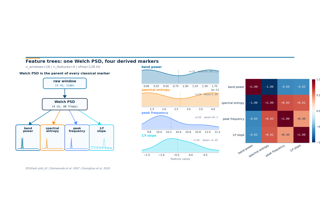
  • How to compose preprocessors and feature definitions as a tree where shared computations (FFT, covariance) execute once.

  • How to feed the feature table into sklearn.pipeline.Pipeline or LightGBM and run a stratified cross-validation.

  • How to compare a feature baseline against a deep model on the same split (the Evaluation track builds on this).

Run the lessons in order:

  1. plot_40_first_features.py – a feature table from windows.

  2. plot_41_feature_trees.py – preprocessor and dependency trees.

  3. plot_42_features_to_sklearn.py – a scikit-learn / LightGBM baseline from feature tables.

How do I turn EEG windows into a band-power feature matrix?

How do I turn EEG windows into a band-power feature matrix?

How do classical EEG markers compose on top of one Welch PSD?

How do classical EEG markers compose on top of one Welch PSD?

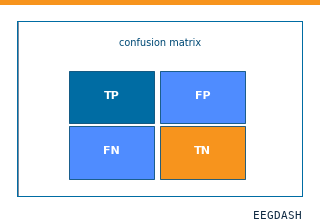
How do I push EEGDash features through a scikit-learn Pipeline?

How do I push EEGDash features through a scikit-learn Pipeline?