


EEG/EMG Foundation Challenge 2026#
Runnable EEGDash workflows using recorded task-specific signals and observed labels. Each page explains acquisition, preprocessing, targets, splits, fitting and evaluation. First execution downloads the explicit subset named there; cropping a recording does not reduce its download size.
Read both the competition tracks and the NeuralBench starter kit. The competition site defines the tasks; NeuralBench documents the executable public baselines. Checked on September 10, 2026: exclusive competition releases are scheduled for September 21. Public warm-up scores do not reproduce the hidden competition leaderboard.
Run the tutorials:
tutorial_track_1_eeg_to_image.py– retrieve held-out THINGS images from recorded EEG, keeping image identities separate during model selection.tutorial_track_2_bci.py– classify real motor-imagery trials across sessions. This small binary warm-up introduces the split boundary; the competition has three commands in Graz / BrainHero data.tutorial_track_3_sleep_onset.py– predict capped seconds remaining to first N2 from five-second Sleep-EDF windows, with held-out participants and binned MAE. The competition uses Muse recordings from unseen sleepers; transferring clinical PSG to a wearable also changes hardware and channels.tutorial_track_4_emg_to_pose.py– regress 20 observed joint-angle trajectories from 16-channel EMG2Pose wrist signals. Preserve published splits, exclude invalid inverse-kinematics intervals and report angular MAE.
Track 4 is hand-pose regression. The former typing tutorial used a different dataset, target and metric and has been replaced. Follow each NeuralBench track guide for the full model, cohort, evaluation and submission workflow.
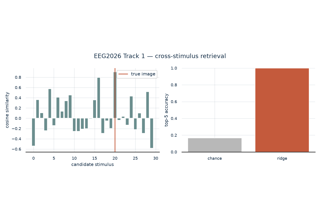
Track 1: retrieve actual viewed images from recorded EEG
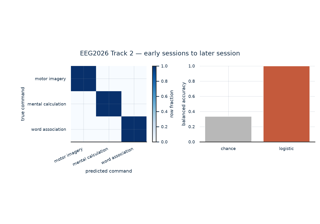
Track 2: a public motor-imagery warm-up for session transfer
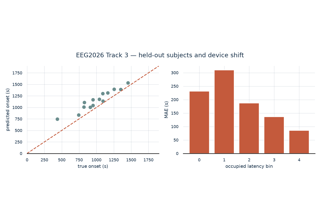
Track 3: predict time remaining until the first N2 epoch
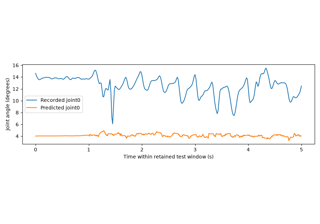
Track 4: predict real hand-joint trajectories from wrist EMG