


Note
Go to the end to download the full example code or to run this example in your browser via Binder.
Track 4: predict real hand-joint trajectories from wrist EMG#
Load three EMG2Pose recordings through EEGDash and regress 20 joint-angle trajectories from 16-channel wrist EMG. The public dataset is NM000281. The recordings retain their published train, validation and test assignments; the test recording belongs to the held-out user-and-stage scenario.
This small linear baseline teaches the real pose target and evaluation path. It does not reproduce the full VEMG2Pose baseline or hidden 2026 evaluation.
Sources: https://neural-interfaces26.github.io/tracks.html https://facebookresearch.github.io/neuroai/neuralbench/auto_examples/biosignal_challenge_2026/plot_track4_emg_to_pose.html
Before you start#
Install EEGDash, MNE, NumPy, SciPy, pandas, pooch, scikit-learn and Matplotlib.
The three selected BDF files require about 24 MB, cached in
EEGDASH_CACHE_DIR. The full public release is hundreds of gigabytes;
selecting exact recordings prevents an accidental full download.
Track 4 predicts continuous hand pose, not typing. Its 20 targets are joint angles obtained from motion capture and inverse kinematics. They are stored as MISC channels in radians alongside the 16 EMG channels at 2000 Hz. Mean absolute angular error is reported in degrees, averaging over joints and time. This is neither a character error rate nor a fingertip distance.
import matplotlib.pyplot as plt
import mne
import numpy as np
import pandas as pd
import pooch
from scipy.signal import lfilter
from sklearn.dummy import DummyRegressor
from sklearn.linear_model import Ridge
from sklearn.metrics import mean_absolute_error
from sklearn.pipeline import make_pipeline
from sklearn.preprocessing import StandardScaler

from eegdash.paths import get_default_cache_dir

from eegdash import EEGDash, EEGDashDataset
Read the published recording assignments#
These right-wrist recordings come from three different users. Training uses a free-style movement, validation a thumb movement, and testing a held-out movement stage. The pinned BIDS scans tables contain the original source-file identity, stage, split and generalization fields. Older dataset releases omit the last two fields, so we explicitly retrieve the version containing them. No split is inferred from recording order or generated from windows.
The selected test scenario is user_stage; the paper also evaluates held-out
users and held-out stages separately. One recording per split cannot estimate
population performance or reproduce those full benchmark comparisons.
cache = get_default_cache_dir()
revision = "90cb29b450de36bb275b226cbc47918f6cbc3b09"
source = f"https://raw.githubusercontent.com/nemarDatasets/nm000281/{revision}"
selections = [
    ("train", "06", "01", "23"),
    ("val", "45", "01", "15"),
    ("test", "02", "02", "31"),
]
scans_hashes = {
    "06": "034c6c2e47db211d417ecb3f9ec1cd7e6e9b576e5f2e9114a3f8529f384f5210",
    "45": "51dc75aaa654868e3377085d88d82bb5a6051e6dc159117bfca6fd710bf9e607",
    "02": "d5dd75bb248ee5c7124e6d55d72c01bad6137797d5a3782814690828b74c70a0",
}
arrays, users, stages = {}, {}, {}
api = EEGDash()
Load aligned EMG and pose, excluding failed tracking#
BIDS channel types keep the measured EMG separate from the pose labels. The source already high-pass filtered EMG at 40 Hz and rescaled its noise floor; its channel sidecar declares volts, but these are processed amplitudes, not untouched amplifier voltages. Pose targets were low-pass filtered at 15 Hz and interpolated upstream to the EMG sampling grid. No extra EEG reference, artifact-subspace reconstruction or target filtering is appropriate here.
BDF files contain integer-second padding. Crop to the recorded duration from
scans.tsv, then cut non-overlapping five-second windows. MNE rejects windows
intersecting BAD_IK (inverse-kinematics failure) or other BAD annotations.
Reject a complete window when any target is nonfinite as an additional guard;
interpolating failed targets would create unobserved supervision.
A causal 100 ms RMS envelope summarizes each EMG channel. SciPy’s lfilter
computes the moving mean of squared samples, using only the current and past
signal, before taking its square root. It starts with zero filter state at
the recording boundary. Envelopes are computed continuously before windowing
so later windows retain their preceding EMG context. Joint trajectories remain
at 2 kHz; no temporal average replaces the dense pose target. Only the local
envelope is causal; source preprocessing is not claimed causal. Dense samples
are temporally correlated, and these arrays need hundreds of MB of RAM.
for split, subject, session, run in selections:
    filename = (
        f"sub-{subject}_ses-{session}_task-emg2pose_run-{run}_recording-right_emg.bdf"
    )
    relative = f"sub-{subject}/ses-{session}/emg/{filename}"
    scans_name = f"sub-{subject}_ses-{session}_scans.tsv"
    scans_path = pooch.retrieve(
        f"{source}/sub-{subject}/ses-{session}/{scans_name}",
        known_hash=scans_hashes[subject],
        path=cache / "emg2pose-splits" / revision,
        fname=scans_name,
    )
    scans = pd.read_csv(scans_path, sep="\t").set_index("filename")
    assignment = scans.loc[f"emg/{filename}"]
    records = api.find(dataset="nm000281", subject=subject, session=session, run=run)
    records = [record for record in records if record["bids_relpath"] == relative]
    users[split] = records[0]["participant_tsv"]["original_user"]
    stages[split] = assignment["stage"]
    dataset = EEGDashDataset(records=records, cache_dir=cache)
    raw = dataset.datasets[0].raw
    stop = int(round(float(assignment["duration"]) * raw.info["sfreq"]))
    raw.crop(tmax=(stop - 1) / raw.info["sfreq"])
    signal = raw.get_data(picks="emg")
    envelope = np.sqrt(lfilter(np.ones(200) / 200, [1.0], signal**2, axis=-1))
    epochs = mne.make_fixed_length_epochs(
        raw, duration=5.0, preload=True, reject_by_annotation=True
    )
    targets = epochs.get_data(picks="misc").transpose(0, 2, 1)
    inputs = np.stack(
        [envelope[:, start : start + 10000].T for start in epochs.events[:, 0]]
    )
    finite = np.isfinite(targets).all(axis=(1, 2)) & np.isfinite(inputs).all(
        axis=(1, 2)
    )
    inputs, targets = inputs[finite], targets[finite]
    arrays[split] = (inputs, targets)
    print(split, users[split], stages[split], assignment["generalization"])
    print("EMG envelope / pose shapes:", inputs.shape, targets.shape)
[10/24/26 14:14:28] INFO     HTTP Request: GET                   _client.py:1025
                             https://data.nemar.org/nm000281/
                             "HTTP/1.1 200 OK"
[10/24/26 14:14:30] INFO     HTTP Request: GET                   _client.py:1025
                             https://data.nemar.org/nm000281/v1.
                             0.3/manifest.json "HTTP/1.1 413
                             Payload Too Large"
                    WARNING  Could not fetch NEMAR manifest for      base.py:289
                             nm000281: Error when retrieving NEMAR
                             manifest for nm000281 v1.0.3: HTTP 413
                             This version has more than 38000 files,
                             which is more than manifest.json can
                             list in one response. Enumerate it one
                             directory at a time instead:
                             https://data.nemar.org/data/nm000281/v1
                             .0.3/?format=json lists the top level,
                             and each directory's URL with
                             ?format=json lists that directory's own
                             files and subdirectories.

Downloading sub-06_ses-01_task-emg2pose_run-23_recording-right_emg.bdf:   0%|          | 0.00/9.07M [00:00<?, ?B/s]
Downloading sub-06_ses-01_task-emg2pose_run-23_recording-right_emg.bdf:   0%|          | 0.00/9.07M [00:00<?, ?B/s]
Downloading sub-06_ses-01_task-emg2pose_run-23_recording-right_emg.bdf:  11%|█         | 1.00M/9.07M [00:00<00:04, 1.81MB/s]
Downloading sub-06_ses-01_task-emg2pose_run-23_recording-right_emg.bdf:  99%|█████████▉| 9.00M/9.07M [00:00<00:00, 12.4MB/s]
Downloading sub-06_ses-01_task-emg2pose_run-23_recording-right_emg.bdf: 100%|██████████| 9.07M/9.07M [00:00<00:00, 11.7MB/s]
[10/24/26 14:14:33] WARNING  Could not fetch the electrode sidecars base.py:1288
                             of
                             sub-06/ses-01/emg/sub-06_ses-01_task-e
                             mg2pose_run-23_recording-right_emg.bdf
                             : GitHub truncated the file tree of
                             nm000281
Not setting metadata
8 matching events found
No baseline correction applied
0 projection items activated
Loading data for 8 events and 10000 original time points ...
2 bad epochs dropped
train 055bb1b487 OneHandedFreeStyle none
EMG envelope / pose shapes: (6, 10000, 16) (6, 10000, 20)

Downloading sub-45_ses-01_task-emg2pose_run-15_recording-right_emg.bdf:   0%|          | 0.00/6.81M [00:00<?, ?B/s]
Downloading sub-45_ses-01_task-emg2pose_run-15_recording-right_emg.bdf:   0%|          | 0.00/6.81M [00:00<?, ?B/s]
Downloading sub-45_ses-01_task-emg2pose_run-15_recording-right_emg.bdf:  15%|█▍        | 1.00M/6.81M [00:00<00:03, 1.82MB/s]
Downloading sub-45_ses-01_task-emg2pose_run-15_recording-right_emg.bdf: 100%|██████████| 6.81M/6.81M [00:00<00:00, 9.56MB/s]
[10/24/26 14:14:36] WARNING  Could not fetch the electrode sidecars base.py:1288
                             of
                             sub-45/ses-01/emg/sub-45_ses-01_task-e
                             mg2pose_run-15_recording-right_emg.bdf
                             : GitHub truncated the file tree of
                             nm000281
Not setting metadata
6 matching events found
No baseline correction applied
0 projection items activated
Loading data for 6 events and 10000 original time points ...
5 bad epochs dropped
val 29ddab35d7 ThumbsSwipesWholeHand user
EMG envelope / pose shapes: (1, 10000, 16) (1, 10000, 20)

Downloading sub-02_ses-02_task-emg2pose_run-31_recording-right_emg.bdf:   0%|          | 0.00/6.60M [00:00<?, ?B/s]
Downloading sub-02_ses-02_task-emg2pose_run-31_recording-right_emg.bdf:   0%|          | 0.00/6.60M [00:00<?, ?B/s]
Downloading sub-02_ses-02_task-emg2pose_run-31_recording-right_emg.bdf:  15%|█▌        | 1.00M/6.60M [00:00<00:03, 1.85MB/s]
Downloading sub-02_ses-02_task-emg2pose_run-31_recording-right_emg.bdf: 100%|██████████| 6.60M/6.60M [00:00<00:00, 9.43MB/s]
[10/24/26 14:14:38] WARNING  Could not fetch the electrode sidecars base.py:1288
                             of
                             sub-02/ses-02/emg/sub-02_ses-02_task-e
                             mg2pose_run-31_recording-right_emg.bdf
                             : GitHub truncated the file tree of
                             nm000281
Not setting metadata
6 matching events found
No baseline correction applied
0 projection items activated
Loading data for 6 events and 10000 original time points ...
2 bad epochs dropped
test 0219627c14 HandOverHandCountingUpDownFingerWigglingSpreading user_stage
EMG envelope / pose shapes: (4, 10000, 16) (4, 10000, 20)
Fit a dense regression baseline using training data only#
Each time point supplies 16 envelope features and 20 simultaneous angle targets. Flattening window and time axes allows Ridge to fit all targets with a shared regularization strength. Adjacent time samples remain strongly correlated: they are not independent participants or independent trials. StandardScaler is fitted on training EMG only. Angle units stay in radians.
Choose the penalty from three values using the actual validation recording. The held-out test trajectory is evaluated once after selection. A training-mean pose provides a useful constant baseline: a complicated decoder should improve on predicting the same hand configuration at every time point.
X_train, y_train = arrays["train"]
X_valid, y_valid = arrays["val"]
X_test, y_test = arrays["test"]
models, validation_errors = [], []
for alpha in (0.1, 10.0, 1000.0):
    model = make_pipeline(StandardScaler(), Ridge(alpha=alpha))
    model.fit(X_train.reshape(-1, 16), y_train.reshape(-1, 20))
    prediction = model.predict(X_valid.reshape(-1, 16))
    validation_errors.append(mean_absolute_error(y_valid.reshape(-1, 20), prediction))
    models.append(model)
best = int(np.argmin(validation_errors))
prediction = models[best].predict(X_test.reshape(-1, 16)).reshape(y_test.shape)
dummy = DummyRegressor(strategy="mean").fit(
    X_train.reshape(-1, 16), y_train.reshape(-1, 20)
)
dummy_prediction = dummy.predict(X_test.reshape(-1, 16))
mae_degrees = np.rad2deg(
    mean_absolute_error(y_test.reshape(-1, 20), prediction.reshape(-1, 20))
)
dummy_degrees = np.rad2deg(
    mean_absolute_error(y_test.reshape(-1, 20), dummy_prediction)
)
print("Validation MAE (degrees):", np.rad2deg(validation_errors))
print("Selected alpha:", (0.1, 10.0, 1000.0)[best])
print("Test angular MAE (degrees), ridge / constant:", mae_degrees, dummy_degrees)
Validation MAE (degrees): [28902084.92495301 28901922.17749346 28886449.45649816]
Selected alpha: 1000.0
Test angular MAE (degrees), ridge / constant: 25558196.6107441 24890163.171511512
Inspect an actual trajectory and understand the scope#
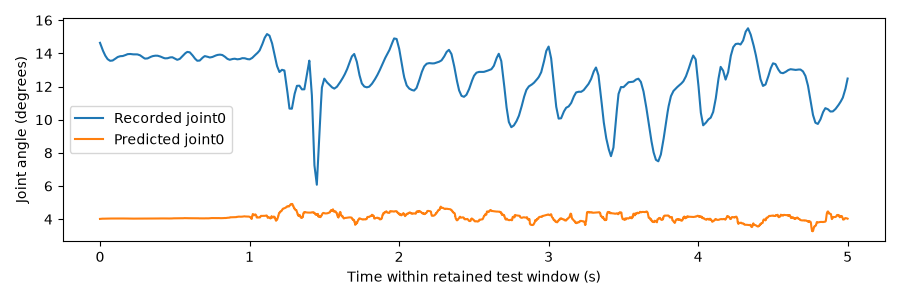
Plot joint0 from the first retained test window. The reported MAE above uses all 20 joints and all retained test windows, not just this illustrated joint. Predictions need not satisfy joint limits or produce anatomically consistent hand poses; forward kinematics and a temporal pose model are useful extensions.
This small baseline preserves actual pose labels, five-second dense outputs and the paper’s split assignments. Its linear envelope decoder, three users, single validation recording and partial movement coverage differ substantially from VEMG2Pose and the complete challenge protocol. Do not compare this score directly with the competition leaderboard or treat many time samples as evidence of broad user generalization. Expand recordings within each predefined split before comparing models, keeping test users and stages reserved throughout.
For the full public NeuralBench baseline, follow the linked official guide:
neuralbench emg pose -m vemg2pose --download, then --prepare, then
--debug, and finally the same command without an action flag. The full
release requires substantially more disk and compute than this tutorial.
time = np.arange(10000) / 2000
fig, ax = plt.subplots(figsize=(9, 3))
ax.plot(time, np.rad2deg(y_test[0, :, 0]), label="Recorded joint0")
ax.plot(time, np.rad2deg(prediction[0, :, 0]), label="Predicted joint0")
ax.set(xlabel="Time within retained test window (s)", ylabel="Joint angle (degrees)")
ax.legend()
fig.tight_layout()
plt.show()
Total running time of the script: (0 minutes 11.049 seconds)
