


Note
Go to the end to download the full example code or to run this example in your browser via Binder.
How do I fine-tune a published EEG foundation model (REVE)?#
Difficulty 3 | Runtime: ~2m (CPU) | Compute: CPU (GPU Optional)
Adapt the published REVE-Base checkpoint to a motor-imagery-vs-rest task from
OpenNeuro dataset ds003810, served through EEGDash and trained with
Braindecode’s EEGClassifier. The checkpoint is
https://huggingface.co/brain-bzh/reve-base (documented by Braindecode’s REVE
model). It is gated: accepting the authors’ terms once and logging in to the
Hugging Face Hub is part of this tutorial. It downloads about 280 MB of weights
and 7 MB of EEG (one participant, four runs).
Two ways to adapt a pretrained encoder are shown with the same code path: a linear probe (encoder frozen, only the classification head trains – runs on a laptop CPU) and full fine-tuning (everything trains at a lower learning rate – enabled automatically on a GPU). Runs 1 and 2 train, run 3 chooses when to stop, and run 4 is scored exactly once. The small budget demonstrates adaptation, not a foundation-model benchmark.
Keywords: foundation-model, fine-tuning, linear-probe, REVE, motor-imagery, transfer-learning
Before you start#
REVE (Representation for EEG with Versatile Embeddings) is a transformer pretrained with a masked-autoencoder objective on about 60,000 hours of EEG from 92 datasets. Its distinctive part is a 4-D positional encoding: every electrode is described by its 3-D position on a template head plus time, so one model accepts any montage. A 15-channel low-cost headset recording goes straight into a model pretrained mostly on 19- to 128-channel data, with no common-channel subset to pick.
The weights are published under a gated license (the electrode position table,
brain-bzh/reve-positions, is public). One-time setup:
Open https://huggingface.co/brain-bzh/reve-base and accept the terms.
Log in once from a terminal:
hf auth login(or setHF_TOKEN).
The check below turns a missing login into a readable message instead of an HTTP traceback further down. Without network it simply continues and relies on the local cache.
import logging
import os
from pathlib import Path

import matplotlib.pyplot as plt
import mne
import numpy as np
import torch
from huggingface_hub import auth_check
from huggingface_hub.errors import HfHubHTTPError
from skorch.callbacks import EarlyStopping
from skorch.helper import predefined_split
from sklearn.metrics import balanced_accuracy_score

from braindecode import EEGClassifier
from braindecode.datasets import BaseConcatDataset
from braindecode.models import REVE
from braindecode.preprocessing import (
    Preprocessor,
    create_windows_from_events,
    preprocess,
)
from eegdash import EEGDashDataset

MODEL_ID = "brain-bzh/reve-base"
MODEL_REVISION = "fa9a2163a4b7c0a42c8e28b56077ef9c368944dc"  # checkpoint commit the numbers below were measured with
DATASET, SUBJECT, RUNS = "ds003810", "02", ["1", "2", "3", "4"]
SFREQ = 200  # REVE was pretrained at 200 Hz; it does not check, so we must
WINDOW_S = 4  # cue -> end of trial in this paradigm
CACHE_DIR = Path(os.environ.get("EEGDASH_CACHE_DIR", "~/.eegdash_cache")).expanduser()
DEVICE = os.environ.get("REVE_TUTORIAL_DEVICE") or (
    "cuda"
    if torch.cuda.is_available()
    else "mps"
    if torch.backends.mps.is_available()
    else "cpu"
)
# Full fine-tuning updates all 69M parameters; on CPU that is minutes per epoch,
# so it runs only on an accelerator. Force it with REVE_TUTORIAL_FINETUNE=1.
RUN_FINETUNE = DEVICE != "cpu" or os.environ.get("REVE_TUTORIAL_FINETUNE") == "1"
FT_EPOCHS = int(os.environ.get("REVE_TUTORIAL_FT_EPOCHS", 5))
torch.manual_seed(0)
print(
    f"device: {DEVICE} | full fine-tuning: {'on' if RUN_FINETUNE else 'off (linear probe only)'}"
)

# Keep the output readable: the libraries are chatty at INFO level.
mne.set_log_level("WARNING")  # filter-design reports, "legacy function" notes
for name in ("httpx", "huggingface_hub", "eegdash", "braindecode"):
    logging.getLogger(name).setLevel(logging.WARNING)
try:
    auth_check(MODEL_ID)
    print("Hugging Face access to", MODEL_ID, "OK")
except HfHubHTTPError as err:  # gated repo without an accepted license / token
    print(
        f"\nCannot access {MODEL_ID} ({err.__class__.__name__}). The REVE weights are gated:\n"
        f"  1) open https://huggingface.co/{MODEL_ID} and accept the terms\n"
        f"  2) run `hf auth login` (or export HF_TOKEN=...) and re-run this example.\n"
    )
    # A plain Exception, never SystemExit: sphinx-gallery reports it on this page
    # and carries on with the rest of the docs build.
    raise RuntimeError(
        f"no access to the gated {MODEL_ID}; see the steps above"
    ) from None
except Exception as err:  # no network: fine if the weights are already cached
    print(
        f"Could not reach the Hub ({err.__class__.__name__}); continuing with the local cache."
    )
device: cpu | full fine-tuning: off (linear probe only)
Hugging Face access to brain-bzh/reve-base OK
Match the real signal to the encoder input#
Load one participant’s motor-imagery runs from EEGDash and bring them to the format REVE was pretrained on.
ds003810 (“Motor Imagery vs Rest – Low-Cost EEG System”) has ten
participants, 15 electrodes at 125 Hz and five runs each. Run 0 is a warm-up
in which the participant really squeezes their hand – with the same event
codes as the imagery runs – so loading it would train on executed movement
labelled as imagery. We load runs 1-4 only.
The recording software (OpenViBE) wrote its own cue codes: OVTK_GDF_Right
is the imagery cue and OVTK_GDF_Tongue the rest cue (the dataset’s
events.json documents this). Each cue is an instantaneous marker and the
trial runs 4 s from cue to feedback, so one 4 s window per cue fits exactly.
REVE’s input contract – none of it enforced at runtime: 200 Hz, EEG channels only, and per-channel z-scored input clipped at 15 standard deviations.
ds = EEGDashDataset(cache_dir=CACHE_DIR, dataset=DATASET, subject=SUBJECT, run=RUNS)
print(ds.description[["subject", "run", "task"]].to_string(index=False))


def zscore_clip(x, clip=15.0):
    """Per-channel z-score over time, clipped at ``clip`` SD (REVE's pretraining normalisation).

    ``x`` is the whole (channels, times) array -- braindecode's ``apply_on_array`` is not
    channel-wise by default -- so reduce over the time axis explicitly.
    """
    x = (x - x.mean(axis=-1, keepdims=True)) / (x.std(axis=-1, keepdims=True) + 1e-8)
    return np.clip(x, -clip, clip)


preprocess(
    ds,
    [
        Preprocessor("pick", picks="eeg", apply_on_array=False),
        Preprocessor("filter", l_freq=0.5, h_freq=45.0, apply_on_array=False),
        Preprocessor("resample", sfreq=SFREQ, apply_on_array=False),
        Preprocessor(zscore_clip, apply_on_array=True),
    ],
)
chs_info = ds.datasets[0].raw.info["chs"]
print(len(chs_info), "EEG channels:", [c["ch_name"] for c in chs_info])

# The cue markers have zero duration, so the trial would be empty with the
# default stop offset; extend each trial to exactly one window from the cue.
windows = create_windows_from_events(
    ds,
    mapping={"OVTK_GDF_Right": 0, "OVTK_GDF_Tongue": 1},  # 0 = motor imagery, 1 = rest
    trial_start_offset_samples=0,
    trial_stop_offset_samples=WINDOW_S * SFREQ,
    window_size_samples=WINDOW_S * SFREQ,
    window_stride_samples=WINDOW_S * SFREQ,
    preload=True,
)
print(
    len(windows),
    "windows of",
    WINDOW_S * SFREQ,
    "samples;",
    "labels per run:",
    windows.get_metadata().groupby("run")["target"].value_counts().unstack().to_dict(),
)
subject run     task
     02   1 MIvsRest
     02   2 MIvsRest
     02   3 MIvsRest
     02   4 MIvsRest

Downloading sub-02_task-MIvsRest_run-1_eeg.edf:   0%|          | 0.00/1.65M [00:00<?, ?B/s]
Downloading sub-02_task-MIvsRest_run-1_eeg.edf:   0%|          | 0.00/1.65M [00:00<?, ?B/s]
Downloading sub-02_task-MIvsRest_run-1_eeg.edf:  61%|██████    | 1.00M/1.65M [00:00<00:00, 1.57MB/s]
Downloading sub-02_task-MIvsRest_run-1_eeg.edf: 100%|██████████| 1.65M/1.65M [00:00<00:00, 2.36MB/s]

Downloading sub-02_task-MIvsRest_run-1_channels.tsv:   0%|          | 0.00/242 [00:00<?, ?B/s]
Downloading sub-02_task-MIvsRest_run-1_channels.tsv:   0%|          | 0.00/242 [00:00<?, ?B/s]
Downloading sub-02_task-MIvsRest_run-1_channels.tsv: 100%|██████████| 242/242 [00:00<00:00, 2.45kB/s]

Downloading sub-02_task-MIvsRest_run-1_eeg.json:   0%|          | 0.00/382 [00:00<?, ?B/s]
Downloading sub-02_task-MIvsRest_run-1_eeg.json:   0%|          | 0.00/382 [00:00<?, ?B/s]
Downloading sub-02_task-MIvsRest_run-1_eeg.json: 100%|██████████| 382/382 [00:00<00:00, 2.66kB/s]

Downloading sub-02_task-MIvsRest_run-2_eeg.edf:   0%|          | 0.00/1.62M [00:00<?, ?B/s]
Downloading sub-02_task-MIvsRest_run-2_eeg.edf:   0%|          | 0.00/1.62M [00:00<?, ?B/s]
Downloading sub-02_task-MIvsRest_run-2_eeg.edf:  62%|██████▏   | 1.00M/1.62M [00:00<00:00, 1.76MB/s]
Downloading sub-02_task-MIvsRest_run-2_eeg.edf: 100%|██████████| 1.62M/1.62M [00:00<00:00, 2.34MB/s]

Downloading sub-02_task-MIvsRest_run-2_channels.tsv:   0%|          | 0.00/242 [00:00<?, ?B/s]
Downloading sub-02_task-MIvsRest_run-2_channels.tsv:   0%|          | 0.00/242 [00:00<?, ?B/s]
Downloading sub-02_task-MIvsRest_run-2_channels.tsv: 100%|██████████| 242/242 [00:00<00:00, 1.97kB/s]

Downloading sub-02_task-MIvsRest_run-2_eeg.json:   0%|          | 0.00/382 [00:00<?, ?B/s]
Downloading sub-02_task-MIvsRest_run-2_eeg.json:   0%|          | 0.00/382 [00:00<?, ?B/s]
Downloading sub-02_task-MIvsRest_run-2_eeg.json: 100%|██████████| 382/382 [00:00<00:00, 3.67kB/s]

Downloading sub-02_task-MIvsRest_run-3_eeg.edf:   0%|          | 0.00/1.25M [00:00<?, ?B/s]
Downloading sub-02_task-MIvsRest_run-3_eeg.edf:   0%|          | 0.00/1.25M [00:00<?, ?B/s]
Downloading sub-02_task-MIvsRest_run-3_eeg.edf:  80%|███████▉  | 1.00M/1.25M [00:00<00:00, 1.63MB/s]
Downloading sub-02_task-MIvsRest_run-3_eeg.edf: 100%|██████████| 1.25M/1.25M [00:00<00:00, 1.85MB/s]

Downloading sub-02_task-MIvsRest_run-3_channels.tsv:   0%|          | 0.00/242 [00:00<?, ?B/s]
Downloading sub-02_task-MIvsRest_run-3_channels.tsv:   0%|          | 0.00/242 [00:00<?, ?B/s]
Downloading sub-02_task-MIvsRest_run-3_channels.tsv: 100%|██████████| 242/242 [00:00<00:00, 2.03kB/s]

Downloading sub-02_task-MIvsRest_run-3_eeg.json:   0%|          | 0.00/382 [00:00<?, ?B/s]
Downloading sub-02_task-MIvsRest_run-3_eeg.json:   0%|          | 0.00/382 [00:00<?, ?B/s]
Downloading sub-02_task-MIvsRest_run-3_eeg.json: 100%|██████████| 382/382 [00:00<00:00, 3.61kB/s]

Downloading sub-02_task-MIvsRest_run-4_eeg.edf:   0%|          | 0.00/1.59M [00:00<?, ?B/s]
Downloading sub-02_task-MIvsRest_run-4_eeg.edf:   0%|          | 0.00/1.59M [00:00<?, ?B/s]
Downloading sub-02_task-MIvsRest_run-4_eeg.edf:  63%|██████▎   | 1.00M/1.59M [00:00<00:00, 1.38MB/s]
Downloading sub-02_task-MIvsRest_run-4_eeg.edf: 100%|██████████| 1.59M/1.59M [00:00<00:00, 2.02MB/s]

Downloading sub-02_task-MIvsRest_run-4_channels.tsv:   0%|          | 0.00/242 [00:00<?, ?B/s]
Downloading sub-02_task-MIvsRest_run-4_channels.tsv:   0%|          | 0.00/242 [00:00<?, ?B/s]
Downloading sub-02_task-MIvsRest_run-4_channels.tsv: 100%|██████████| 242/242 [00:00<00:00, 2.05kB/s]

Downloading sub-02_task-MIvsRest_run-4_eeg.json:   0%|          | 0.00/382 [00:00<?, ?B/s]
Downloading sub-02_task-MIvsRest_run-4_eeg.json:   0%|          | 0.00/382 [00:00<?, ?B/s]
Downloading sub-02_task-MIvsRest_run-4_eeg.json: 100%|██████████| 382/382 [00:00<00:00, 3.85kB/s]
15 EEG channels: ['Pz', 'Cz', 'T6', 'T4', 'F8', 'P4', 'C4', 'F4', 'Fz', 'T5', 'T3', 'F7', 'P3', 'C3', 'F3']
150 windows of 800 samples; labels per run: {0: {'1': 20, '2': 20, '3': 15, '4': 20}, 1: {'1': 20, '2': 20, '3': 15, '4': 20}}
Reserve runs, not windows#
Windows from the same run share slow drifts, electrode impedance and the participant’s state, so a random window-level split leaks. Split by run: runs 1-2 train, run 3 decides when to stop training, run 4 is scored once at the end and never looked at before that.
This is a within-subject design, chosen so the page runs on a CPU in a minute. To claim the model works on new people you need to hold out whole participants – and one held-out participant is a single draw from a wide spread, so the reference number at the end is a leave-one-subject-out mean over all ten participants, computed with the same recipe on a GPU.
train 80 windows | valid 30 | test 40
Load the checkpoint and understand the head#
REVE.from_pretrained reads the checkpoint’s config.json to build
Braindecode’s REVE module at the right depth and width, loads the weights,
and swaps the pretraining head for a fresh classification head with
n_outputs classes. Electrode positions are resolved from channel names
against the published position table (543 standard names -> x, y, z). That
lookup is exact and case-sensitive and unknown names are dropped silently, so
check that every channel resolved before training.
model = REVE.from_pretrained(
    MODEL_ID,
    revision=MODEL_REVISION,
    n_outputs=2,
    n_chans=len(chs_info),
    n_times=WINDOW_S * SFREQ,
    sfreq=SFREQ,
    chs_info=chs_info,
)
missing = [
    c["ch_name"] for c in chs_info if c["ch_name"] not in model._position_bank.mapping
]
assert not missing, f"channels missing from REVE's position bank: {missing}"
n_total = sum(p.numel() for p in model.parameters())
print(
    f"REVE-Base: {n_total / 1e6:.1f}M parameters | positions resolved: {tuple(model.default_pos.shape)}"
)
# The head flattens every token: 15 channels x 4 patches (200-sample patches with
# 20 overlap across 800 samples) x 512 dims = 30,720 features -> 2 classes.
print("head:", model.final_layer)
REVE-Base: 69.3M parameters | positions resolved: (15, 3)
head: Sequential(
  (0): Flatten(start_dim=1, end_dim=-1)
  (1): LayerNorm((30720,), eps=1e-05, elementwise_affine=True, bias=True)
  (2): Linear(in_features=30720, out_features=2, bias=True)
)
Two ways to adapt the encoder#
Linear probe: freeze the encoder and train only final_layer. Cheap,
stable with little data, and a fair test of what the pretrained features
already contain.
Full fine-tuning: unfreeze everything and continue from the probed model at a lower learning rate. More capacity, more data needed, and it overfits fast on a few hundred windows – which is why both use early stopping on run 3.
Both share one EEGClassifier recipe. A note on the learning rate: REVE’s
paper probes at 1e-3, but with this 30,720-wide head Adam saturates at 1e-3
and predicts one class for the first epochs – it looks like a broken model.
1e-4 behaves from epoch 1.
def set_trainable(model, head_only):
    # Freezing only touches gradients. That is enough for REVE: it has no dropout or
    # batch-norm, so the frozen encoder returns the same features in train and eval mode.
    for name, p in model.named_parameters():
        p.requires_grad = (not head_only) or name.startswith("final_layer")
    n_train = sum(p.numel() for p in model.parameters() if p.requires_grad)
    print(
        f"trainable parameters: {n_train:,} of {n_total:,} ({'head only' if head_only else 'all'})"
    )


def make_classifier(model, lr, patience=5):
    stop = EarlyStopping(
        monitor="valid_balanced_accuracy",
        lower_is_better=False,
        patience=patience,
        load_best=True,
    )
    return EEGClassifier(
        model,
        criterion=torch.nn.CrossEntropyLoss,
        optimizer=torch.optim.AdamW,
        optimizer__lr=lr,
        optimizer__weight_decay=1e-2,
        train_split=predefined_split(valid_set),  # run 3 is scored after every epoch
        batch_size=32,
        callbacks=["balanced_accuracy", stop],
        classes=[0, 1],
        device=DEVICE,
        iterator_train__shuffle=True,
    )


def score_on_test(clf):
    y_true = test_set.get_metadata()["target"].to_numpy()
    return balanced_accuracy_score(y_true, clf.predict(test_set))


def valid_curve(clf):
    return clf.history[:, "valid_balanced_accuracy"]
Linear probe#
Skorch prints one line per epoch: training loss, validation balanced accuracy on run 3, and timing. Early stopping ends the run five epochs after the last improvement and restores the best epoch’s weights.
results, curves = {}, {}
set_trainable(model, head_only=True)
probe = make_classifier(model, lr=1e-4)
probe.fit(train_set, y=None, epochs=30)
results["linear probe"] = score_on_test(probe)
curves["linear probe"] = valid_curve(probe)
print(
    f"\nlinear probe: test balanced accuracy on run 4 = {results['linear probe']:.3f}"
)
trainable parameters: 122,882 of 69,312,002 (head only)
  epoch    train_balanced_accuracy    train_loss    valid_acc    valid_balanced_accuracy    valid_loss     dur
-------  -------------------------  ------------  -----------  -------------------------  ------------  ------
      1                     0.5000        0.8583       0.5000                     0.5000        0.7022  5.5964
      2                     0.5000        0.7579       0.5000                     0.5000        0.6894  5.6761
      3                     0.7125        0.6457       0.5333                     0.5333        0.6699  5.6322
      4                     0.5000        0.6355       0.5000                     0.5000        0.7449  5.5830
      5                     0.9000        0.6186       0.5667                     0.5667        0.6500  5.6160
      6                     0.9000        0.4679       0.6000                     0.6000        0.6398  5.6161
      7                     0.8750        0.4599       0.5333                     0.5333        0.6465  5.6147
      8                     0.9625        0.4260       0.6667                     0.6667        0.6279  5.5861
      9                     1.0000        0.3794       0.8000                     0.8000        0.6236  5.6167
     10                     0.9750        0.3609       0.6333                     0.6333        0.6303  5.5963
     11                     1.0000        0.3333       0.8000                     0.8000        0.6159  5.5878
     12                     1.0000        0.3042       0.7333                     0.7333        0.6091  5.6036
     13                     1.0000        0.2742       0.6667                     0.6667        0.6080  5.6506
Stopping since valid_balanced_accuracy has not improved in the last 5 epochs.
Restoring best model from epoch 9.

linear probe: test balanced accuracy on run 4 = 0.700
Full fine-tuning (GPU)#
Continue from the probed model with every parameter trainable, for a few epochs at the same learning rate. On CPU this cell only reports what it would do; on a GPU it runs (about 1.5 s per epoch on a V100 for this participant).
if RUN_FINETUNE:
    model = probe.module_
    set_trainable(model, head_only=False)
    finetune = make_classifier(model, lr=1e-4, patience=2)
    finetune.fit(train_set, y=None, epochs=FT_EPOCHS)
    results["fine-tune"] = score_on_test(finetune)
    curves["fine-tune"] = valid_curve(finetune)
    print(
        f"\nfull fine-tune: test balanced accuracy on run 4 = {results['fine-tune']:.3f}"
    )
else:
    print(
        "Skipped on CPU. Same recipe with set_trainable(model, head_only=False), lr 1e-4,",
        f"{FT_EPOCHS} epochs, early stopping; set REVE_TUTORIAL_FINETUNE=1 to run it here.",
    )
Skipped on CPU. Same recipe with set_trainable(model, head_only=False), lr 1e-4, 5 epochs, early stopping; set REVE_TUTORIAL_FINETUNE=1 to run it here.
Result#
Left: validation balanced accuracy per epoch, with the epoch whose weights were kept. Right: the number that matters, balanced accuracy on run 4, scored once.
fig, (ax_curve, ax_bar) = plt.subplots(1, 2, figsize=(10, 3.6))
for name, curve in curves.items():
    epochs = np.arange(1, len(curve) + 1)
    ax_curve.plot(epochs, curve, marker="o", ms=3, label=name)
    ax_curve.scatter(
        epochs[np.argmax(curve)],
        max(curve),
        s=90,
        facecolors="none",
        edgecolors="k",
        zorder=3,
    )
ax_curve.axhline(0.5, color="grey", ls=":", lw=1)
ax_curve.set(
    xlabel="epoch",
    ylabel="validation balanced accuracy (run 3)",
    title="early stopping on run 3",
)
ax_curve.legend()
ax_bar.bar(
    list(results), list(results.values()), color=["#4a8", "#c44"][: len(results)]
)
ax_bar.axhline(0.5, color="grey", ls=":", lw=1)
ax_bar.set(
    ylim=(0.4, 1.0),
    ylabel="test balanced accuracy (run 4)",
    title=f"participant {SUBJECT}, 40 test trials",
)
fig.tight_layout()

print("Summary -- balanced accuracy on run 4 (chance = 0.50):")
for name, acc in results.items():
    print(f"  {name:14s} {acc:.3f}")
plt.show()
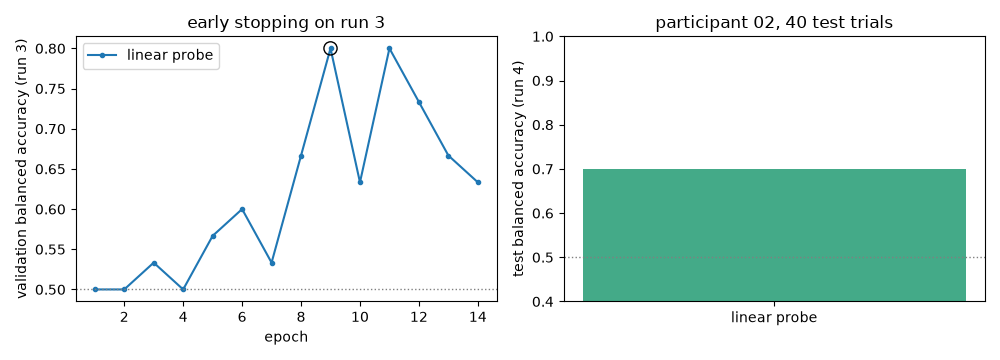
Summary -- balanced accuracy on run 4 (chance = 0.50):
  linear probe   0.700
Read the result and design the next experiment#
This is one participant and 40 test trials. One trial is 2.5 points of balanced accuracy, so the standard error is about 8 points. Differences of that size are noise; report participants, not windows.
Cross-subject is the real question. The same recipe, looped over the ten participants of
ds003810on a GPU node (train on eight, stop on a ninth, test on the tenth, 40 max epochs, patience 5), gives REVE-Base a leave-one-subject-out mean of 0.74 +- 0.08 balanced accuracy (range 0.56-0.84; about 50 s per fold on a V100). A single favourable split had scored 0.825 – one more reason to average over participants.More encoder is not more accuracy. REVE-Large (390M parameters) probed on the same 1,270 training windows scored lower (0.688 on the same split): it memorised them. Early stopping is not optional at this data size.
Full fine-tuning needs thousands of labelled trials to beat the probe reliably; the paper’s benchmark for that is BCI-IV-2a via MOABB (0.64 fine-tuned vs 0.52 probed with REVE-Base).
References#
El Ouahidi et al. (2025). REVE: A Foundation Model for EEG – Adapting to Any Setup with Large-Scale Pretraining on 25,000 Subjects. NeurIPS 2025. https://arxiv.org/abs/2510.21585
Peterson et al. (2021). Motor Imagery vs Rest – Low-Cost EEG System. OpenNeuro ds003810. https://openneuro.org/datasets/ds003810
Total running time of the script: (2 minutes 39.124 seconds)
