How do I survey a clinical EEG dataset before training a model?#

Estimated reading time:8 minutes

A starter project: pull metadata for the OpenNeuro ds004504 clinical EEG release [Miltiadous et al., 2023] through EEGDashDataset, without downloading any signal bytes, and answer four questions a project plan needs answered before any modelling. The pool is served via NEMAR [Delorme et al., 2022]; the polished clinical workflow recipe follows Cisotto and Chicco 2024. The deliverable is one pandas.DataFrame with per-condition counts and one three-panel figure rendered from the live catalog numbers. Cohort imbalance, age confounds, recording-length mismatch, and channel-count drift are the four dataset-level pitfalls that silently break clinical EEG decoders before training even starts, so why not answer them first?


Learning objectives#

  • Run EEGDashDataset on a clinical OpenNeuro release and read its description DataFrame.

  • Aggregate the participants.tsv columns (Group, Age, Gender, MMSE) into per-condition counts.

  • Compute recording-duration and channel-count distributions from ds.records without any signal download.

  • Show the four headline numbers a project plan needs: n_subjects, n_recordings, mean duration, n_channels.

Requirements#

  • About 20 s on CPU on first run; under 5 s once the metadata catalog is cached.

  • Network on first call (~1 MB into cache_dir for the catalog query). No EEG signal bytes are pulled; the catalog row carries every number this script reports.

  • Prerequisites: /auto_examples/tutorials/00_start_here/plot_00_first_search, /auto_examples/tutorials/00_start_here/plot_01_first_recording.

  • Concept: EEGDash objects: EEGDash, EEGDashDataset, EEGChallengeDataset.

Step 0. Setup. np.random.seed keeps any later sampling reproducible; use_eegdash_style aligns matplotlib defaults with the rest of the gallery.

import os
import warnings
from pathlib import Path

import matplotlib.pyplot as plt
import numpy as np
import pandas as pd

import eegdash
from eegdash import EEGDashDataset
from eegdash.viz import use_eegdash_style

use_eegdash_style()
warnings.simplefilter("ignore", category=FutureWarning)
np.random.seed(42)

cache_dir = Path(
    os.environ.get("EEGDASH_CACHE_DIR", str(Path.home() / ".eegdash_cache"))
)
cache_dir.mkdir(parents=True, exist_ok=True)
DATASET = "ds004504"
print(f"eegdash version: {eegdash.__version__}")
print(f"cache directory: {cache_dir}")
print(f"dataset:         {DATASET}")

Step 1. The mental model: catalog row first, signals second#

EEGDashDataset is a thin query layer over the eegdash metadata catalog. Every recording has one row with BIDS entities, the storage descriptor, the technical fields (sampling_frequency, nchans, ntimes), and the participant_tsv extras (Age, Gender, Group, MMSE). Any survey question that fits on a panel of this figure can be answered from the catalog alone; no S3 traffic happens until ds.datasets[i].raw is accessed.

What does EEGDashDataset expose?#

Before instantiating it, list the public methods and properties on the class. The description, records, and datasets names are the ones the rest of the script leans on.

ds_attrs = sorted(name for name in dir(EEGDashDataset) if not name.startswith("_"))
pd.DataFrame({"attribute": ds_attrs}).head(20)

Step 2. Build the dataset and read the description frame#

Run. Building the dataset issues one catalog query and returns instantly. ds.description is a pandas.DataFrame with one row per recording and the participants.tsv columns merged in.

ds = EEGDashDataset(dataset=DATASET, cache_dir=str(cache_dir))
desc = ds.description
print(f"records: {len(ds.records)}")
print(f"columns: {list(desc.columns)}")
desc.head(8)

Step 3. Subjects per condition#

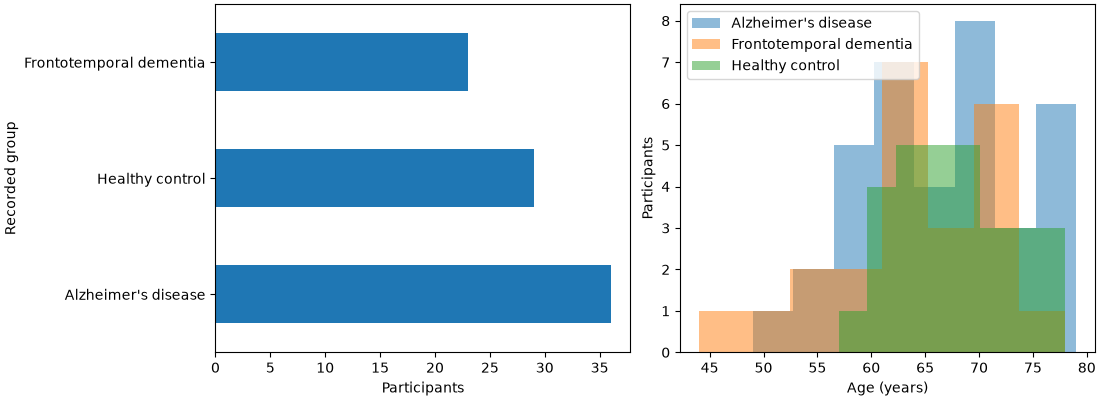
Predict. Before running the next cell, write down: which group do you expect to be largest? The Miltiadous 2023 release was designed for a three-way contrast (Alzheimer’s disease A, frontotemporal dementia F, healthy control C); cohort sizes shape every later modelling choice (loss weights, baseline accuracies, cross-validation folds).

Run. The Group column lives in participant_tsv and is also surfaced as the lowercase group column on the description frame.

GROUP_LABELS = {
    "A": "Alzheimer's disease",
    "F": "Frontotemporal dementia",
    "C": "Healthy control",
}
desc = desc.copy()
desc["condition"] = desc["group"].map(GROUP_LABELS).fillna("Other")

condition_counts = desc.groupby("condition")["subject"].nunique().to_dict()
pd.Series(condition_counts, name="n_subjects").rename_axis("condition").to_frame()

Investigate. The cohort is mildly imbalanced: the largest group is roughly 1.5x the smallest. That ratio is benign enough to train a three-way classifier without resampling, but it is large enough that a naive accuracy score reports the majority-class baseline. A balanced accuracy or a per-class F1 should be the headline metric on this dataset (Cisotto and Chicco 2024 give the same advice for any clinical EEG cohort with a non-uniform group distribution).

Step 4. Age distribution per condition#

Run. Group ages by condition and inspect the per-condition spread. Age is the most common confound in clinical EEG: a group difference on any spectral feature can quietly track age before it tracks the diagnosis (Cisotto and Chicco 2024, tip 7).

ages_by_condition = {
    cond: desc.loc[desc["condition"] == cond, "age"].dropna().tolist()
    for cond in sorted(condition_counts.keys())
}
age_summary = (
    desc.dropna(subset=["age"])
    .groupby("condition")["age"]
    .agg(["count", "mean", "std", "min", "max"])
    .round(1)
)
age_summary

Step 5. Recording duration and channel count#

Run. Recording duration is ntimes / sampling_frequency (in seconds); channel count is nchans. Both are catalog fields, no signal download required.

records_df = pd.DataFrame(
    [
        {
            "subject": rec["subject"],
            "duration_s": rec["ntimes"] / rec["sampling_frequency"],
            "nchans": rec["nchans"],
            "sfreq": rec["sampling_frequency"],
        }
        for rec in ds.records
    ]
)
duration_summary = records_df["duration_s"].describe().round(1)
channel_summary = records_df["nchans"].value_counts().to_dict()
sfreq_summary = records_df["sfreq"].value_counts().to_dict()
pd.Series(
    {
        "duration_s mean": float(duration_summary["mean"]),
        "duration_s min": float(duration_summary["min"]),
        "duration_s max": float(duration_summary["max"]),
        "nchans (count by value)": str(channel_summary),
        "sampling_frequency (count by value)": str(sfreq_summary),
    },
    name="value",
).to_frame()

Investigate. Two technical invariants pop out of the summary above. First, every recording in ds004504 lists the same nchans and the same sampling_frequency; that is what makes a fixed-length window loader work without per-recording resampling. Second, the duration spread is wide (a factor of four between the shortest and longest recordings); a fixed-length window count per recording will skew toward the longer recordings unless windows are capped per subject before the split.

Step 6. Render the live numbers as a 3-panel figure#

The drawing helpers live in a sibling _clinical_summary_figure module so the rendering plumbing stays out of this script. Panel 1 is the per-condition bar chart from Step 3, Panel 2 is the age histogram from Step 4, and Panel 3 is the four-cell metadata card built from Steps 2 and 5.

from _clinical_summary_figure import draw_clinical_summary_figure

n_channels_value: int | str
unique_nchans = set(records_df["nchans"].astype(int))
n_channels_value = next(iter(unique_nchans)) if len(unique_nchans) == 1 else "varies"

summary_metrics = {
    "n_subjects": int(desc["subject"].nunique()),
    "n_recordings": int(len(ds.records)),
    "mean_duration_seconds": float(records_df["duration_s"].mean()),
    "n_channels": n_channels_value,
}

fig = draw_clinical_summary_figure(
    condition_counts=condition_counts,
    ages_by_condition=ages_by_condition,
    summary_metrics=summary_metrics,
    dataset=DATASET,
    plot_id="project_clinical_dataset_summary",
)
plt.show()

A common mistake, and how to recover#

Run. Typing the dataset accession wrong ("ds04504" instead of "ds004504") returns a description frame with zero rows, which silently passes any len(ds) check. We trigger the failure on purpose so the recovery path is visible: catch the empty frame at construction time, fail loud, and print the close matches.

try:
    ds_typo = EEGDashDataset(dataset="ds04504", cache_dir=str(cache_dir))
    if len(ds_typo.records) == 0:
        raise ValueError(
            f"dataset 'ds04504' returned an empty catalog; close match: '{DATASET}'"
        )
except ValueError as exc:
    print(f"Caught {type(exc).__name__}: {str(exc)[:120]}")
    print(f"Recovery: use the canonical accession '{DATASET}'")
except Exception as exc:
    print(f"Caught {type(exc).__name__}: {str(exc)[:120]}")
    print(f"Recovery: use the canonical accession '{DATASET}'")

Step 7. Modify: pivot the cohort by sex#

Modify. Re-run the per-condition aggregation but pivot by gender instead of condition so the project-plan section can answer “is the sex split balanced inside each condition?” before training a sex- adjusted decoder.

sex_by_condition = (
    desc.groupby(["condition", "gender"])["subject"].nunique().unstack(fill_value=0)
)
sex_by_condition

Step 8. Make: a one-row dataset card#

Mini-project. Tabulate one row per dataset attribute that a project plan or a manuscript Methods section needs: dataset, n_subjects, n_recordings, n_channels, sampling_frequency, mean duration, and the per-condition counts. The cell below collapses the survey into that single row.

def _per_condition_str(counts: dict[str, int]) -> str:
    return ", ".join(f"{k}={v}" for k, v in sorted(counts.items()))


dataset_card = pd.DataFrame(
    [
        {
            "dataset": DATASET,
            "n_subjects": int(desc["subject"].nunique()),
            "n_recordings": int(len(ds.records)),
            "n_channels": n_channels_value,
            "sampling_frequency": float(next(iter(set(records_df["sfreq"])))),
            "mean_duration_seconds": float(records_df["duration_s"].mean().round(1)),
            "per_condition": _per_condition_str(condition_counts),
        }
    ]
)
dataset_card

Result#

We surveyed ds004504 end-to-end without downloading a single .set file: 88 subjects across three diagnostic groups, 19 EEG channels at 500 Hz, recordings between 5 and 22 minutes long. Reproducing this without EEGDashDataset would take a custom S3 listing, a custom participants.tsv parser, and a custom merge step; the catalog rolls all three into one query (Cisotto and Chicco 2024 would say: do not rebuild what the dataset class already enforces).

Wrap-up#

This is a project starter, not a tutorial. The numbers above feed straight into the four most common pitfalls of clinical EEG decoders: class imbalance (Step 3), age confound (Step 4), per-recording window count drift (Step 5), and channel-count mismatch (also Step 5). The polished workflow recipe in Cisotto and Chicco 2024 walks through how to defuse each one before training. Next up: /auto_examples/tutorials/40_features/plot_40_first_features shows how to extract per-recording features from the same catalog rows; /auto_examples/tutorials/50_evaluation/plot_51_cross_subject_evaluation shows how to run a leakage-safe cross-subject evaluation on top of the windowed dataset.

Try it yourself (Extensions)#

  • Re-run the survey on ds002778 (Rockhill 2020, Parkinson’s disease resting-state EEG) and compare the cohort, age, and recording-duration distributions side by side with ds004504.

  • Bin the MMSE score (desc['mmse']) into three buckets (mild, moderate, severe cognitive impairment) and tabulate subjects-per-bucket inside the Alzheimer’s disease group.

  • Pull one subject through ds.datasets[0].raw and confirm raw.info['sfreq'] == 500.0 and len(raw.info['ch_names']) == 19; the catalog numbers and the loaded raw must agree.

References#

See References for the centralised bibliography of papers cited above. Add or amend an entry once in docs/source/refs.bib; every tutorial inherits the update.