Resting-State and State Decoding#

Estimated reading time:2 minutes

The canonical beginner decoding lesson on resting-state EEG: eyes-open versus eyes-closed classification, decoded from alpha-rhythm differences with a band-power baseline. Difficulty 1; assumes the Start Here trio.

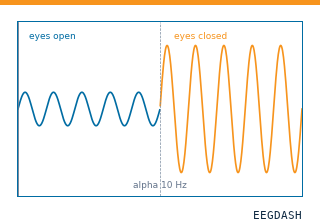
Resting-state state decoding is the cleanest neurophysiological benchmark in the field: the alpha increase on eye closure is large, reproducible, and present at the single-recording level, so it is the ideal lesson for verifying that your preprocessing pipeline is doing something sane before you point it at a noisier event-related task. Sourced from docs/tutorial_restructure_plan.md Category D (lines 425-435), with preprocessing guidance from Cisotto and Chicco (2024).

What you will learn:

  • How to label EEG segments by resting-state condition (eyes open vs eyes closed) from BIDS events.tsv rows.

  • How to compute alpha-band (8-12 Hz) power per channel and visualise the eyes-open / eyes-closed difference topographically.

  • How to train a logistic-regression baseline on band-power features and report subject-level cross-validation accuracy.

  • How to read a topomap critically – where the alpha effect should appear and what to do when it doesn’t.

Run the lesson:

  1. plot_30_eyes_open_closed.py – alpha-band classification of resting-state EEG.

Decode eyes-open vs. eyes-closed from resting-state EEG

Decode eyes-open vs. eyes-closed from resting-state EEG